

Every enterprise AI team that built a Retrieval-Augmented Generation system in the past two years learned the same thing: retrieval is needed, but it’s not enough. The models became more intelligent in the context windows. The tasks became more challenging. Somewhere between the first successful proof of concept and the fiftieth production failure, a deeper problem surfaced. The problem was never about finding the right documents. The issue was really about getting all the information together at the right moment. We had to make sure this information was in a form that made sense and that we had the safety measures in place so the model could actually do something helpful. The model needed the documents and the right context to work properly.
That problem now has a name: context engineering for AI. In 2026, context engineering has emerged as the discipline that sits between data infrastructure and model orchestration, defining how information flows into large language models across retrieval, memory, tools, workflow state, and governance layers. For data engineers, this shift is not academic. It changes what you build, how you build it, and what your AI systems can deliver in production.
This article breaks down what context engineering actually means, why it matters beyond RAG, and what data engineers at enterprise organizations need to understand to build context-aware AI systems that are reliable, cost-efficient, and ready for agentic workloads. Whether your team is scaling copilots, deploying autonomous agents, or simply trying to make your existing AI applications more accurate, the architecture starts with context.
Why RAG Is No Longer the Whole Context Story
Why retrieval is only one part of how modern AI systems get the right context
RAG became important because it solved a real business problem: generic model answers. By retrieving the right internal documents and adding relevant context to prompts, companies can ground outputs in their own knowledge. That made AI more accurate, useful, and practical for real-world enterprise use across teams and workflows. But retrieval is only one channel through which a model receives context. In any production system handling multi-step tasks, the model also needs session history, tool outputs, user preferences, workflow state, and governance constraints. RAG addresses the first requirement and leaves the rest to ad hoc engineering.
The limits of treating context as a vector search problem alone
Vector search is great at finding content that sounds similar, but similarity does not always mean relevance. A result might be outdated, missing context, or repeating something the model already knows. When teams rely solely on vector search, they often encounter noisy results, weak rankings, and higher token usage, with little improvement in answer quality. These limits become more obvious in large organizations, where relevance also depends on structured data, access permissions, and freshness. That is why vector search works best as one part of retrieval, not the whole strategy.
How agents, tools, memory, and workflow state change the architecture
The rise of agentic AI has fundamentally changed what context means. An agent who books a meeting checks the inventory. Drafting a follow-up email requires more than just documents. This agent needs to know what is going on with the calendar API. It also needs to know the inventory system’s state. The agent has to remember what was discussed in a conversation about the meeting or the inventory.
The agent needs to know what step they are on in the workflow. This is important because the agent has to use this information to do a things. The agent has to book a meeting with the customer check if the company has the items in stock and write a follow-up email to the customer. The agent has to use the workflow information to do all of these things like booking a meeting and checking inventory and drafting a follow-, up email. The agent needs to have all of this information to do their job and help the customer.
Context in agentic systems is dynamic, multi-source, and stateful. This is a different architectural challenge than building a retrieval pipeline, and it demands a different engineering discipline.
Why 2026 AI systems need context pipelines, not just retrieval layers
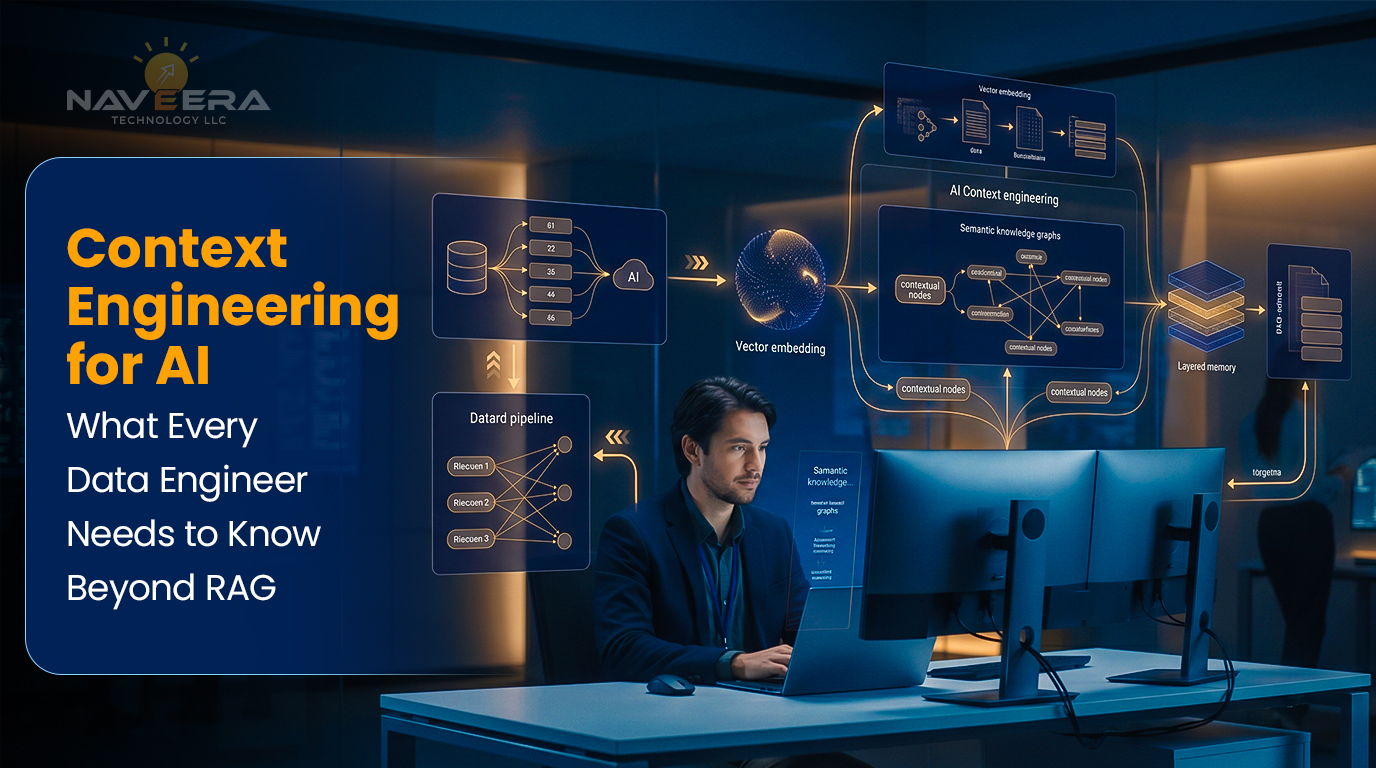
Across mature enterprise AI deployments, a clear pattern is emerging: the context pipeline. It pulls in context from multiple sources, filters what matters, simplifies it for the model, and passes along the right metadata and permissions. This helps the AI work effectively with relevant, secure, and usable information every time. Context pipelines for AI agents are not a replacement for RAG. They are the broader architecture within which RAG fits. Organizations working with partners like Naveera Technology on AI infrastructure and cloud architecture are increasingly building these pipelines as first-class components of their AI stack, not afterthoughts bolted onto retrieval.
What Context Engineering Actually Means in Production
Managing what the model sees, when it sees it, and why it matters
Context engineering is the discipline of controlling the information environment of a language model during inference. The context window includes every decision, about the things that are put into it. This means what gets to go in the context window the order that these things appear how they are formatted and the rules that they have to follow. The context window is affected by all of these decisions about what enters the context window and how it is presented. In production, this means managing prompt assembly as a systematic process rather than a manual craft. The model’s output quality is bounded by the quality of its input context. Engineering that context with the care applied to data pipelines is what makes prototype AI different from production AI. Prototype AI usually lacks the level of care. The same level of engineering care is needed for production-grade AI. It separates them.
Production-grade AI needs this engineering care, with data pipelines.
Context isolation, persistence, and compression as core engineering patterns
Three patterns define production context engineering. Context isolation prevents one user’s data or session from leaking into another user’s, which is essential in shared enterprise AI systems. Context persistence controls how information is carried across turns, sessions, and reused models, helping long-running workflows retain memory, maintain continuity, and manage context safely and correctly over time. Context compression addresses the practical reality that context windows, while growing, are still finite and expensive. Techniques like summarization, selective inclusion, and dynamic truncation keep token usage efficient without sacrificing the information the model needs. These are not optional optimizations. They are core engineering patterns for any context-aware AI system operating at scale.
The role of retrieval, tools, memory, and system state in one context model
In a well-architected system, retrieval, tools, memory, and system state are not separate subsystems that happen to feed the same model. They are layers of a single context model, each contributing a different type of information. Retrieval provides grounding in static or semi-static knowledge. Tools provide live, operational data from APIs and systems of record. Memory provides continuity and personalization. The system state shows where the model is in the workflow. It also shows what the model can. Cannot do.
- The model has actions or permissions at that point.
- The big engineering challenge is to integrate these layers.
- They need to be integrated into a prompt assembly process.
- This process has to be something that the model can effectively reason over.
- The model and the workflow are components, in this process.
Why prompt design is downstream of context design, not a substitute for it
Many teams spend a lot of time writing prompts. They forget to think about the situation they are, in. A good prompt is not enough if the context is missing or if it does not make sense or if it is hard to understand. The context is important when you are creating prompts because a good prompt cannot make up for context. Many teams need to remember that they have to think about the context when they are writing prompts.
The prompt is the interface between context and model behavior, but the context is the substance. In a production context, engineering for enterprise AI, prompt design is downstream of decisions about what information to retrieve, how to format tool outputs, when to include memory, and how to compress long context. Getting the context right makes prompt engineering simpler and more reliable. Getting the context wrong makes even the best prompts fragile.
The Context Stack — A Practical Framework Beyond RAG
Layer 1 — Retrieval: search, ranking, and grounding
The retrieval layer remains foundational. This system is really good at finding what you need. It uses two ways to search: vector search and hybrid search.
- Hybrid search is a combination of understanding what you mean and matching keywords.
- It then reorders the results to make them more relevant.
To make it work well teams need to plan how to break down the data. They should pick the model for converting data into numbers and design the index with care. The team should check not how many results they get but how helpful they are. This is especially important, for companies, where finding the information is crucial. The quality of what’s retrieved and how relevant it is, really matters in practice. Teams should focus on getting the information, not just a lot of it. The goal is to make sure the information they retrieve is useful.
Layer 2 — Memory: session continuity, state, and history
Memory is what distinguishes a stateless query-response system from an intelligent assistant. This layer manages conversation history, user preferences, prior decisions, and accumulated context across interactions. Short-term memory handles within-session continuity. Long-term memory, often backed by vector stores or structured databases, enables the system to recall information from previous sessions. For AI context engineering for data engineers, building the memory layer means designing storage, retrieval, and eviction strategies that balance completeness with token efficiency. Not everything needs to be remembered, and not everything remembered needs to be included in every context window.
Layer 3 — Tools: live systems, APIs, and operational context
Tools are the model’s interface to live systems. When an agent calls an API, queries a database, or executes a function, the tool output becomes part of the context for subsequent reasoning. This layer introduces unique challenges: tool outputs can be large, unpredictable in format, and variable in relevance. Data engineers need to build parsers, formatters, and filters that normalize tool outputs into context-ready formats. The tool layer also raises questions about latency, error handling, and fallback strategies when live systems are unavailable. Organizations leveraging Naveera Technology’s data engineering services often find that the tool integration layer is where retrieval-only architectures first break down.
Layer 4 — Orchestration: handoffs, filtering, and relevance control
Orchestration is the control plane for context. It determines which context layers shape each model’s response, how conflicts between sources are handled, and how information flows across agents in a multi-agent setup. One key part is context handoff. When one agent passes work to another, the next agent needs enough background to continue smoothly without extra details that waste tokens or create confusion. Orchestration also filters for relevance, so only useful information reaches the model for the task at hand. That is what turns separate retrieval steps and tool calls into one clear, connected reasoning environment for real-world use.
Layer 5 — Governance: traceability, permissions, and cost-aware context assembly
The governance layer ensures that context assembly respects enterprise constraints. This includes permission-aware retrieval that filters results based on the requesting user’s access rights, audit trails that record what context was provided for each model invocation, and cost-aware policies that manage token usage across teams and workloads. For enterprises subject to regulatory requirements, traceability is mandatory. Every piece of context that influences a model’s output must be logged and reproducible. This layer is where context engineering intersects with enterprise AI governance, and it is often the layer that distinguishes a proof of concept from a production deployment.
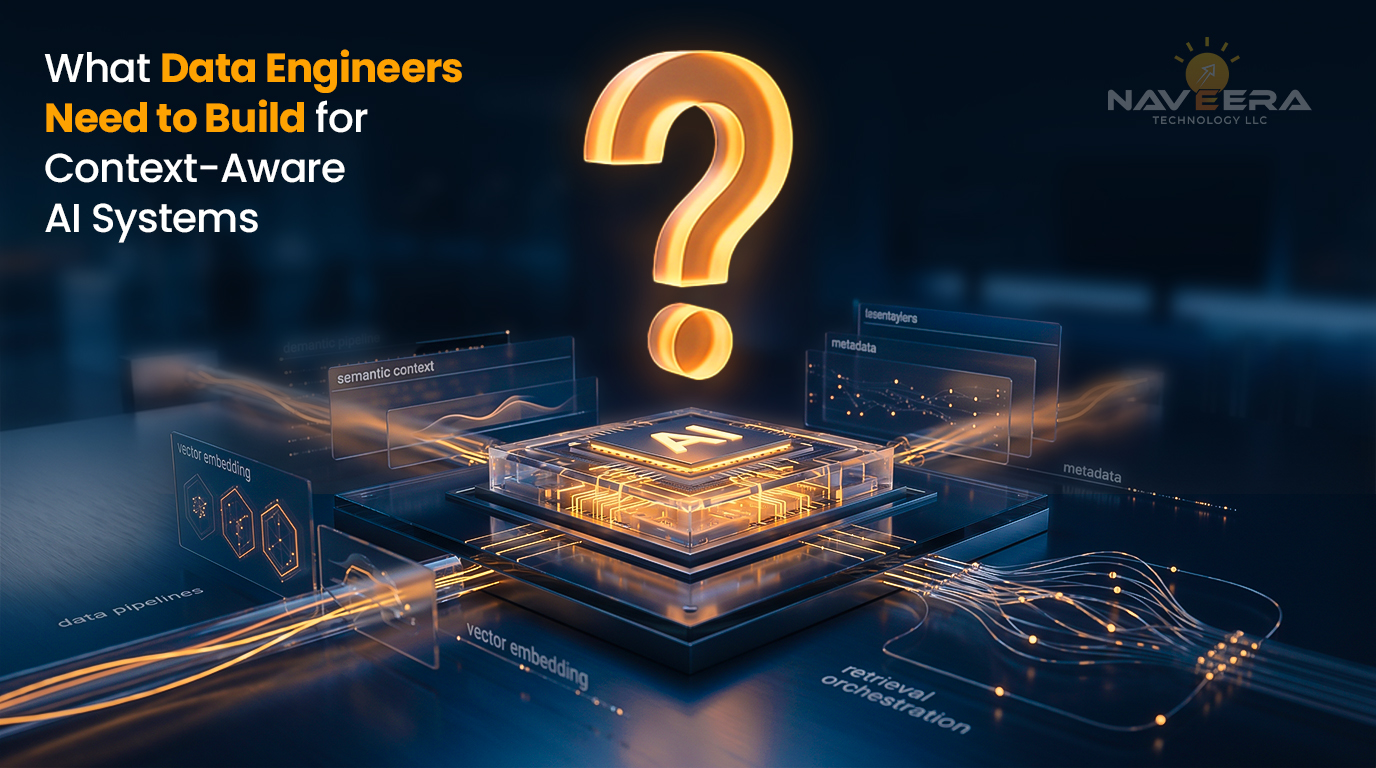
What Data Engineers Need to Build for Context-Aware AI Systems
Chunking, metadata, and indexing for better retrieval quality
When we talk about retrieval quality it begins with how we prepare our documents. We need to break down the content into parts that make sense and keep the ideas that are related to each other together. We also need to add some information like who wrote it when it was written and what it is about. The quality of our search results depends on how we organize these parts and we can do this by using ways like embeddings or keywords or maybe even both. Retrieval quality is important because it helps us find what we need and it all starts with how we prepare our documents, for retrieval quality. Better structure and smarter indexing lead to more accurate, complete results for end users. Data engineers should treat the retrieval preparation pipeline with the same rigor as any ETL process, including version control, quality checks, and monitoring.
Context pipelines that combine structured, unstructured, and live system data
Enterprise AI usually does not work with one type of data. For instance a support agent might need * knowledge articles that’re not in a fixed format* order history that is in a fixed format * and live shipping updates from an application programming interface. To make this work all this data must be changed to be used in the way. It has to be matched to a shared plan and combined in a way. The system must also know how up- to-date each source of data is. This way it can use information instead of old data when it is needed. The system needs data to work well. Enterprise AI requires all these things to work with types of data.
Building these pipelines is core data engineering work, and it is where context engineering beyond RAG becomes a practical discipline.
Relevance filtering, compression, and token-efficiency controls
Not every piece of retrieved or generated context belongs in the model’s prompt. Relevance filtering uses scoring, thresholds, and sometimes secondary model calls to prune low-value context before it consumes tokens. Context compression techniques, from extractive summarization to learned compression models, reduce the token footprint of necessary context without losing critical information. Token efficiency is not about saving money. When the context is too long it can make the model work poorly, take longer to respond and add information that can cause wrong results. These settings should be easy to change, easy to measure and a normal part of how the context pipeline works. Token efficiency is important for the model to work well so these controls should be part of the process, for the context pipeline.
How to handle multi-step workflows and multi-agent context handoffs
When we have a lot of steps to follow in a process each step in the process is based on what we did in the process. So we have to keep an eye on what happened at each point in the process what we decided to do in the process and what rules we still have to follow in the process. We also have to make sure we give the person or the agent the information when the work is passed to the person or the agent. The handoff of the work to the person or the agent has to be clear and complete so the process stays consistent and nothing important gets lost in the process.
Data engineers who are building systems for search and multi-agent architectures should design context schemas, for the systems that support serialization, selective inclusion and provenance tracking across the handoff boundaries of the process.
Why observability is needed for context quality, not just model quality
Most AI observability efforts focus on model outputs: accuracy, latency, and cost. But model outputs depend on model inputs. If the context provided to the model is incomplete, irrelevant, or poorly structured, no amount of output monitoring will diagnose the root cause. Context observability means tracking what was retrieved, what was included, what was filtered, and how each component contributed to the final prompt. It means measuring retrieval precision, memory utilization, tool call success rates, and token allocation across context layers. Teams working with Naveera Technology on generative AI services are increasingly instrumenting their context pipelines with the same depth they apply to traditional data quality monitoring.
Why Context Engineering Changes the Economics and Reliability of AI
More context is not always better context.
The intuition that more information leads to better outputs is wrong in practice. Research and production experience both show that beyond a certain point, adding more context degrades model performance. The model has trouble finding the important information. This is because it spreads its attention thin across many words. As a result it may focus on details.
Context engineering is actually about knowing what information to leave out. It’s not, about adding information. For teams that are used to including a lot of data the main change is this: sometimes having less context makes systems work better.
Token growth, latency, and retrieval noise as production risks
Every token in the context window incurs costs: financial, computational, and latency. As context grows, API costs increase linearly, response times lengthen, and the probability of retrieval noise—irrelevant or contradictory information—grows. In production systems handling thousands of requests per hour, these costs compound. Token growth without corresponding quality gains is a production risk that should be managed with the same deliberation as database query optimization or network latency. Enterprise AI context architecture must include token budgets, compression policies, and alerting on context bloat.
Why bad context design creates hallucinations, weak tool use, and poor task completion
The model gets blamed for Hallucinations a lot. The truth is that many Hallucinations happen because the context is not complete or it is conflicting. Sometimes the model does not have information so it tries to fill in the gaps with details that seem plausible or it picks one version of a contradiction, which results in the model giving users inaccurate answers. If the outputs, from tools are not formatted well or are incomplete the models ability to think about them and make sense of them is not as good, which affects the models reasoning over the tool outputs the models reasoning over these tool outputs.
Poor task completion in agentic workflows frequently stems from a missing critical state or instruction. Fixing these issues requires fixing the context pipeline, not retraining the model.
Context quality as a lever for both cost control and accuracy
The most powerful insight in context engineering is that quality and cost are not always in tension. Better context—more precisely selected, better compressed, more relevantly filtered—often costs fewer tokens than naive context assembly while producing more accurate outputs. Context quality helps make AI systems more profitable and reliable.
Enterprises are investing in context engineering as a strategy, not just to improve technical aspects. It improves the economics and reliability of AI systems. That is why it is an investment for them.
Why context engineering is becoming a core AI systems discipline
As AI moves from single-turn question answering to multi-step agentic workflows, the complexity of context management increases by an order of magnitude. Context engineering is emerging as its own discipline alongside data engineering, machine learning engineering, and platform engineering in business AI. It brings its own methods, tools, safeguards, and best practices. Companies that ignore context are more likely to build AI systems they cannot trust. Those who invest in context engineering can create systems that are more accurate, effective, reliable, efficient, and ultimately far more trustworthy in real-world business use today.
The 2026 Pattern — From RAG Pipelines to Context-Aware AI Architectures
How enterprises are moving from document retrieval to context orchestration
The leading enterprise AI deployments in 2026 are not just doing better retrieval. Teams are bringing together data from multiple sources, carrying context across sessions and agents, and assembling it under consistent security and access rules. This is a change from just finding documents to making sense of the whole situation. Finding documents is still important. Now it is part of a bigger system that includes memory and tools and how work gets done and the rules that everyone has to follow. This is a move forward for Artificial Intelligence in big companies, like Enterprise. The Enterprise is using Artificial Intelligence in a way that includes document retrieval and this is good.
Why the strongest systems combine retrieval, memory, tools, and workflow state
The AI systems that deliver the most consistent value in enterprise settings are those that integrate all four context sources. Retrieval provides grounding. Memory provides continuity. Tools provide live operational data. Workflow state helps us know what task we are on and what rules apply. If any part of this is missing, the system gets confused. Makes mistakes, like errors or incomplete work. AI systems that use all parts are better and more accurate. Can handle hard tasks that take many steps, like those in a big company, and that is where real value is.
When simple RAG is enough and when broader context engineering is required
Not every AI use case needs a full context stack. Simple question answering, knowledge base search, single-turn search, and internal FAQ tools can often work well with a solid RAG setup alone. The need grows when applications become multi-step, multi-turn, or involve many users, agents, tools, or higher stakes. Costs, observability, coordination, and error impact also start to matter more. To get it right you need to know where your application fits in.
- You have to figure out how complicated it is.
- Is it an application or a small one>
- You also need to know what kind of risks it has.
- The size of your application and its complexity will help you determine the risks.
- Your applications risks will help you get it right.
When you know these things, about your application you can pick the architecture for your situation. This way you do not end up building much or too little for what your application really needs.
Why context engineering matters most for agents, copilots, and long-running workflows
Context engineering is really important for agents, copilots and workflow automation. This is because these systems work over time and they use different tools and data sources. They have to stay consistent across steps. If you do not do context engineering these systems can get the information. They can lose track of what they’re trying to do. They can waste resources. Produce results that are not even.
When you do context engineering well it helps autonomous and semi-autonomous AI systems like agents and copilots stay focused on what they’re doing. It helps them be reliable. Do what they are supposed to do in the real world. Context engineering helps these systems handle changing inputs and make decisions that’re more complex and have many steps. This is important for context engineering and, for agents and copilots to work well.
What does “production-ready context” mean in enterprise AI
Production-ready context means context that is governed, observable, cost-managed, and architecturally sound. It means context pipelines that are versioned, testable, and monitored. It means context assembly that respects access permissions, maintains audit trails, and operates within defined token budgets. It means retrieval is evaluated not just for recall but also for its downstream impact on model performance. Naveera Technology works with enterprise teams to define and implement these standards, ensuring that AI systems are not just functional but production-grade across their full context architecture. For teams exploring this path, Naveera’s case studies and insights page provides practical examples of how context engineering transforms enterprise AI outcomes.
Getting Started — A Practical 90-Day Path Beyond Basic RAG
Step 1 — Audit how your current AI system assembles context
Begin by mapping exactly how context reaches your models today. Document every retrieval call, every hardcoded prompt component, every tool integration, and every piece of session state that contributes to the context window. Most teams discover that context assembly is more ad hoc than they realized, with significant variation across use cases and no consistent framework. This audit creates the baseline from which all improvements are measured.
Step 2 — Identify where retrieval alone is failing
Review your AI system’s failure cases with a context lens. For each hallucination, incomplete answer, or failed tool call, ask whether the model had the context it needed. In many cases, failures trace back to missing information, irrelevant retrieval results, stale data, or context that was present but poorly formatted. This analysis reveals the specific gaps that context engineering beyond RAG needs to address: memory, tools, orchestration, or governance.
Step 3 — Add memory, tool context, and orchestration only where needed
Context engineering is not about building the most complex architecture possible. It is about adding the right layers where they create measurable value. If your system fails due to a lack of session continuity, add memory. If it fails because it cannot access live data, add tool integration. If it fails because irrelevant context drowns out useful information, add orchestration and filtering. Each addition should be justified by a specific failure mode and measured against a specific quality metric.\
Step 4 — Instrument context quality, token usage, and failure patterns
Once context layers are in place, instrument them. Track retrieval precision and recall, memory hit rates, tool call success and latency, token usage per request, and the correlation between context composition and output quality. This instrumentation enables continuous improvement and early detection of regression. It also provides the data needed to justify further investment in context engineering to leadership.
Step 5 — Build a governed context pipeline before scaling autonomy
Before granting agents greater autonomy or expanding AI-driven workflows, ensure the context pipeline is governed. This means access controls on retrieved content, audit trails for context assembly, cost policies for token usage, and quality gates for context relevance. Scaling autonomy without governance creates risk. Scaling autonomy with a governed context pipeline creates capability. This is the inflection point where enterprise AI moves from experimental to operational.
What a 90-day context engineering assessment looks like
A 90-day review checks your AI setup finds problems creates a good plan prepares for monitoring and makes rules for management.
Naveera Technology helps AI teams use that review to make a plan with important suggestions based on work, data systems and how ready the organization is. Going from the current situation to a safe ready-to-use setup.
- We look at your AI environment.
- Identify gaps in it.
- Design the architecture for it.
- Plan, for monitoring it.
- Build rules to manage it.
Naveera Technology helps AI teams turn that review into a plan.
They give prioritized suggestions based on:
- Workloads
- Data infrastructure
- How ready the organization is
This helps move from the state to a secure and production-ready deployment. The goal is to make the AI setup safe and ready to use. Naveera Technology guides AI teams through this process.
Teams interested in accelerating this journey can explore Naveera’s generative AI services and data engineering services as starting points for engagement.
FAQ
Q1: What is context engineering in AI?
Shadow Context engineering is about giving a language model the right information at the right moment. The model needs to find the right data organize its memory pick the tools manage its workflow and follow the rules so it can understand what is going on.
The main goal of the model is to be more accurate give relevant information and be more useful which helps the model give better answers to users when they do different things every day.
Q2: How is context engineering different from RAG?
RAG is a way for models to generate answers by looking at documents that have already been found. This is part of a field called context engineering. Context engineering includes RAG and other components, such as memory and tools. RAG helps determine which documents to use when asking a model a question. Context engineering is, about making sure the model has all the information it needs to do its job. The model needs everything to work properly.
It is making sure the model has everything.
Q3: Why do data engineers need to think beyond retrieval?
AI systems such as agents and copilots need context from many sources: documents, APIs, memory, system state, and governance metadata. Data teams are best positioned to build the pathways that connect, filter, and deliver that context where it is needed. Treating AI context as simple retrieval limits capability and creates bigger problems over time as systems become more complex quickly.
Q4: What role do memory and tools play in context-aware AI systems?
Memory helps the system remember user preferences, past decisions, and conversation context. Tools connect to live data from APIs, databases and other systems. This helps the system go beyond static documents. It uses real-time information that is personalized for each user. The system can handle -step tasks more accurately and independently. It does this in a way that stays relevant, to each user.
Q5: How should enterprises build context pipelines for production AI?
Companies need to look at how their systems work now. They have to find out where things go wrong with getting to the data or making different systems work together. Then they can start adding the tools and rules to fix these problems.
The system has to have rules, for who can get to the data a way to track what people are doing a way to control costs and a way to always check the quality of the data and how it is being used.
Naveera Technology can help companies do this faster with a plan that is made just for them and the knowledge to make it work really well.