
Enterprise AI Agents are no longer interesting because they can answer questions. They are interesting because they can take action. They can retrieve information, call tools, update systems, trigger workflows, escalate issues, draft decisions, and move work forward across business operations. That is where the value is. It is also where the risk begins, making AI agent governance essential for real enterprise workflows.
Most enterprise AI agent projects do not fail because the models are weak. They fail because governance is treated as a compliance issue rather than an architectural requirement. Teams build for autonomy first, then try to add control later. By that point, the workflow is already exposed to the wrong risks: broad tool access, unclear permissions, weak approval logic, poor traceability, and no reliable way to evaluate whether the agent is behaving within acceptable boundaries.
At Naveera, governed AI agents are defined by the explicit boundaries they operate within—autonomy is carefully bounded. These agents are not open-ended intelligence, chatbots with extra tools, or unreliable workflows. A governed AI agent is a production system that acts only within defined policy boundaries, permissions, data restrictions, decision requirements, and audit parameters.
That is what makes the difference between an impressive demo and a trustworthy enterprise workflow.
Why Most Enterprise AI Agent Projects Fail Before Governance Is Designed
The difference between a demo agent and a production workflow agent
A demo agent succeeds by being convincing. A production workflow agent succeeds by being controlled.
In a demo, the agent can operate in a narrow sandbox with limited consequences. If it makes a poor judgment, the cost is low. In production, that same agent may touch systems that affect customers, financial records, service operations, internal approvals, employee requests, compliance-sensitive workflows, or core knowledge systems.
That changes everything.
A production AI agent is not simply generating language. It is participating in business operations. Once it moves from response generation into action, the real design problem becomes orchestration, permissions, policy enforcement, escalation, and accountability.
That is why enterprise AI agent architecture cannot begin with prompting alone. It has to begin with workflow design.
Why autonomy without a bounded scope creates operational risk
Autonomy appears attractive, but in practice must be measured against operational requirements.
An agent with undefined scope can retrieve the wrong context, call the wrong tool, overstep its permissions, take action without sufficient confidence, or continue operating far beyond where the workflow should have stopped. In enterprise settings, the risk is not theoretical. It is operational, financial, legal, and reputational.
The issue is not that autonomy is bad. The issue is that autonomy without boundaries becomes ungovernable.
That is why the right model is not maximum automation but bounded autonomy. The agent must be able to perform tasks in a specific way, use designated systems, have specified permissions, obtain approval from identified individuals, and know precisely when to stop.
When the agent lacks these rules, the organization is not using a workflow. This is crucial for the agent to function correctly. The absence of rules creates operational uncertainty.
Governance is an architecture layer, not a post-launch patch.
One of the most common mistakes in enterprise agentic workflows is sequencing.
Teams build the agent loop first. Then they talk about logging. Then they talk about approvals. Then they ask security how to constrain tool access. Then they realize evaluation has no defined baseline. Then they discover no one can explain why the agent made a decision three days ago.
This is backwards.
Governance is not what gets wrapped around the workflow after it works. Governance makes workflow production-ready.
It should be part of the execution process.
This means including things like:
- policy checks
- access controls
- budget limits
- approval steps
- handling exceptions
- rollback plans
- Keeping a record
All of these are part of the workflow’s governance.
If these are outside the architecture, they will eventually be bypassed by it.
Why enterprise buyers should think in workflow boundaries, not model novelty
Too many enterprise conversations about agents still revolve around novelty: the newest model, the most advanced reasoning, the most “autonomous” architecture.
That is the wrong decision framework.
Enterprise buyers should ask different questions. What workflow is this agent responsible for? What systems can it access? What decisions can it make independently? What requires approval? What data can it retrieve or remember? What happens when it fails? How is it monitored? How is it evaluated? How is it stopped?
These are workflow-boundary questions, not model-hype questions.
A governed AI strategy starts by defining where the workflow begins, where it ends, what sits inside the boundary, and what must remain under human control.
What “Governed” Actually Means for an Enterprise AI Agent
Policy boundaries — what the agent is allowed to do
A governed AI agent needs explicit policy boundaries.
This means we must clearly define the boundaries for what tasks this thing can do, which actions it must refuse, which outcomes fall outside its responsibility, the required levels of certainty, and when it should escalate to someone else. These boundaries—what it is permitted and not permitted to do—should be embedded not just in the system prompt, but also within the application logic and control layer.
Policy is what turns “smart behavior” into accountable behavior.
Without policy boundaries, the agent is forced to infer governance from language. That is not governance. That is wishful thinking.
Tool boundaries — what systems it can call and under what permissions
Tool calling is where AI agents become operationally valuable. It is also where control must become much stricter.
A governed agent should never have broad, loosely defined access to enterprise systems. Every tool should be explicitly allowlisted. Every function should have schema constraints. Every action should run under scoped permissions. Sensitive tools should be separated from low-risk utilities. Execution should be validated before action is taken.
This is especially important for secure AI agents for business workflows. Once an agent can update records, send communications, approve changes, or trigger downstream operations, tool access must be treated with the same seriousness as any privileged application integration.
Data boundaries — what context it can retrieve, write, or remember
Not all context should be accessible just because it is technically searchable.
Governed AI agents need retrieval governance. They must clearly understand their boundaries: which repositories may be queried, which records are in scope, which content is restricted, which fields may be written back, and which memory must never persist beyond the task.
This is where enterprise data access controls become essential. An agent should not see more than the user, workflow, or role permits. It should not treat all retrieved content as equally trustworthy. It should not store memory without explicit boundaries. And it should not mix sensitive enterprise context across unrelated tasks.
Retrieval without governance creates invisible risk. Memory without governance creates accumulating risk.
Decision boundaries — what requires human approval
A governed agent is defined by boundaries for independent decisions. It must stop work and seek explicit human approval for actions exceeding its authorized authority, especially those beyond specified risk or reversibility thresholds. This boundary ensures oversight and prevents unintended consequences.
Some actions are low-risk and reversible. Others are not.
Irreversible actions need thought.
- Customer-facing decisions
- steps
- Compliance-relevant actions
- System changes
- Approvals, with business consequences should all be checked by people.
These should go through approval processes. The process should be set up in the workflow from the start. It should not be made up after something goes wrong. We need to make sure people are involved in approving these actions. This way, we can prevent problems.
Approvals must be built into the workflow from the start.
Human oversight enables safe automation in many enterprise workflows.
Audit boundaries — what must be logged, traced, and reviewable
If an organization cannot reconstruct how an agent behaved, it cannot govern it.
A production agent should produce a reviewable audit trail across prompts, retrieval events, tool calls, model routing decisions, approvals, exceptions, retries, outputs, and downstream actions. Traceability is what allows an enterprise to answer the questions that always matter later: What happened? Why did it happen? What data was used? What tool was called? What policy was applied? Where did the workflow go wrong?
Governance without traceability does not scale. It only delays the first serious problem.
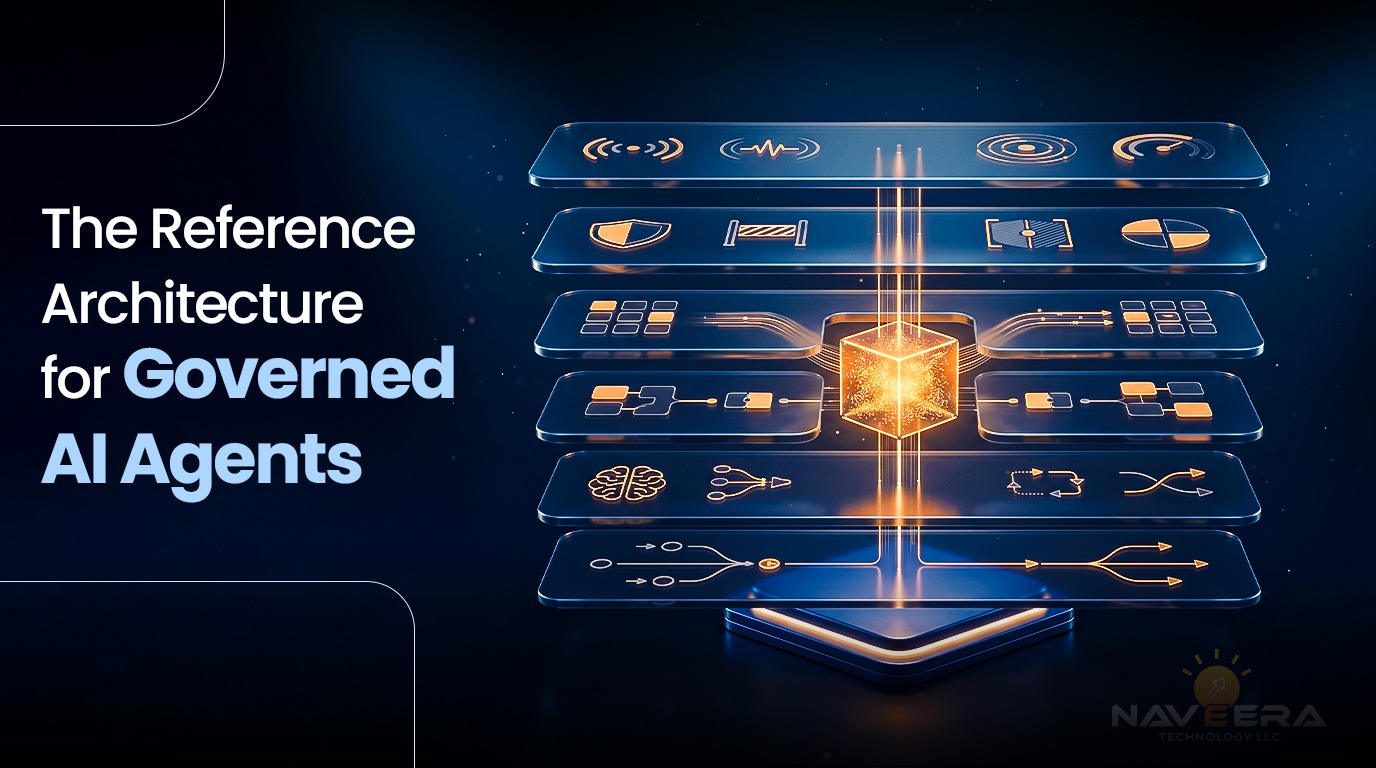
The Reference Architecture for Governed AI Agents
Workflow layer — trigger, task decomposition, and stop conditions
The workflow layer defines how the agent enters the business process.
What triggers the workflow? What is the task? How is work decomposed? What conditions define completion? What signals force a stop? What retries are allowed? What failure paths exist?
This is the first layer of bounded autonomy architecture. Without clear triggers and stop conditions, agents tend to expand into open-ended loops, vague retries, or unnecessary tool usage. Production agents need a defined job, not a general sense of initiative.
Model layer — model selection, routing, and fallback behavior
Different parts of a workflow require different capabilities.
Some steps need classification. Some need extraction. Some need reasoning. Some need summarization. Some need structured output. A governed architecture should not assume the same model is optimal for every task. It should use model routing, fallback logic, and step-specific selection based on risk, cost, latency, and capability requirements.
This is not only a performance decision. It is also a governance decision.
When the architecture defines which model can be used for which kinds of steps, under what conditions, and with what fallback behavior, it reduces both unpredictability and cost exposure.
Tool layer — allowlists, schemas, and execution constraints
The tool layer is where action happens, so it must also be where control becomes explicit.
Every tool should be exposed through a constrained interface. Inputs should follow strict schemas. Tool usage should be validated before execution. Sensitive actions should be separated into narrower permission scopes. High-risk tools should require additional approval or policy checks. Function calling should not mean unrestricted system invocation.
The best enterprise AI agent architecture treats tools as governed execution surfaces, not generic powers handed to the model.
Data layer — retrieval, memory, and enterprise data access controls
The data layer should define what can be retrieved, how retrieval is filtered, how trust is assigned to sources, and how memory boundaries are enforced.
This includes repository access, document-level permissions, field-level controls, retrieval governance, context scoping, session memory rules, and retention boundaries. It also includes a clear separation between the transient workflow context and long-term memory.
In enterprise systems, context is not just a matter of relevance. It is a governance problem.
Control layer — policy engine, human approvals, and exception handling
This layer makes the system work as it should in life.
The control layer does important things.
- It makes sure policies are followed.
- It checks if users have permission to do things.
- It evaluates limits and thresholds.
- It sometimes waits for people to approve actions.
- It handles problems and exceptions.
- It limits how much the system can do on its own.
- It directs failures to escalation or rollback paths.
This layer manages all approval steps, workflows for escalation, limited permissions, and rules for enforcing policies and handling exceptions.
If this layer is not strong, the rest of the system is hard to trust. Even if the model looks strong, a weak control layer causes problems. The control layer is crucial for a system. A strong control layer makes the system reliable.
Observability layer — traces, evals, cost telemetry, and incident review.
An agent workflow cannot be monitored in the same way as a basic chatbot.
It needs observability across decisions, tool calls, retrieval behavior, model routing, policy outcomes, latency, retries, failures, and cost. It needs an evaluation harness to test behavior against known scenarios. It needs tracing to understand where decisions changed. It needs telemetry to reveal token usage, tool-call patterns, and workflow drift. And it needs incident review capabilities to support post-event analysis and continuous improvement.
AI agent observability and evaluation are not operational luxuries. They are core governance functions.
How to Reduce Risk Without Killing Automation Value
Start with read-heavy workflows before write-heavy automation.
Many enterprises aim too high too early.
A smarter approach is to begin with workflows that are read-heavy, support-heavy, and recommendation-oriented. These workflows can generate clear business value while keeping operational risk lower. Examples include triage, summarization, knowledge retrieval, policy lookup, issue classification, draft generation, and approval preparation.
Write-heavy automation can come later once the control setup, approval rules and monitoring are tested in real-life situations.
Use human-in-the-loop approvals for irreversible actions.
- If an action is difficult to undo, costly to fix or important to the business it should generally need approval.
- This includes things like promises, messages to people outside the company changes to system settings, sensitive updates, changes to important records and serious issues that affect customers or staff.
- Human-, in-the-loop AI processes let companies get the benefits of speed and good suggestions without giving up control where human judgment’s still crucial.
- Over time, approval steps can be reduced. But they should be earned through evidence, not skipped through optimism.
Treat indirect prompt injection as a design assumption.
When we design agents, we often make mistakes. We think that the only information that can cause problems comes from the user. That is not true. In the world, agents have to deal with all sorts of things. They have to process tickets, emails, documents, knowledge articles, PDFs, spreadsheets, and content from systems inside and outside the company. Agents have to handle all these things, like tickets, emails, documents, knowledge articles, PDFs, spreadsheets and content, from systems and external systems.
Any of that content can contain instructions, manipulative language, or malicious patterns that attempt to alter agent behavior.
That means prompt injection is not an edge case. It is a design assumption.
A governed architecture should isolate untrusted content, constrain tool access, validate execution plans, and prevent retrieved instructions from overriding policy or permission logic.
Minimize blast radius with scoped credentials and least privilege.
Least-privilege permissions are essential in governed AI agents.
The agent should only have access to the systems, actions, and data required for the workflow it owns. Credentials should be tightly scoped. Sensitive operations should use narrower trust boundaries. High-risk environments should be separated. Access should be reviewable and revocable. Broad service-level permissions should be avoided wherever possible.
This reduces blast radius when something goes wrong, and it also improves explainability
Prefer deterministic workflows where agentic reasoning is not necessary.
Not every workflow needs an agent.
When the process is well-organized, follows many rules, and you can predict what will happen, deterministic orchestration is usually the way to go. This is because the process is highly predictable, and things change little. Deterministic orchestration works well with highly structured processes. Agentic reasoning should be reserved for ambiguity, unstructured input, exception handling, synthesis, and multi-step judgment where fixed logic becomes brittle.
This is one of the most practical ways to reduce risk without killing value: use agentic design only where it creates meaningful operational advantage.
Evaluation, Observability, and Cost Control Are Part of Governance
What to evaluate — task completion, tool selection, policy adherence, safety
A governed agent cannot be evaluated only on whether the final answer sounds good.
It must be evaluated on whether it completed the workflow correctly, chose the right tools, stayed within policy boundaries, respected approval logic, handled sensitive data correctly, and behaved safely under edge cases. Evaluation should cover success rates, failure modes, misuse of tools, policy violations, escalation quality, and reliability under realistic enterprise conditions.
That is what an agent evaluation harness is for.
Why traces matter more in agents than in simple chat applications
In a chat application, the input and output may be enough to diagnose an issue.
In an agentic workflow, they are not.
Between the user request and the final action may sit retrieval steps, tool calls, approval gates, retries, fallback logic, memory usage, policy checks, and exception paths. Without traces, teams are forced to guess where the workflow succeeded or failed.
Tracing makes the workflow reviewable. It also makes the organization faster at improving it.
Budget guardrails — token, tool, latency, and retry ceilings
Governance is not only about security and compliance. It is also about operating discipline.
Production AI agents need budget guardrails. That includes things like limits on tokens, limits on how many times you can use a tool, limits on how many times you can retry something, limits on how long you can wait for something to happen, and what to do when a step fails. Without these limits, the agents can become really expensive, really hard to predict, and, in a way, really hard to grow.
Budget guardrails also help the team decide how to build things. They force trade-offs to be explicit rather than hidden within model usage.
Prompt caching, model routing, and smaller-model usage where appropriate
A governed system should not use frontier-scale model capacity where narrower capability is sufficient.
Prompt caching, semantic caching, smaller-model routing, and workload-aware inference design all contribute to stronger economics and tighter operational control. They reduce unnecessary usage, improve latency, and support more sustainable production deployment.
In enterprise settings, cost control is part of governance because cost instability often signals architectural instability.
Governance, FinOps, and agent lifecycle management
A production agent should have a lifecycle, not just a launch date.
That lifecycle should include design review, permission review, evaluation baselines, staged rollout, telemetry review, incident handling, policy refinement, access recertification, and retirement criteria. Governance and FinOps should work together here. One ensures the agent behaves within acceptable control boundaries. The other ensures it remains sustainable as usage scales.
A workflow that cannot be governed operationally or economically is not production-ready.
Getting Started — From Bounded Pilot to Production Workflow
Step 1 — Choose one narrow workflow with clear business value
Do not begin with an “agent platform” initiative.
Begin with one bounded workflow that has clear ownership, measurable business value, limited system dependencies, and obvious escalation paths. Strong early candidates include support triage, approval packet generation, internal knowledge retrieval, policy-aware drafting, or service desk assistance.
Narrow scope is not a limitation. It is what creates a credible starting point.
Step 2 — Define permissions, approvals, and failure boundaries
Before launch, define the operating envelope.
What systems can the agent access? What tools are allowed? What data is in scope? What actions require approval? What exceptions stop execution? What happens when the model is uncertain? What gets logged? What gets escalated?
The quality of these answers matters more than the creativity of the prompt.
Step 3 — Build the evaluation and observability layer before launch
Do not wait for production usage to discover how the workflow behaves.
Build tracing, logging, evals, telemetry, review paths, and policy visibility before deployment. That helps the team spot problems early. They can test choices against real-life situations. This way, they can set a starting point for improvement.
This is a difference between a test run and a full-scale workflow.
Step 4 — Roll out in phases: observe, recommend, execute
The most practical rollout model for governed AI agents is phased autonomy.
First, let the agent observe and explain.
Then let it recommend with approval gates.
Then let it execute within tightly defined boundaries.
This progression gives the organization time to validate outputs, refine controls, inspect traces, improve policies, and earn confidence in the workflow before action becomes automated.
What a 90-day governed agent readiness engagement looks like
A strong 90-day readiness program usually begins by identifying one enterprise workflow with clear value and a bounded scope. From there, the next steps are to define data access boundaries, approval logic, least-privilege permissions, failure paths, evaluation criteria, and observability requirements. Only then should the workflow move into controlled deployment and phased execution.
At Naveera, this is how we approach governed AI agent programs for real enterprise environments: workflow-first, control-first, and production-minded from day one.
If the goal is to build agents that the business can actually trust, governance cannot be something added later. It has to be part of the architecture from the start.
FAQ
What makes an AI agent “governed” in an enterprise setting?
A governed AI agent operates within defined policy, permission, data, decision, and audit boundaries. It has scoped tool access, explicit approvals, observable behavior, and reviewable execution history.
How do enterprises prevent AI agents from misusing tools or data?
They use allowlisted tools, schema-constrained execution, least-privilege permissions, approval gates, retrieval governance, access controls, policy enforcement layers, and full tracing across agent behavior.
Do enterprise AI agents need human approval before taking action?
Not always. It’s a good idea for actions that can’t be undone, are very sensitive, have a high risk, or can be seen by others.
People’s approval is especially important when AI agents are first being used and when they are making many changes.
What is the difference between an AI assistant and an AI agent in production?
An assistant mainly responds to prompts. A production AI agent can plan steps, call tools, retrieve context, manage state, and move work forward across a workflow. That added capability is why governance requirements are much higher.
How should enterprises evaluate and monitor agentic workflows?
They should evaluate task completion, tool selection, policy adherence, safety, latency, retries, and cost behavior. They should also use tracing, telemetry, and incident reviews to understand how the workflow behaves over time.