
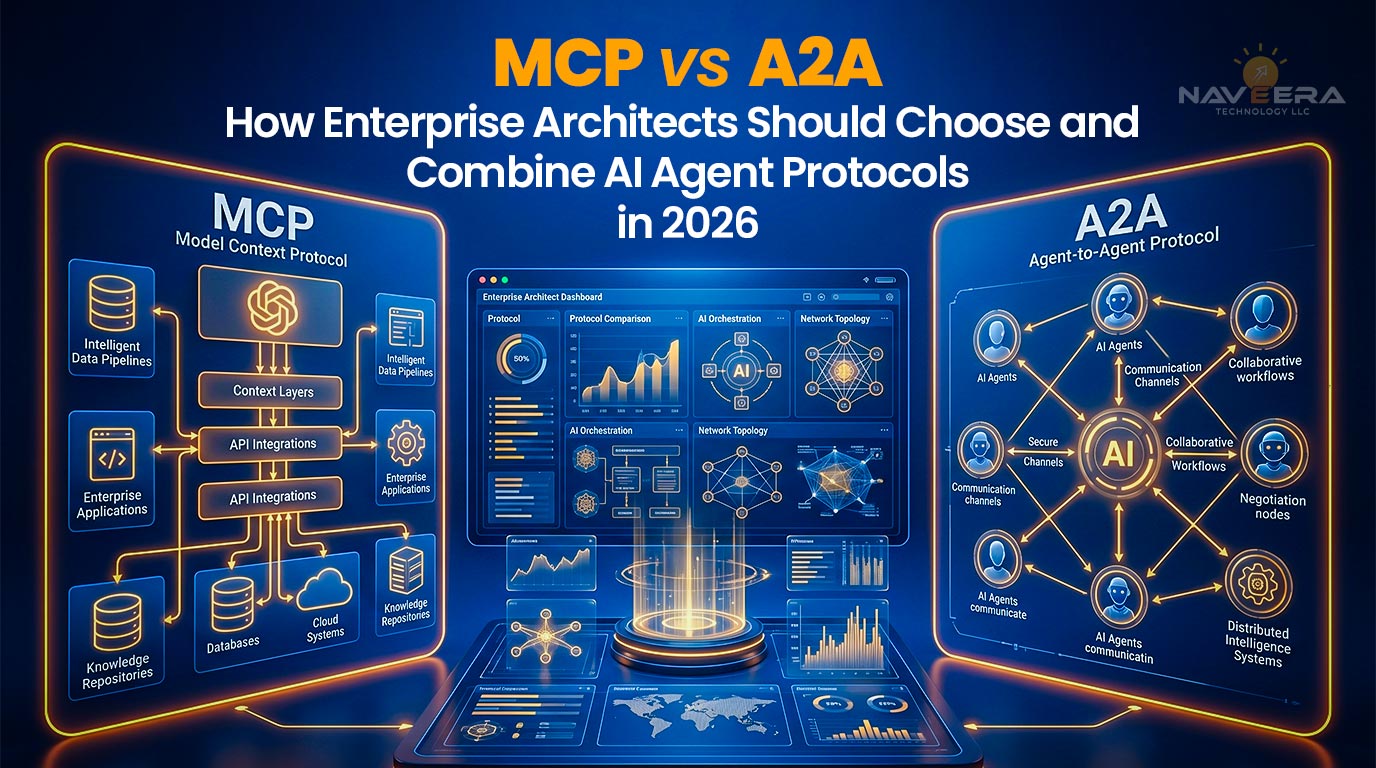
If you have spent any time in enterprise Artificial Intelligence circles lately you have probably heard both MCP and A2A terms thrown around in the breath. If you are like architects, I talk to your first reaction was something like: “Wait, are these competing standards or do they actually do different things?” The honest answer is, a little of both and neither.
Understanding where each Artificial Intelligence agent protocol fits is not an academic exercise. When you are designing a -agent system that needs to talk to databases called external Application Programming Interfaces and coordinate work across vendor boundaries picking the wrong mental model early will cost you weeks of rework. This guide cuts through the noise.
Why Artificial Intelligence Agent Protocols Are Becoming an Enterprise Architecture Decision:
Artificial Intelligence agents are no isolated tools. They are becoming part of core enterprise systems. That means the protocols behind how they connect, share data and collaborate now directly impact scalability and long-term flexibility. For architects, this is shifting from a detail to a strategic decision.
Why custom agent integrations do not scale across tools, systems and vendors:
Custom integrations might work on, but they quickly become hard to manage as more tools and agents are added. Every new connection increases complexity making systems fragile and expensive to maintain. Over time, this approach slows innovation of enabling it.
The rise of protocol fragmentation in agentic AI:
As more vendors build their agent frameworks, the ecosystem is becoming fragmented with incompatible protocols. This makes it harder for agents to communicate and share context across platforms. Without standards enterprises risk getting locked into isolated systems.
Why enterprise teams now need interoperability standards, not one-off connectors:
Enterprise teams can no longer rely on point-to-point connectors for every tool or workflow. Standardized protocols create a way for agents, data and tools to interact. This shift reduces integration effort. Supports scalable future-ready architectures.
Why 2026 is the year protocol literacy starts to matter for architecture teams:
In 2026 understanding protocols like MCP and A2A is becoming a core skill for enterprise architects. It is no longer about building Artificial Intelligence agents but knowing how they connect, communicate and scale. Teams that develop this literacy early will be better positioned to design Artificial Intelligence systems.
What MCP Does Best. Standardizing How Agents Access Tools, Data and Context:
MCP quietly solves one of the frustrating problems in enterprise Artificial Intelligence: every team is building the same connectors over and over again. Need your agent to query Salesforce? Write a connector. Need it to read from Confluence? Write another one. MCP puts an end to that cycle by giving Artificial Intelligence applications a standardized way to reach external tools, data sources and resources no matter what is on the other end.
For enterprise architects this is not a developer convenience. It is a foundation. When tool access is standardized, it becomes governable, auditable and reusable across your Artificial Intelligence stack.
MCP as the integration layer between Artificial Intelligence applications and external systems:
MCP acts as the bridge that connects Artificial Intelligence agents to enterprise tools, Application Programming Interfaces and data platforms. It simplifies how agents interact with resources without needing deep custom logic. This allows teams to plug into existing systems efficiently.
Hosts, clients and servers. The MCP interaction model:
MCP introduces a structure with hosts, clients and servers defining how interactions happen across the system. This model keeps communication organized and predictable as systems grow. It also helps teams design modular and maintainable architectures.
Tool exposure, resource access and workflow connectivity:
With MCP, tools and resources can be exposed in a way making them easily discoverable by agents. This improves how workflows are connected and executed across systems. As a result, agents can perform tasks seamlessly across different environments.
Why MCP is strongest at context and capability integration inside an agent system:
MCP is particularly effective at managing context and integrating capabilities within an agent environment. It makes sure agents always have the right data and tools availability at the right time, without unnecessary complexity. Because of this, it becomes much easier to build AI applications that are truly context aware and able to respond intelligently in real-world scenarios.
What A2A Does Best – Standardizing How Agents Discover, Communicate and Collaborate:
A2A solves a problem entirely not how an agent connects to your systems but how agents find and work with each other. Once you move beyond an agent doing a single job you need a way for agents to introduce themselves, understand each other’s capabilities and hand off work cleanly. That is what A2A was built for.
It is the protocol that makes multi-agent systems feel like a team rather than a pile of independent scripts passing strings back and forth.
A2A as the Communication Layer Between Distinct Agents:
Think of A2A as the protocol that lets agents introduce themselves and negotiate. Where MCP is primarily concerned with connecting an Artificial Intelligence model to tools and data A2A is one agent finding another agent understanding what it can do and handing off work across that boundary. It is the difference between a worker picking up a tool and a manager delegating to a contractor from a firm entirely.
A2A uses HTTP and SSE as its transport layer, which means it fits naturally into existing enterprise infrastructure without requiring networking setups. Importantly it is built around asynchronous long-running task patterns, which is exactly what real enterprise workflows look like. Most meaningful work does not complete in 200 milliseconds.
Agent Cards, Capability Discovery and Remote Agent Access:
One of A2A’s practical features is the concept of agent cards, a structured manifest that tells other agents what a given agent is capable of, what inputs it expects and how to reach it. For enterprise architects this matters because it moves capability discovery from a configuration problem to a runtime negotiation problem. Your orchestration layer does not need to know everything upfront; it can ask, discover and adapt dynamically.
This is especially useful as your agent ecosystem grows. By maintaining a central registry that every team has to update manually agent cards let individual agents self-describe. New agents can join the ecosystem. Be discovered without requiring changes to every orchestrator that might want to use them. It is a more scalable model for large organizations.
Coordinating Distributed Agents Across Vendors, Clouds and Platforms:
The reality of enterprise Artificial Intelligence in 2026 is that you are not running one model from one vendor in one cloud. You have agents built on frameworks deployed across AWS, Azure and on-prem some built by your team and some bought or licensed from third parties. A2A gives you a handshake protocol so these agents can coordinate without you building custom integration glue for every single pairing.
This cross-vendor interoperability is one of the reasons the Linux Foundation took stewardship of A2A. Enterprises need governance and long-term stability not a protocol that is controlled by a single vendor with shifting roadmap priorities. When you are building production systems that will run for years that kind of backing matters a great deal.
Why A2A Is Strongest When Enterprises Need Multi-Agent Collaboration, Not Tool Calling:
If your use case is essentially “Large Language Model plus a bunch of tools ” MCP probably gets you there. Once you are orchestrating specialized agents, one that handles compliance checking, another that manages customer data, another that writes and executes code you need something that understands agent-to-agent delegation, not just model-to-tool invocation. That is the gap A2A was designed to close.
The mental model shift here is important. With tools, Artificial Intelligence is always the actor and the tool is always the resource. With A2A you have agents that’re themselves capable of reasoning, taking initiative and pushing back. That peer-to-peer dynamic requires a different protocol. One that supports negotiation, status updates and running collaboration rather than simple request-response cycles.
MCP vs A2A is the Wrong Debate – The Real Pattern Is Layering Them Together:
Imagine you have a workflow that handles procurement approvals. This workflow has an agent that receives a request, uses A2A to ask a compliance agent to review the request and uses MCP to get the relevant vendor contracts from your document management system. The compliance agent then uses MCP to check databases and sends a structured response back to the first agent via A2A.
MCP for agent to system connectivity, A2A for agent-to-agent interoperability:
This workflow is cleaner and easier to maintain than having one agent do everything. Each protocol does what it is designed for and the boundaries between them are clear and manageable. This is not a theoretical idea. It is what the most mature enterprise AI teams are already doing.
How a single enterprise workflow can use both protocols:
One of the problems in early enterprise AI deployments was custom integration code. Every agent needed connectors and custom communication patterns. Over time this accumulated into a kind of debt that made the whole system brittle and expensive to maintain.
Where protocol layering reduces custom integration debt:
Using MCP and A2A together eliminates this debt. When both layers are standardized, you are not writing custom integration code anymore. You are writing business logic on top of a foundation. This shift from “glue code” to “business logic” is one of the underappreciated benefits of using both protocols.
Why enterprise architects should design around boundaries, not hype cycles:
Enterprise architects should design their systems around boundaries not hype cycles.
Every year brings AI tools with breathless launch announcements and competing claims about what is “the standard.” Architects who chase each thing end up with systems that reflect the hype cycle rather than their actual operational needs. The right move is to identify the boundaries of your system. Where does an agent need system access and where does it need to hand off to another agent. And then choose protocols that serve those boundaries.
The emerging control-plane view of agent interoperability:
MCP and A2A are no longer just experimental ideas, they’ve gained enough industry traction and support to be treated as foundational building blocks. While they’ll continue to evolve, their core design principles are already solid enough to build on with confidence. For organizations, this means focusing on these foundations is a practical and forward-looking long-term strategy.
Looking at enterprise architects are starting to think about agent interoperability as a control-plane problem, not just an application problem. In this view MCP and A2A are not developer tools. They are infrastructure primitives that need to be managed, monitored and governed at the platform level just like a service mesh or an API gateway.
The Enterprise Decision Framework – When to Use MCP, A2A, or Both:
This way of thinking has implications for how you staff and organize your AI platform teams. Someone needs to own the MCP server layer. Someone needs to own the A2A discovery and routing infrastructure. These are not afterthoughts. They are platform capabilities that determine whether your agent ecosystem scales cleanly or devolves into chaos.
So how do you decide when to use MCP, A2A or both? It is not complicated once you anchor it to the question: is your agent’s primary challenge accessing something or coordinating with someone?
Use MCP when the problem is accessing tools, data, or enterprise context:
If your agent can’t reach your CRM, can’t query your database, or has no idea your internal tools even exist, that’s an MCP problem. It’s simply the layer that connects what your AI is capable of to what your business actually runs on day to day.
Use A2A when the problem is coordinating remote or specialized agents:
If your agent needs to coordinate with specialized agents use A2A. A2A is about delegating work to other agents especially across team or vendor boundaries. If you find yourself writing a lot of custom code to pass context between agents or if your orchestration logic is getting complicated that is a sign you need A2A.
Use both when agents need both internal capabilities and external collaboration:
Most of the time you will need to use both MCP and A2A. Each individual agent in your ecosystem likely needs MCP to do its job and the agents need A2A to work together. These are needs that show up at different layers of the same system.
When simpler workflow orchestration is better than protocol complexity:
Just know which layer you’re in at any given moment, that one habit will save you more headaches than any framework or tool. Setting up an agent? You’re in MCP territory. Figuring out how agents talk to each other? that is A2A conversation, if you keep those two separate in your head and everything else falls into place naturally.
Choose based on architecture scope, governance needs, and operational overhead:
It is worth being honest. Not every enterprise AI use case needs both protocols. If you are building a single focused AI assistant that accesses a handful of tools and does not need to coordinate with other agents MCP alone is probably sufficient. Adopting A2A before you actually need -agent coordination adds complexity without adding value
Governance, Security, and Observability Across Agent Protocols:
Your protocol choices should reflect not technical requirements but also your organization’s governance maturity and operational capacity. A2A introduces coordination infrastructure that needs to be managed by agent card registries routing logic, failure handling across agent boundaries. If your team is not ready to own that overhead, starting with MCP-only is the right call.
Why protocol adoption does not remove the need for policy protocols:
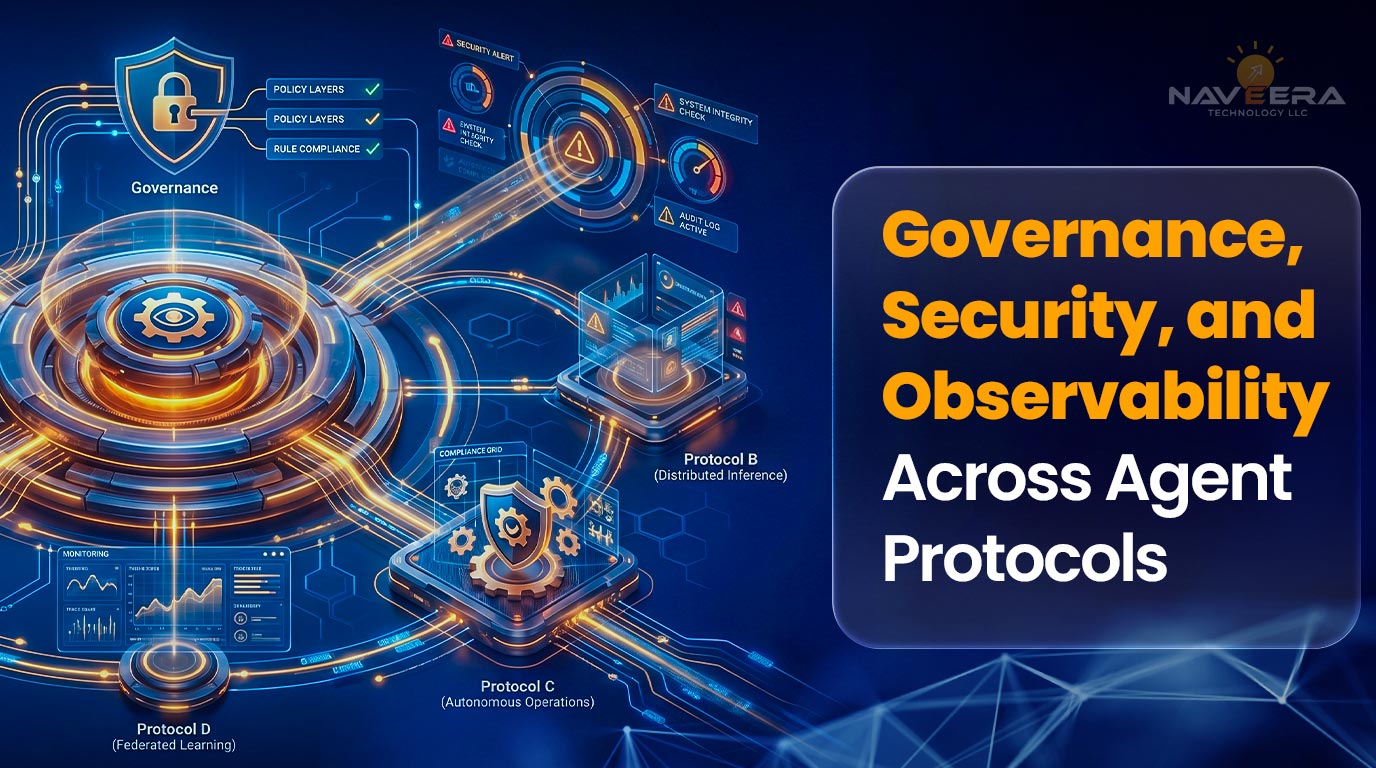
Adopting MCP and A2A does not automatically make your agent architecture safe or auditable. It just gives you defined surfaces to govern. The policy work still has to happen on your end. Who can access which tools? Which agents are trusted to delegate to agents? What data is allowed to cross which boundaries? These questions do not answer themselves just because you are using a protocol.
One of the common mistakes enterprises make when adopting new protocols is assuming that standardization equals safety. MCP and A2A both provide structure. Structure is not a substitute for policy. You still need to define what tools an agent is allowed to access, which agents are authorized to delegate to which agents and what data can flow across which boundaries.
Access boundaries, trust models, and identity considerations:
In an agent system identity gets complicated fast. When Agent A delegates a task to Agent B and Agent B calls a tool via MCP, whose identity is being used for that tool call? This is not a hypothetical. It is a real access control question with compliance implications especially in regulated industries like finance and healthcare.
Enterprise architects need to establish trust models early: which agents are trusted to act on behalf of users, how credentials flow through agent handoffs and where authorization decisions are made. These are not problems that MCP or A2A solve for you out of the box. They require architecture decisions and integration with your existing identity and access management infrastructure.
Observability and traceability across tool calls and agent handoffs:
In a traditional microservices architecture distributed tracing is essential. The same principle applies to agent architectures. The tracing story is more complex because the “calls” between agents involve natural language, reasoning steps and probabilistic outputs, not just deterministic function calls. You need observability tooling that understands agent- concepts, like prompt inputs, tool invocations, agent handoffs and task completion states.
The good news is that both MCP and A2A create points to track what is happening. Every time an MCP tool is used it is an event that can be logged. Every time an A2A task is handed off it is an interaction with a defined payload. If you set up these boundaries well you can see the path of any agent workflow, which is what your security and compliance teams will want to see when something goes wrong.
Runtime Governance in Distributed Agent Systems:
Static governance policies that are defined at the beginning are not enough for distributed agent systems that change and grow on their own. You need runtime governance: the ability to enforce policies, detect anomalies and intervene in agent behaviour while workloads are running. This is an area but the basic building blocks are the same as in other distributed systems: limiting the rate of requests, circuit breakers, anomaly detection and kill switches.
For MCP this means controlling which tools are available while the system is running, not just which tools are exposed in the configuration. For A2A it means being able to take an agent’s authorization to delegate or accept tasks in real time. Building these controls into your agent platform from the start is much easier than adding them
Avoiding Protocol Sprawl, Duplicated Control Planes and Hidden Integration Risk:
As your agent ecosystem grows there is a risk of protocol sprawl. Teams adopting different versions, custom extensions or alternative protocols for similar problems. Over time this creates a landscape where the benefits of standardization are undermined by inconsistent implementation. Setting internal standards early, even informal ones, prevents a lot of future problems.
Duplicated control planes are a problem. If your MCP layer and your A2A layer each have their separate governance, monitoring and access control systems you are doubling your operational overhead and creating gaps where neither system has full visibility. The better solution is an observability and governance layer that sits above both protocols and treats them as complementary data sources.
Getting Started – A Practical Path for Enterprise Architects in 2026:
The biggest risk at this stage is not moving slowly. It is moving without a coherent strategy. Many enterprise teams have a dozen MCP experiments running in parallel with no shared infrastructure, no governance and no one connecting the dots. That is not progress. That is technical debt.
The path forward is straightforward: map your architecture and run one scoped pilot that uses both protocols to intentionally get your governance foundations in place and then scale. The order of these steps matters more than the speed.
Step 1. Map Where Your Architecture Needs Integration vs Interoperability:
Before writing a line of code or evaluating any tooling do the mapping exercise. Take your target use cases and classify each component: is this agent primarily connecting to systems and data. Is it primarily coordinating with other agents? This classification exercise will make your protocol choices more obvious than contentious.
Do not rush this step. A few hours of architecture mapping will save you weeks of protocol mismatch later. Involve the people who understand both the business requirements and the technical constraints. The best architecture decisions at this layer are made with both perspectives in the room.
Step 2. Identify Which Workloads Need Tools, Remote Agents or Both:
Not all workloads are created equal. Some of your AI use cases are smart automation. An agent that processes incoming requests pulls data and generates outputs. These are MCP workloads. Others involve coordinating expertise across multiple agents. A research task that needs a data agent, a writing agent and a quality review agent working in sequence. These are A2A workloads.
Map your priority use cases against this framework. You will quickly see which investments pay off first. Most enterprise teams find that their value near-term use cases are MCP-dominant with A2A becoming more relevant as they move toward more complex multi-step workflows. That sequencing insight alone can help you prioritize your platform investments.
Step 3. Pilot One Layered Workflow Using Clear Protocol Boundaries:
Theory only takes you far. Pick one enterprise workflow that naturally involves both layers: an agent that needs tool access via MCP and needs to hand off to a specialized agent via A2A. And build it end to end. Keep the scope small to complete in a sprint or two but realistic enough that the lessons transfer to production use cases.
The goal of this pilot isn’t just to prove the technology works. It’s to surface governance questions that you can’t answer from a whiteboard. Where does tracing break down? What does the failure mode look like when an A2A handoff fails? How do you rotate credentials in the MCP layer without disrupting running workflows? These are the questions your pilot should answer.
Step 4. Add Governance, Tracing and Architecture Standards Before Scale:
This is the step most teams skip. It’s the one they regret most. Once your pilot demonstrates viability the temptation is to expand to more use cases and more agents. Resist that temptation enough to put governance and observability foundations in place. It’s far easier to establish tracing, access controls and architecture standards on a two-agent system than on a twenty-agent system.
Define your standards explicitly: which MCP server patterns are approved for production use, how A2A agent cards should be structured and versioned, what observability is required before any agent workflow goes to production. These standards don’t need to be elaborate. A one-page architecture decision record for each pattern is often enough to keep teams aligned as the ecosystem grows.
Step 5. Build a Protocol Strategy, not a Collection of Experiments:
There’s a difference between an organization that has a protocol strategy and one that has a collection of experiments. The latter has teams independently exploring MCP and A2A in silos with no shared infrastructure, inconsistent governance and growing fragmentation. The former has a platform that individual teams build on top of with shared tooling, shared standards and shared lessons learned.
Getting to a protocol strategy requires someone. An architect, a platform team lead, a CTO office. To own the cross-cutting view and make deliberate decisions about what gets standardized and what stays flexible. It doesn’t require hand centralization but it does require someone to connect the dots across teams and prevent the archipelago problem where every team has its own island of agent infrastructure.
What a 90-Day Agent Protocol Architecture Review Looks Like:
A 90-day review is a timeline for most enterprise teams to go from “we’re exploring MCP and A2A” to “we have a coherent architecture position.” The first 30 days should focus on discovery: mapping existing and planned use cases, auditing integration patterns and identifying which teams are already building with these protocols. The next 30 days should focus on piloting: running the layered workflow experiment described above and capturing the lessons.
The final 30 days should focus on standardization: drafting the architecture standards, establishing the governance model and socializing the protocol strategy with the teams that will need to build on it. At the end of 90 days you should have a documented architecture position, a pilot architecture that other teams can learn from and a clear roadmap for expanding your agent capabilities on a solid foundation. That’s not a moonshot. It’s a deliverable for a focused senior-level architecture effort.
Final thoughts:
Building your enterprise agent architecture. The protocol decisions you make in 2026 will shape what you’re able to build and how easily you can maintain it. For years to come. Start with boundaries, invest in governance early and treat MCP and A2A as complementary tools rather than competing standards