

Every modern business runs on data, but very few operate on data that is as reliable as leaders assume. Dashboards refresh late. Customer events arrive out of order. Revenue numbers fail to reconcile across systems. Downstream machine learning jobs inherit broken inputs without warning. By the time someone notices, the issue has already spread across reports, decisions, and operational workflows.
That is the real problem with pipeline failures. They are rarely isolated technical inconveniences. They are business interruptions disguised as engineering issues.
For years, people have been handling things in a way: they add more monitors, send out more alerts, and expect data engineers to react quickly. This approach worked well when data setups were smaller, schedules were regular, and there weren’t many things to keep track of. That is no longer the world in which most organizations operate. Today’s data estates span cloud warehouses, event streams, third-party APIs, reverse ETL tools, orchestration layers, transformation frameworks, semantic layers, and AI-driven downstream applications. The sheer operational surface area has changed the math.
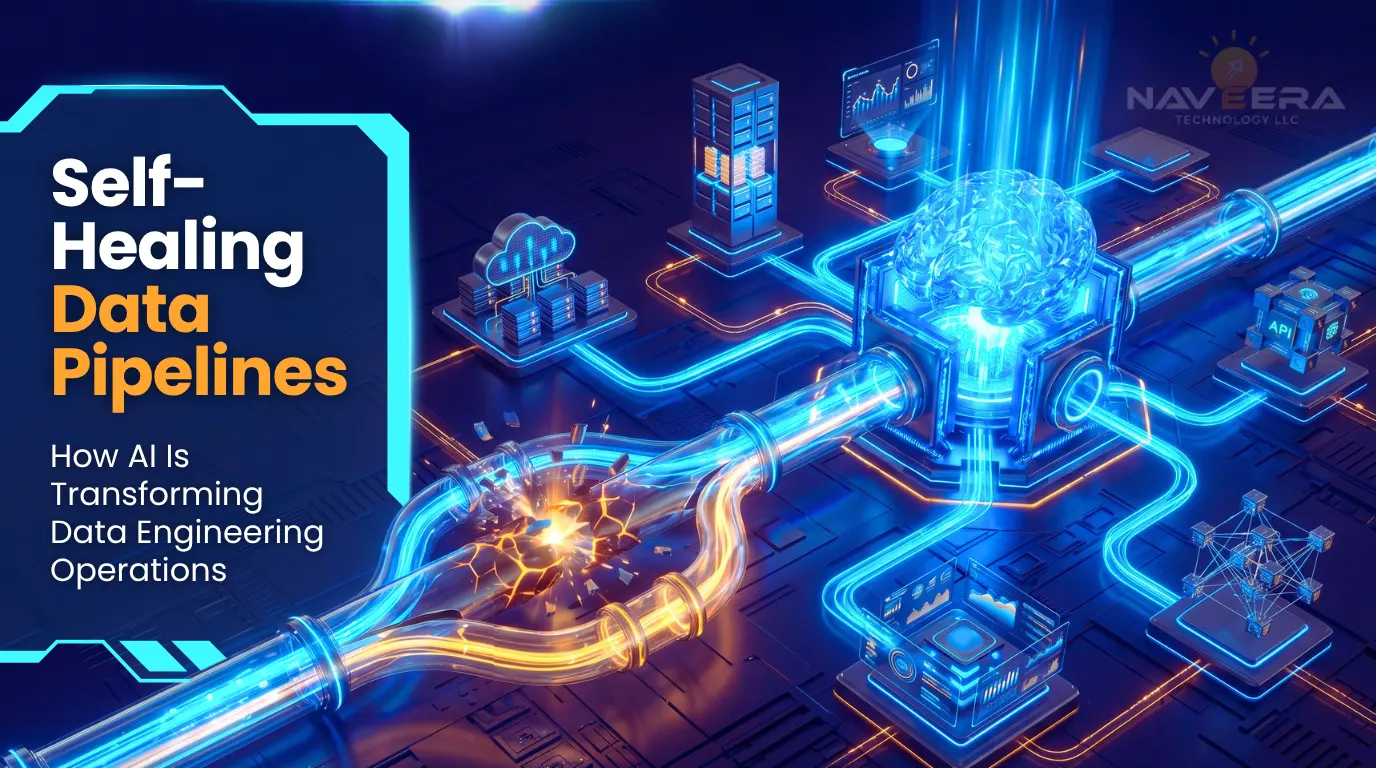
Data pipelines that can fix themselves are really important here. We do not want to take engineers out of the process or think that artificial intelligence can handle every problem on its own. What we want to do is make sure the pipeline system works so it can find problems early, identify what is probably causing them, suggest solutions, and, when it is safe to do so, fix the problem before it becomes too expensive. In words, the main goal of self-healing data pipelines is to ensure everything runs smoothly, not just to automate blindly.
For executives, this matters because reliability has become a cost, a governance issue, and a speed-to-decision issue. For engineering leaders, it matters because reactive pipeline support does not scale. And for data teams, it matters because the future of data engineering is not just building pipelines. It is building systems that can survive and recover under real production pressure.
The Data Pipeline Operations Problem — Why Traditional Reliability Models No Longer Scale
The hidden business cost of brittle pipelines in modern data estates
Brittle pipelines are a problem. They do not just cause issues. They also create significant uncertainty. When these pipelines fail without warning, people start to lose trust in the system. Leaders begin to question the information they see on their dashboards. Analysts have to spend their time checking numbers to ensure they are correct, rather than using that time to uncover new insights. Product teams are also hesitant to make decisions because they are not sure what information is current, complete or correct.
The cost of these problems is often much higher than it seems at first. If a data load fails, it can delay the reports the finance team needs. It can also disrupt how customers are grouped. It can even produce inaccurate demand forecasts. It can send bad data into the systems that the company uses every day. The mistake itself might seem small. The problems it causes can add up very quickly. In companies that have been around for a while, the biggest problem with pipelines is not when they fail. Brittle pipelines are an issue because they can lead people to make decisions based on incomplete or incorrect data. This is often an expensive problem caused by brittle pipelines.
That is why brittle pipelines are not simply an engineering inconvenience. They are a reliability tax on the entire business.
Why alert-driven operations create slow detection and expensive recovery cycles
Traditional data operations really rely on alerts. When a job fails, or a threshold is breached, or a freshness check trips, the system sends a notification to a person. This seems like a good idea at first, but it becomes a problem when there are too many alerts for teams to quickly review and understand what is going on.
In life, using alerts to run operations causes delays at every step. Someone has to see the alert and determine whether it is important. They have to find out what went wrong and look at the things that depend on it. They have to determine whether the problem is with one thing or a bigger issue. Then they have to decide what to do about it. Really good engineering teams waste time trying to understand what is happening, looking back at what happened before, and gathering information from different tools.
The problem is not with monitoring data operations. Monitoring is necessary. The problem is that we rely too much on monitoring without having enough tools to diagnose problems and automate operations. An alert just tells you that something is wrong. It does not tell you why it happened, how bad the problem is, or what you should do to fix it. Data operations and alerts are closely related. We need to think about how data operations and alerts can work better together. Data operations and alerts need improvement to help teams quickly and easily fix problems.
What changed — pipeline sprawl, tool fragmentation, and always-on data expectations
Data engineering has expanded from a narrower batch-processing discipline into a distributed operational function. Organizations now manage ingestion frameworks, transformation layers, streaming infrastructure, orchestration tools, data contracts, observability platforms, warehouses, lakehouses, and business-facing serving layers. Most environments were not designed in a single, clean stroke. They evolved over time, often through project-by-project adoption.
That creates fragmentation. One tool captures lineage. Another track’s freshness. Another logs orchestration errors. Another store’s infrastructure metrics. Another contains transformation models. Engineers are often forced to piece together the operational story across a fragmented landscape.
At the same time, the business expects data to be continuously available. Revenue teams want real-time visibility. Product teams want event-driven insight. AI systems expect consistent, well-governed inputs. The old assumption that data teams can fix issues after the morning batch is no longer sufficient. Reliability expectations are now closer to platform operations than traditional reporting support.
Why data engineering teams now need automated diagnosis, not just monitoring
The next step in making our pipeline better is not about getting more warnings or looking at more graphs. It is about cutting down the time it takes to figure out what went wrong with the pipeline and do something about it. We need to reduce the time between when something fails, when we understand what happened to the pipeline, and when we take action to fix it. That requires systems that can interpret operational signals, correlate incidents across layers, and surface likely root causes with enough confidence to accelerate remediation.
This is where AI becomes valuable. Not as a replacement for engineering judgment, but as a force multiplier for operational awareness. In a modern data environment, the winning teams are not the ones that see the most alerts. They are the ones that can detect the right problems, classify them accurately, and respond at a controlled pace.
What Self-Healing Data Pipelines Actually Mean
Defining self-healing in a real data engineering context
A self-healing data pipeline is not a magical system that fixes every issue on its own. In a practical enterprise context, it is a pipeline operating model designed to recognize abnormal behavior, assess likely causes, and initiate safe recovery actions with minimal human delay.
The focus should be on controlled resilience. This means the system can do things like try again automatically when it fails for a while, run things again when it knows what depends on what, change how it uses resources on the fly, make smart choices about where to send information based on what it looks like, separate out suspicious information, or get a person involved when things get too risky. The main thing is that the system does not just watch when it fails. It addresses it and stays within the rules. Controlled resilience is what matters. The system has to be able to respond to problems, and controlled resilience enables it to do so.
Detection, diagnosis, remediation, and recovery — the operational control loop
True self-healing works in a loop.
- First the system checks if something is not working right.
- Second it figures out what and where the problem’s
- Third it decides how to fix it.
- Fourth it fixes it. Tells you how to fix it and then checks if everything is okay again.
The system keeps doing this to make sure everything runs smoothly.
It always. Fixes problems in this order: detect, diagnose, remediate and validate.
That loop matters because detection alone is not enough. Many teams already know when something fails. The bottleneck is diagnosis and action. Self-healing designs reduce the manual effort required to move from “an incident occurred” to “a safe corrective path has been identified and verified.”
The difference between retries, rule-based automation, and true self-healing behavior
Many teams already use retry fallback logic and operational scripts. These are tools, not self-healing systems. A retry assumes that the problem will go away on its own. A fixed rule assumes that we know what is going wrong and that it will keep happening. Self-healing systems do more. They analyze signals, evaluate the situation, and adapt their response to what is happening now. This difference is important. A pipeline that retries every failed step, without understanding why it failed, can waste computer resources. It can also prolong problems. In some cases, it can even make things worse downstream.
A self-healing system should be smart enough to decide what to do. It should know whether to retry a step, pause the pipeline, isolate records, or involve a human. Self-healing systems are context-aware. They make decisions based on the situation. Retries and fallback logic are not self-healing. They are simple fixes. Self-healing systems go further. They. Respond to what is happening now.
Where AI fits — anomaly detection, root cause inference, and remediation guidance
AI is especially useful in the spaces between signals. It can identify abnormal behavior before a hard failure occurs, infer likely relationships across logs and metrics, cluster incident patterns, and suggest actions based on prior resolutions. In mature implementations, AI can also help rank remediation options by confidence and operational risk.
That does not mean every pipeline needs an agent that makes decisions independently. In some cases, the most valuable use of Artificial Intelligence is to help with diagnosis. By having engineers figure out what went wrong on their own, the system can show them the likely causes, the assets affected, and what they should do next. This really helps to reduce the time it takes to get things back to normal. The system uses Artificial Intelligence to assist with diagnosis. It helps engineers to fix problems faster.
The decision boundary — what should be automated, approved, or escalated
This is where serious enterprise design is really different from what I call automation theater. Not every problem should be fixed automatically. Some problems are pretty simple, and we know exactly what is going on. It is okay to use automation to fix them. These are the problems that cause little trouble. We can easily fix them if something goes wrong. On the other hand, serious enterprise design problems that could cause major issues, such as critical tables, sensitive data, or updates that cannot be changed, should always be checked by a human. Enterprise design is about knowing when to use automation and when to have a human make the decisions.
A strong self-healing model defines these boundaries clearly. It does not ask whether automation is possible in theory. It asks whether automation is safe, explainable, and governed in practice.
The Technical Architecture Behind Self-Healing Pipelines
Observability foundations — logs, lineage, metrics, traces, and metadata
Self-healing begins with visibility. If the system cannot see enough of itself, it cannot reason effectively. Logs provide event detail. Metrics reveal health trends. Traces expose timing and execution behavior. Lineage shows how failures propagate. Metadata ties the technical story to the business context.
Without these layers, teams are left to diagnose incidents in fragments. With them, the pipeline’s operating system becomes sufficiently observable for machine-assisted reasoning. This is why self-healing is not just an AI project. It is fundamentally an observability and architecture project.
Data quality signals — freshness, schema drift, volume shifts, distribution changes, and contract violations
Most pipeline failures are not limited to obvious runtime errors. Some of the most dangerous issues are silent. A table loads successfully, but with missing partitions. A schema change lands upstream without coordination. Event volume drops but does not hit zero. Value distributions shift enough to corrupt downstream assumptions without triggering a hard failure.
That is why self-healing designs must treat data quality as an operational signal, not just a post hoc governance concern. Freshness checks, schema validation, null spikes, volume anomalies, distribution changes, and data contract breaches all provide clues about the pipeline’s health. When interpreted together, they form the basis for earlier and smarter intervention.
Orchestration, dependency mapping, and event-driven remediation workflows
Orchestration platforms do more than schedule pipeline tasks. They must understand dependencies across the pipeline and support intelligent recovery when failures occur. Their role is to coordinate execution with enough context to keep the pipeline resilient, not just on time. The system must understand upstream relationships, downstream impact, retry safety, and business-critical execution paths.
Event-driven remediation becomes powerful here. Instead of waiting for a human to inspect every failure, the system can trigger predefined response paths based on incident type, dependency state, and policy rules. A delayed upstream extract might trigger a bounded retry. A schema break might route data into quarantine and notify owners. A noncritical enrichment step might be skipped temporarily to preserve a business SLA. These patterns turn operations into a guided system rather than a sequence of manual reactions.
AI-assisted diagnosis — learning failure patterns across runs, systems, and incidents
Over time, pipeline incidents generate an operational memory. Failures repeat in recognizable forms. Certain API behaviors correlate with timeouts. Certain schema changes break specific transformations. Certain resource bottlenecks appear before particular workload spikes. AI can help convert that historical noise into usable diagnostic intelligence.
This is one of the most promising areas for applied AI in data engineering. Not because it is flashy, but because it aligns directly with how experienced engineers already think. Strong operators recognize patterns. AI can help systems do the same, at scale, across a broader operational history than any one person can hold in memory.
Guardrails, rollback paths, and approval workflows for safe operational recovery
No self-healing system should be designed without safety controls. Guardrails define what the system is allowed to do automatically. Rollback paths define how to reverse an action if the chosen remediation path proves incorrect. Approval workflows define when a human must review the action before it is executed.
These controls are what make automation trustworthy. Without them, self-healing becomes operational risk. With them, it becomes a disciplined way to reduce incident response time while preserving governance.
Where Self-Healing Delivers Value — And Where It Breaks Down
High-volume ingestion, transformation, and SLA-sensitive reporting pipelines
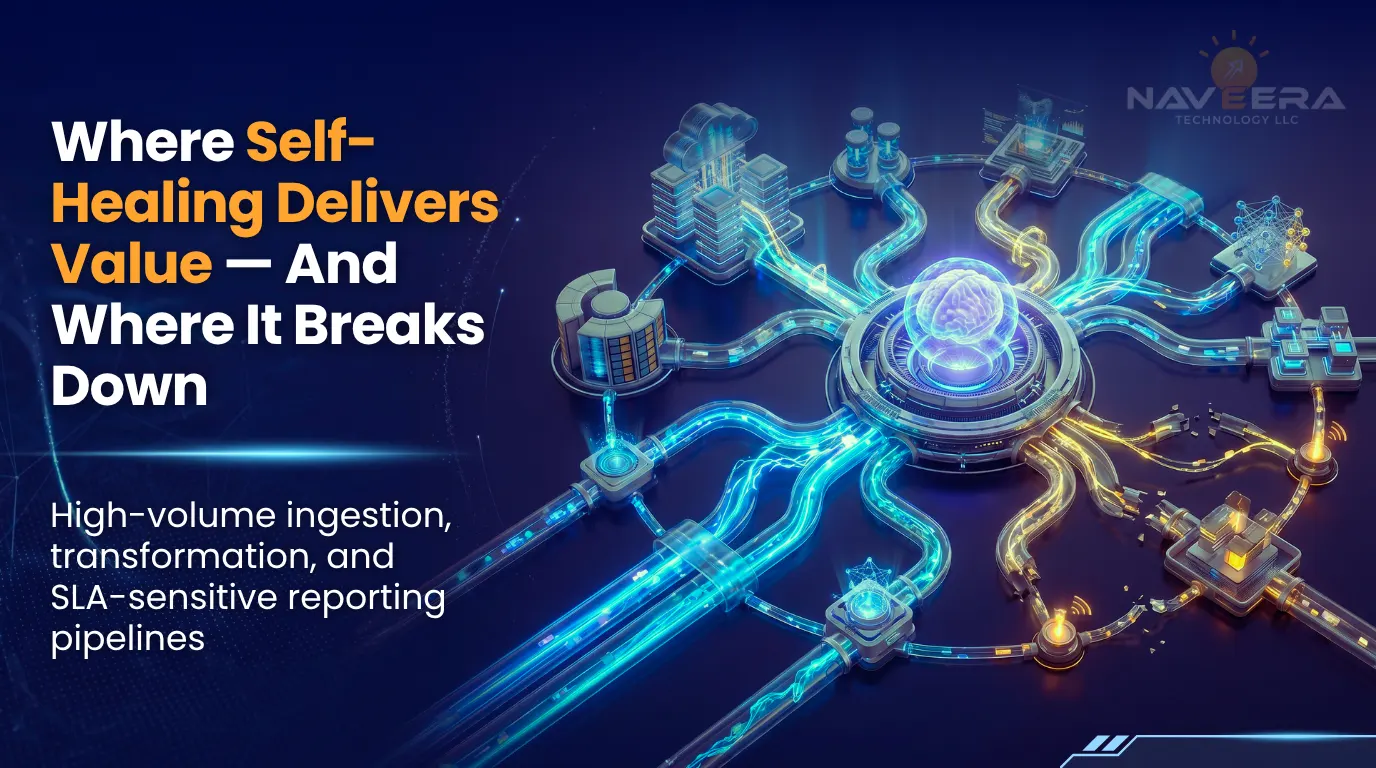
Self-healing creates the most value where incident frequency, operational repetition, and business sensitivity intersect. High-volume ingestion pipelines are strong candidates because they often encounter predictable failure patterns. Transformation pipelines also benefit because dependency structures can be mapped clearly. SLA-sensitive reporting flows benefit from controlled remediation, which can preserve time-critical business visibility.
In these cases, the economics are compelling. Every minute saved in detection and recovery compounds across repeated incidents, especially where pipelines support customer-facing operations or executive reporting.
Batch, streaming, ELT, and hybrid workloads — where recovery patterns differ
Not all pipelines fail in the same way. Batch workloads often have clearer rerun boundaries. Streaming systems may require more nuanced checkpoint handling and replay logic. ELT pipelines may depend more heavily on warehouse behavior and model dependencies. Hybrid workloads combine characteristics from multiple modes, which makes remediation more context-sensitive.
This matters because self-healing should never be implemented as a one-size-fits-all layer. The recovery model must match the execution model. What is safe in one workload may be dangerous in another.
Common failure classes AI can address effectively
AI is well-suited to repetitive, signal-rich failure classes. That includes anomaly detection for freshness and volume, pattern recognition of recurring job failures, correlation across fragmented operational signals, and recommendations for known remediation paths. It can also help prioritize incidents by likely business impact rather than simple technical severity.
This is where teams see practical gains. AI excels when there is enough historical pattern to learn from and enough operational structure to keep recommended actions bounded.
Edge cases that still require engineering judgment and manual intervention
Some failures do not lend themselves to confident automation. Ambiguous business rule changes, poorly documented upstream dependencies, conflicting data semantics, complex schema redesigns, and incidents with compliance implications still require experienced engineering judgment. The same is true for incidents where the wrong automated action could create irreversible downstream effects.
Self-healing is strongest when it is honest about its limits. The goal is not to eliminate human operators. It is to reserve human attention for the cases where it adds the most value.
Why weak metadata, poor observability, and missing data contracts break the self-healing promise
Organizations sometimes try to jump directly to intelligent remediation without first strengthening the foundations. That usually fails. If metadata is inconsistent, lineage is incomplete, observability is shallow, and data contracts do not exist, then the system lacks the context needed to diagnose and recover safely.
This is where many initiatives disappoint. They aim for autonomy before they achieve clarity. In practice, self-healing is only as strong as the operational truth available to the system.
AI, Governance, and ROI — Making Pipeline Automation Trustworthy
Reducing mean time to detect, diagnose, and recover
The most immediate benefit of self-healing is not abstract innovation. It is operational speed. Faster detection reduces exposure. Faster diagnosis reduces engineering toil. Faster recovery reduces business disruption. When these improvements occur consistently, reliability becomes measurable and economically defensible.
That is important to both the engineering and leadership teams.
The technical teams get some space to work.
Business stakeholders get more reliable data operations.
The organization can deliberately improve reliability rather than fix problems as they happen.
The cost equation — incident prevention, engineer time, and automation overhead
Self-healing is not free. It requires instrumentation, policy design, operational workflows, and supporting intelligence. But the relevant question is not whether it costs something to build. The question is whether the operating cost of brittleness is already higher.
In many organizations, the answer is yes. Senior engineers are spending too much time on repetitive triage. Business users are absorbing too much uncertainty. Pipeline failures are taking up a lot of time and effort that we did not plan for. If we have a plan in place to fix the pipeline when something goes wrong, we can save money by being prepared rather than just trying to fix it after it breaks. This way, pipeline failures will not be so expensive. We can focus on strengthening the pipeline.
Human-in-the-loop controls, auditability, and governed remediation paths.
Trustworthy automation requires accountability. The system should record what signal triggered an action, why the action was selected, what policy allowed it, and what outcome followed. That audit trail matters in regulated settings, but it also matters in everyday enterprise operations. Teams need visibility into what the system did and why. A clear understanding of both actions and reasoning is essential for trust and effective oversight.
Human-in-the-loop controls are really important. They let the organization automate with confidence while still being in charge. Human-in-the-loop controls are essential because they help the organization automate confidently without sacrificing control. The most effective operating model is rarely full autonomy. It is selective automation within clearly governed boundaries.
Aligning platform teams, data leaders, and business stakeholders on reliability metrics
Self-healing works best when reliability is treated as a shared operating concern. Platform teams care about infrastructure stability. Data teams care about pipeline correctness. Business leaders care about trusted and timely decisions. These priorities should not compete. They should converge into a shared reliability model.
Metrics are really important. They help us measure things like how incidents occur, how long it takes to fix them, how often they recur, whether we are meeting our service-level agreements, and how much it costs to run our operations. When we have these metrics, we can talk about pipeline reliability in a way that makes sense to both people and business people. This means we can have conversations about planning for the future rather than just fixing problems as they happen. Metrics such as incident rate, recurrence rate, time to recovery, SLA adherence, and operational cost help us understand pipeline reliability.
What production-ready self-healing looks like in enterprise and regulated environments
Production-ready self-healing is not simply intelligent alerting attached to a workflow engine. It is a governed operating capability built on observability, metadata, control policies, safe remediation paths, and human oversight where needed.
This is also where implementation maturity matters. At Naveera Technology, the practical view is that self-healing should be approached as an engineering discipline rather than a marketing concept. The strongest outcomes come from combining data foundations, observability, operational policy, and AI-assisted diagnosis in a way that is measurable, auditable, and aligned to the real business risk of the pipeline environment.
Getting Started — From Reliability Assessment to Controlled Deployment
Step 1 — Audit failure patterns, dependencies, and operational bottlenecks
The first step is to figure out where reliability is actually failing. This means identifying the most common failure types that cause the most damage, the most unstable dependencies, and the slowest parts of the recovery process. Without this information, teams risk fixing the problems.
Step 2 — Get a picture of what’s going on with your systems and data
Before automation can get really smart, it needs to know what’s happening. Teams need to be able to see how pipelines work and how problems occur. How data quality changes over time. This is the foundation that makes automation safer and more effective.
Step 3 — Bring in AI to help with detection, diagnosis and recommendations
Once the basics are in place, AI can start to add value. Start with tasks such as classifying incidents, understanding anomalies, identifying dependencies, and obtaining recommendations for fixes. Often, the first wins come from using AI to help humans make decisions.
Step 4 — Automate low-risk remediation paths before higher-risk recovery actions
The best way to make things fix themselves is to do it a little at a time. Start with the things that’re easy to fix and will not cause big problems if something goes wrong. Watch what happens closely. Only try things when the self-healing system has shown it works well and does what it is supposed to. This makes things safer. People will trust the self-healing system more. The self-healing system will be better. People will like it.
Metrics that matter — incident rate, MTTR, recurrence rate, SLA adherence, and operational cost per pipeline
These metrics matter because they show how engineering improvement affects business value. A self-healing initiative is not about how complex the automation looks. It is about whether the self-healing initiative causes incidents to occur more often and, when they do, helps us recover faster. The self-healing initiative should also make incidents recur frequently. The self-healing initiative should consume less of our engineers’ time at the company.
What a 90-day self-healing pipeline pilot looks like
A serious ninety-day pilot for a data system does not try to do everything on its own. It looks at a part of the data, makes it easier to see what is going on, identifies recurring problems, uses artificial intelligence to help figure out what is wrong, and fixes a few small, low-risk issues. After 90 days, the organization should have a sense of how things are working, understand what is happening when problems arise, and know where it is safe to let the system fix things itself.
That is how we should think about this kind of project: not as a way to make everything automatic. As a step-by-step plan to make our data operations more reliable, smarter and cost-effective.
The big picture is clear. People who work with data are moving away from building pipelines and towards making sure everything runs smoothly. The teams that do well will not just be good at moving data. They will be good at running data systems that can identify problems early, fix them quickly, and return to normal after disruptions. In the future, being able to fix things itself will not be a feature. It will be a part of how we run our data operations.
FAQ
Q1: What is a self-healing data pipeline?
A self-healing data pipeline is a data workflow that can detect problems, identify what is going wrong, and fix them without people having to get involved. It does this by using tools such as observability, data quality checks, and automation to reduce the number of problems.
Q2: How does AI help detect and resolve pipeline failures automatically?
AI is really good at identifying issues by analyzing many different signals and determining what is likely causing the problem. This means it can find the root cause of the issue faster than people can on their own. In some cases, AI can even. Start fixing the problem by retrying a job or sending a warning to someone.
Q3: What types of pipeline issues can self-healing systems fix on their own?
Self-healing systems are really good at fixing problems that recur, such as when a job fails temporarily or data becomes stale. They can also handle issues with data quality, such as when the data isn’t what it is supposed to be. For more complex problems, such as when the business rules are unclear, self-healing systems usually need a human to review them.
Q4: What are the risks of automated data pipeline remediation?
The big risks are that the system might not diagnose the problem correctly, or it might try to fix the problem in a way that makes things worse. This could even corrupt the data. Make it harder to keep track of what is happening. That is why good self-healing systems have safeguards in place, such as requiring approval for actions and keeping a record of what happens.
Q5: How should enterprises begin implementing self-healing data pipelines?
Enterprises should start by looking at what’s going wrong with their data pipelines and what is causing the most problems. Then they should make it easier to see what is happening with their data and ensure they check the data quality. After that, they can start using AI to help diagnose problems and automate some tasks, but they should do so in a small test first to make sure everything works properly.