

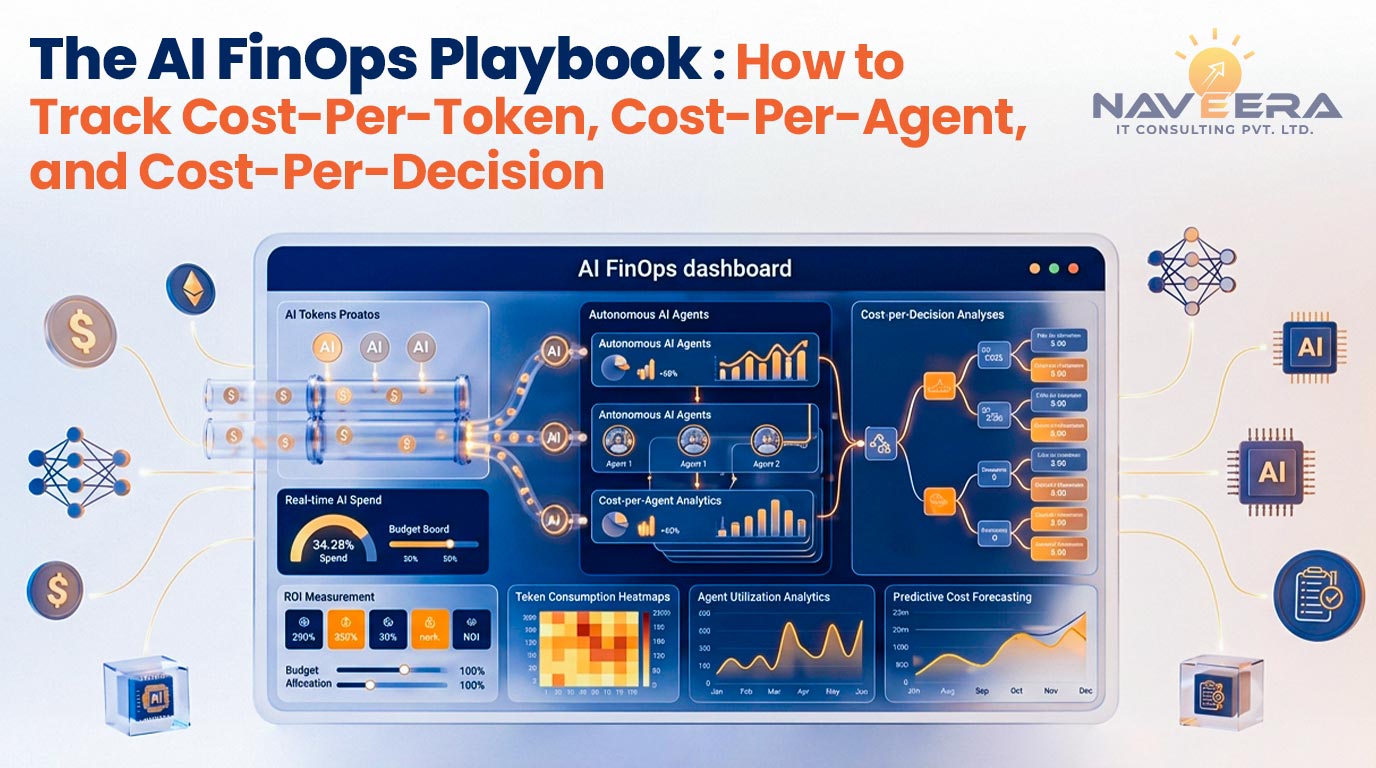
As AI becomes a core part of how businesses operate, keeping track of what it costs you is no longer optional. This guide breaks down three metrics. Cost-per-token cost-per-agent and cost-per-decision. So instead of flying blind on your AI spend, you finally have a clear framework to make confident, informed financial decisions. Consider this your practical guide to making sure every dollar you put into AI is actually pulling its weight.
AI Cost Management Is Moving from Raw Spend to Unit Economics:
Teams today are still looking at their AI bill the same way they look at a cloud invoice. Total spend, maybe broken down by service. That worked fine when AI was a side experiment. Now that it’s running real workflows, that level of visibility just doesn’t cut it anymore. The shift happening now is from “how much did we spend on AI this month?” to “what did every dollar of AI actually produce?”. And that’s a fundamentally different question.
Why Cloud-Style Cost Reporting Is Not Enough for AI Workloads:
Cloud cost reporting was built for compute and storage not for workflows, token usage and multi-step decisions. When your AI is making hundreds of calls retrying failed steps and routing across models a simple line-item invoice tells you nothing useful. You need to see how your AI workflow is doing, not the model invoice.
Cost Per Token as the Starting Point. Not the End State:
Cost per token is the foundation of AI unit economics. Yes, you need to track it. But it’s just the beginning. On its own it tells you how efficiently you’re using infrastructure. It says nothing about whether that usage is actually driving value. Think of it as the step in a process that needs to go much deeper before it becomes actionable for business decisions.
Why Enterprises Now Need Cost Metrics Tied to Agents, Assists and Business Outcomes:
As AI moves into customer support, operations and decision-making finance teams are rightly asking for accountability at the outcome level. Cost per case deflected, cost per assist cost per decision made. These aren’t metrics; they’re what connects your AI spend to real business-value alignment. Without them you’re basically flying blind on ROI while the bills keep growing.
The Shift From “How Much Did We Spend?” to “What Did Each AI Action Produce?”:
The smartest AI teams are already reframing their cost conversations around what each AI action actually produced. Not just what it consumed. This means building cost tools, usage dashboards and chargeback models that tie every token every agent session and every workflow back to an outcome. It’s a system to build but it’s the only one that gives leadership the full picture.
What Each Metric Actually Measures – Why They Matter:
There are three core metrics every AI FinOps strategy needs to cover and they each operate at a different layer of your stack. Treating them as substitutes for each other is one of the common mistakes teams make. In reality they’re meant to be stacked with each one adding a new layer of context on top of the last.
Cost-Per-Token – The Infrastructure Consumption Layer:
Cost-per-token lives at the infrastructure level. It’s your measure of how much you’re paying the model provider per unit of processing. It’s directly tied to usage, latency, retries and whether you’re taking advantage of prompt caching or context caching to reduce redundant spend.
Cost-Per-Agent – The Workflow or Session Layer:
Cost-per-agent zooms out one level to look at what an agent session or workflow actually costs end-to-end including orchestration overhead tool calls, memory reads and handoffs between agents. This is where workflow cost becomes visible. Because a single agent task can quietly rack up dozens of model calls that never show up clearly in token-level reporting.
Cost-Per-Decision – The Business Outcome Layer:
Cost-per-decision is where AI spending finally starts making sense for the business, because it ties what you are spending directly to the results that actually matter to your organization. A resolved support case, a completed transaction, a risk, a deflected ticket. It’s the metric to instrument but it’s the one that CFOs and business leaders actually want to see because it directly speaks to business-value alignment.
Why These Metrics Should Be Stacked, Not Treated as Substitutes:
Each of these three metrics answers a question, which means you genuinely need all three running simultaneously to get a complete view of AI cost efficiency. Dropping cost-per-token because you’re focused on outcomes is like removing your fuel gauge because you’re tracking miles per trip. They measure things at different layers.
How to Avoid Optimizing Token Cost While Destroying Business Value:
One of the sneakiest failure modes in AI cost management is cutting spend in ways that quietly wreck your outcome quality. Aggressive prompt compression, switching to models for complex tasks or slashing retry budgets can all make your cost-per-token look great while your cost-per-decision quietly balloons due to lower accuracy and more failures.
The AI Unit Economics Stack – A Practical Framework for 2026:
If you want to build a cost management system that actually scales with your AI usage you need a framework. Not a single dashboard or a one-size-fits-all metric. The AI unit economics stack is a five-layer model that takes you from raw provider billing all the way up to chargeback, forecasting and the kind of reporting that finance teams can actually work with.
Layer 1 – Provider Billing, Token Usage and Cached vs. Uncached Cost:
The foundation of everything is granular data from your model providers. Broken down by model by call type and critically by whether costs were incurred on cached or uncoached tokens.
Layer 2 – Model, Prompt, Tool and Retry Attribution:
Once you have billing data Layer 2 is about attributing every dollar to its source. Which model, which prompt template, which tool calls and how many retries were burned.
Layer 3 – Agent Session, Workflow and Handoff Cost Aggregation:
Layer 3 is where you start rolling individual call costs up into workflow units. Full agent sessions, multi-step task completions and cross-agent handoffs.
Layer 4 – Decision, Case or Task-Level Value Mapping:
Layer 4 is where the finance and product worlds collide. You’re mapping aggregated workflow costs onto business outcomes like a resolved support case, a completed onboarding or a flagged compliance decision.
Layer 5 – Chargeback, Show back Forecasting and Executive Reporting:
The top layer is where all that structured cost data becomes intelligence. Department-level chargeback and show back models, budget guardrails and quotas by team or product forecast variance tracking and the kind of clean executive dashboards that let leadership make real resource allocation decisions.
Why Cost-Per-Token Alone Fails in Agentic and Multistep AI Systems:
Cost-per-token alone can’t give you the picture of AI cost efficiency. You need to look at all three metrics. Cost-per-token cost-per-agent and cost-per-decision. To make financial decisions, around your AI investments.
If your artificial intelligence was a chatbot making single-turn API calls, cost-per-token would probably tell you most of what you need to know.. The moment you introduce agents tool use, multi-step reasoning and orchestration layers token cost becomes a deeply incomplete picture of what’s actually driving you. The economics of AI are fundamentally different and the teams that don’t adapt their measurement approach end up with cost surprises they can’t explain and budgets they can’t defend.
Agents Create Cost Through Retries Tool Calls, Memory and Orchestration Overhead:
A single agent task doesn’t just make one model call. It might make ten including retries after tool failures, memory lookups, sub-agent delegations and validation passes.
All of that shows up in your bill but it’s scattered across dozens of individual calls with no clear attribution back to the original task.
Tracking cost-per-agent requires you to instrument the full session lifecycle, not just count tokens at the API boundary.
The Hidden Spend of Evaluation, Guardrails and Retrieval Layers:
Beyond the model calls, agentic systems carry a whole layer of hidden costs. The evaluator that scores output the guardrail that checks every response, the retrieval system that runs semantic search before every generation.
These components consume tokens. Computers constantly often account for 20–40% of total AI spend in production systems but they rarely show up as a named line item in standard usage dashboards.
Real AI unit economics has to account for this stack, not just the generation layer.
Why One Expensive Decision Can Still Be Financially Rational:
A single high-stakes decision. Say, an AI flagging a fraud case or resolving an enterprise support ticket. Might burn 50x more tokens than a routine task and that’s completely fine if the business outcome justifies it.
The cost isn’t the problem; the lack of context around the value produced is the problem.
Cost-per-decision gives you the frame to see that a $2 AI decision that saves $500 in review time is a phenomenal ROI even if it looks expensive at the token level.
How Shared Services and Common Prompts Complicate Allocation:
In real AI systems there are some components. System prompts, retrieval indices, safety layers. Are shared across multiple products or teams which makes clean cost allocation genuinely hard.
If three products all use the base agent with the same system prompt, how do you split that cost fairly across departments for chargeback purposes?
Solving this requires shared model cost allocation policies and a clear methodology for handling specification-style cost attribution across overlapping usage patterns.
Why Unit Economics Must Follow the Workflow, Not the Model Invoice:
The core insight of AI FinOps is that the model invoice is the useful unit for business decision-making. It’s too granular, too disconnected from outcomes and too easy to misinterpret.
Unit economics has to follow the workflow: start with what the AI was trying to accomplish, trace every cost component that contributed to that outcome and then evaluate the total against the value produced.
That’s the framing that gives you the observability, tracing and attribution you need to run AI at scale without losing financial control.
The Optimization Levers That Change AI Unit Economics:
Once you know what your AI is actually costing you at every layer the next question is obvious. Where do you pull to bring those numbers down without breaking what’s working?
The good news is there are proven levers that can meaningfully move your unit economics and most of them don’t require switching models or rebuilding your architecture from scratch.
The key is knowing which lever to pull at which layer because the wrong optimization in the place can quietly hurt quality while making your dashboard look great.
Prompt Caching and Context Caching to Reduce Repeat-Input Cost:
If your AI system is sending the system prompts, instructions or context blocks on every single call you’re paying full price for tokens you’ve already paid for. And that’s one of the easiest wins in generative AI cost optimization.
Prompt caching and context caching let you reuse processed inputs across calls, which can cut a chunk of your token spend without touching your model logic or output quality at all.
Most teams that implement this properly see cost reductions and it’s usually one of the first things worth auditing when your token usage feels higher than it should be.
Model Routing – Smaller-Model Default, Larger-Model Escalation:
Not every task your AI handles needs your power. And most expensive. Model and routing intelligently between models is one of the highest-leverage cost moves available to you right now.
The pattern that works best is defaulting to a faster cheaper model for straightforward tasks and only escalating to a larger model when complexity actually warrants it.
Getting this routing logic right requires understanding your task distribution. Teams that do it well routinely cut their model spend by 30–50% with no meaningful drop in output quality.
Token Discipline – Prompt Design, Truncation and Context Governance:
Bloated prompts are one of the common and most overlooked sources of unnecessary AI spend. Every extra sentence in your system prompts every redundant instruction, every piece of context that isn’t actually needed for the task is costing you money at scale.
Token discipline means treating your prompts like code: reviewing them, truncating what isn’t earning its keep and building context governance policies that decide what gets included in each call and what doesn’t.
It’s work but in high-volume production AI systems prompt design improvements can move your cost-per-token numbers faster than almost anything else.
Retry Controls, Tool Budgets and Agent Guardrails:
In systems retries and unconstrained tool use are silent budget killers. An agent that retries three times on every ambiguous step can easily triple the cost of a workflow without anyone noticing until the bill arrives.
Setting retry controls, capping tool call budgets per session and putting agent guardrails around runaway loops are all essential parts of keeping cost-per-agent numbers manageable in production.
These aren’t cost controls either. They tend to make your agents more reliable and predictable which is a win in every dimension.
Quotas, Forecasting Windows and Spend Policies for Production AI:
As your AI usage scales, ad-hoc cost management stops working. You need actual spend policies. Team-level quotas, forecasting windows that flag when you’re trending over budget and clear rules about what happens when a product or workflow hits its ceiling.
AI cost allocation and forecasting at this level is what separates teams that’re in control of their AI economics from teams that are constantly reacting to surprise invoices.
Building these policies before you scale is always easier than retrofitting them after you have already grown past the point where everyone is paying attention.
The Executive View – How CTOs, CFOs and Data Leaders Should Read AI Cost Metrics:
AI cost data means different things to different people in the room and one of the biggest organizational failures in AI FinOps is showing everyone the same dashboard and expecting it to drive aligned decisions.
CTOs want to understand efficiency and architectural risk CFOs want to see spend tied to business outcomes and forecast variance and data leaders want observability into model behaviour and quality trends.
Building an AI FinOps practice means giving each stakeholder the right view of the same underlying data. Because a single generic report thrown at everyone in the room ends up being useful to nobody.
What Engineering Teams Need to See vs. What Finance Teams Need to See:
Engineering teams need real-time visibility. Token usage by model, retry rates, latency patterns, tool call frequency and prompt-level attribution so they can actually debug and optimize what’s running in production.
Finance teams need the opposite end of that stack. Cost by department spend vs. Budget by product, forecast variance trends and chargeback breakdowns they can actually use for planning and accountability conversations.
Both views are built from the data; the difference is aggregation level and the business questions each team is trying to answer.
When to Use Show back Chargeback or Shared-Platform Funding:
Show back. Showing teams what they’re consuming without billing them. Is usually the right starting point when AI is new to an organization and you’re still building the attribution infrastructure to do chargeback fairly.
Chargeback makes sense once your cost allocation models are mature enough to assign spend to teams or products and its particularly powerful for driving cost-conscious behaviour at the team level.
Shared-platform funding is the model when a core AI capability genuinely serves the whole organization and it doesn’t make sense to slice it up. The key is being intentional about which model you’re using and why rather than defaulting to one by accident.
Why Forecast Variance Is Higher in AI Than in Conventional Software:
AI spend is inherently harder to forecast than software costs because usage patterns are shaped by user behaviour, model performance, retry rates and task complexity. All of which can shift in ways that don’t follow the predictable scaling curves of compute or storage.
A product change, a new use case going viral internally or a model update that changes token output length can all send your AI spending in unexpected directions within days.
This is why budget guardrails, real-time alerting and shorter forecasting windows are so important in AI FinOps. The feedback loops need to be tighter than what most finance teams re-used to operate with.
How to Connect Cost Metrics to Throughput, Quality and Business Value:
The mature AI FinOps teams do not just track cost; they track cost alongside throughput, quality scores and business outcomes. This way they can see the picture of what their AI spends actually producing. A cost dashboard that shows spend going up without showing that resolution rates also went up or that error rates went down is missing context.
What a Healthy AI FinOps Dashboard Should Include in 2026:
A useful AI FinOps dashboard needs to span all five layers of the unit economics stack. This includes provider billing and token usage at the bottom to cost-per-decision and chargeback reporting at the top. It should surface forecast variance alerts. Highlight the biggest cost drivers across models and workflows.
If your current dashboard cannot answer which team, which product and which workflow is driving cost growth this week it is not doing its job. Most teams know they need AI cost management but do not know where to begin.
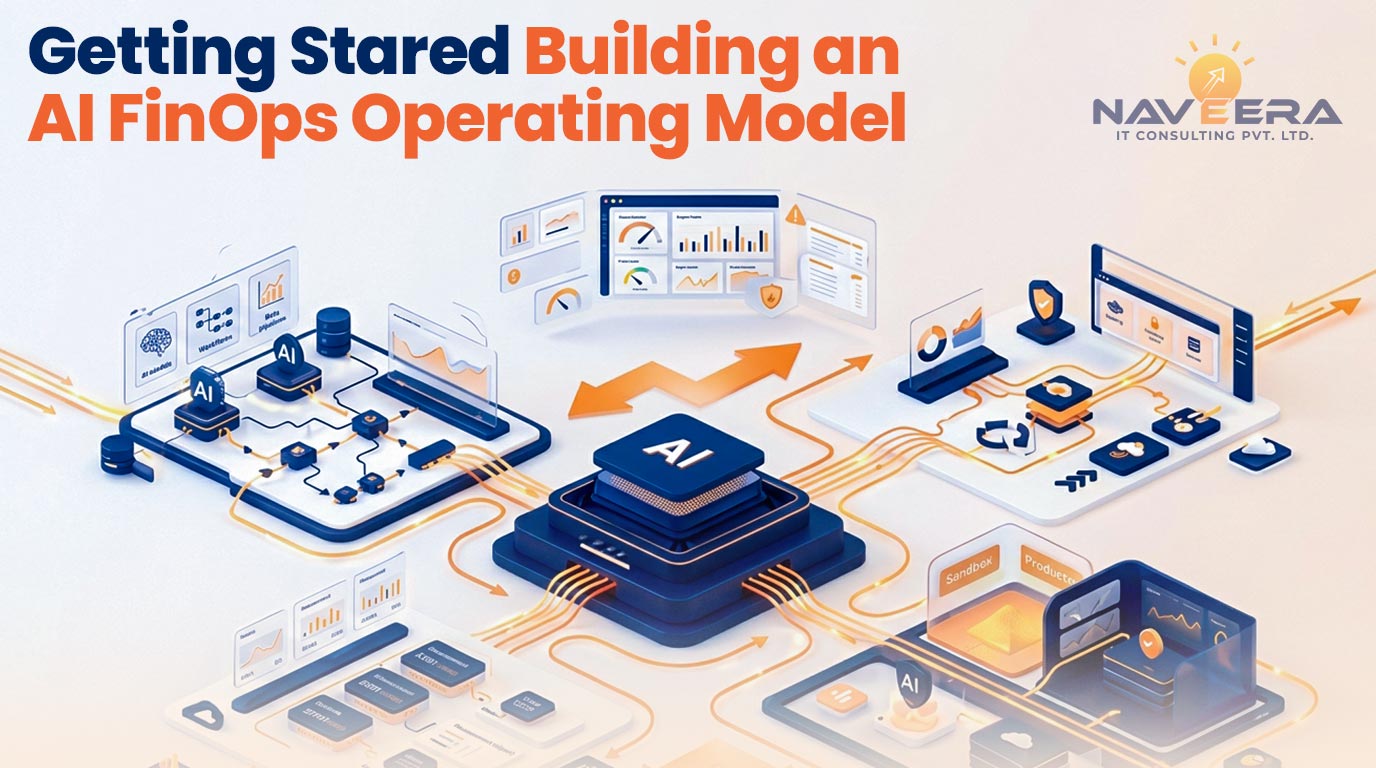
Getting Started – Building an AI FinOps Operating Model:
The good news is you do not need to build a system on day one. You need an operating model that you can stand up incrementally and improve as your AI usage matures.
Step 1 – Instrument Usage, Cost and Attribution at the Model and Workflow Layers:
Before you can manage AI costs you need to see them. This means instrumenting every model call with cost, token usage, latency and enough metadata to trace it back to the workflow or product that triggered it.
Step 2 – Define the Right Unit Metrics for Each Use Case:
Not every AI use case should be measured with the unit metric. Taking the time to define the metric for each use case makes your cost data useful for product and business decisions.
Step 3 – Separate Experiment Spend from Production Spend:
Keeping experiment and prototype spend separate from production spend makes it easier to understand your production cost trajectory.
Step 4 – Add Budgeting, Alerting and Executive Reporting:
Once you have cost data and defined unit metrics you are ready to build the financial control layer. This includes team-level budgets, real-time spend alerts and executive reporting.
Step 5 – Optimize with Caching, Routing and Policy Controls Before Scale:
The time to implement optimization levers is before your AI usage scales. Baking these practices into your AI development workflow means every new feature or agent starts from a cost-efficient baseline.
What a 90-Day AI FinOps Assessment Looks Like:
A 90-day AI FinOps assessment moves through three phases. The first 30 days focus on instrumentation. Baselining your current cost and usage data. The middle 30 days focus on defining unit metrics and identifying the cost drivers. The final 30 days focus on implementing quick-win optimizations.
FAQ
Q1: What is cost-per-token in AI FinOps?
Cost-per-token measures how much you are paying your model provider for each unit of text your AI processes or generates.
Q2: Why is cost-per-token not enough for AI agents?
Cost-per-token tells you the price of each piece. It cannot tell you what a complete agent workflow actually costs end-to-end.
Q3: How should enterprises define cost-per-agent or cost-per-decision?
Cost-per-agent is defined as the fully-loaded cost of a complete agent session or workflow. Cost-per-decision maps that workflow cost to a business outcome.
Q4: What are the ways to reduce AI cost without hurting quality?
The three highest-impact levers, for reducing AI cost without touching output quality are prompt caching, intelligent model routing and token discipline.
Q5: How should finance and engineering teams work together on AI unit economics?
The effective AI FinOps practices happen when engineering owns the instrumentation and observability layer while finance owns the budgeting and chargeback layer.