

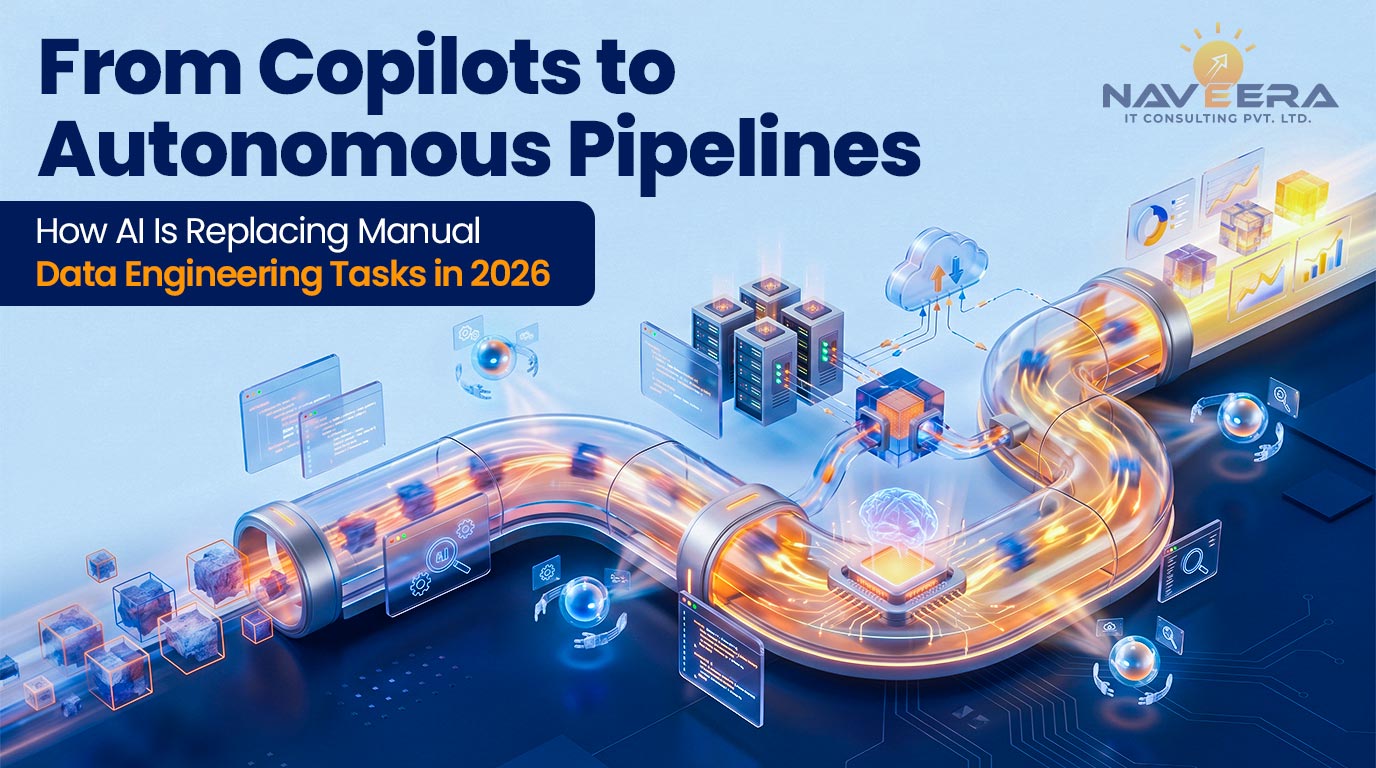
Manual data engineering is changing in 2026. Teams previously spent hours on SQL, debugging, fixing schemas, documenting, and monitoring quality. Now, copilots, agents, and autonomous tools accelerate, recommend, validate, and automate these tasks.
This does not make data engineers less important. Their focus is shifting toward architecture, supervision, governance, and production reliability. The critical question is whether AI can automate manual tasks without creating fragile pipelines, unchecked changes, data exposure, rising costs, or loss of control.
The market is already moving in this direction. By 2026, companies will be checking if their AI is working well, not by how many teams use AI helpers, but by how safely these helpers are used in everyday work.
In data engineering, AI is now doing more than helping write simple SQL code or fixing errors.
AI is starting to help create pipelines, map data structures, fix problems, write documentation, create tests, and support workflow management. All of which require rules for tracking data, controlling access, checking data quality, and managing how AI operates at runtime. The focus is on embedding AI tools into daily workflows, which requires careful planning and controls. AI is becoming part of data engineering, and companies need to ensure it’s used responsibly.
Microsoft Fabric Copilot can generate Data Factory pipelines from natural language, explain errors, and summarize pipeline activity; Google Cloud’s Gemini assistance can generate SQL and Dataform code; dbt’s Developer agent can write, refactor, test, document, and explore dbt projects from natural language while grounding work in lineage, metadata, governance, and the Semantic Layer.
That is why the phrase “AI replacing manual data engineering tasks” should not be read as a simple labor-replacement story. In companies, this means moving from doing things by hand to using automated systems, from using separate scripts to building with metadata, and from fixing problems as they happen to using AI to help manage pipeline operations in a more controlled way. The goal is to make things more efficient and reliable. Automation and AI can help achieve that.
For companies updating their data systems, this is a turning point. The ones that succeed will not be those that automate the most. They will be teams that automate tasks correctly, hold engineers accountable, and implement a management system before independent systems go live.
The Shift Is Real — Data Engineering Is Moving From Manual Authoring to AI-Assisted Execution
Data engineering involves many tasks. These include writing code to retrieve data, mapping data structures, creating data changes, setting up connectors, checking failed jobs, updating tests, documenting data fields, and adjusting data pipelines when other systems change. These tasks are important. However, many of them focus on following rules and understanding context rather than on creativity. They are essential for data engineering.
AI copilots and agents are taking over some of the tasks. They are getting involved in the side of things. These AI tools are helping with the workload. AI copilots and agents are handling an increasing number of tasks. Tools are not only suggesting code snippets; they also interpret pipeline intent, generate workflow logic, propose fixes, summarize runtime failures, and assist with orchestration decisions.
Why copilots were only the first stage of AI in data engineering
Copilots introduced the first useful layer: fast assistance inside the developer workflow. They helped engineers write SQL, Python, PySpark, dbt models, Terraform snippets, orchestration logic, and documentation faster. But copilots were mostly reactive. The person still had to figure out what questions to ask. They had to know where to put the results. They also had to test it. They had to make sure it fit with everything else.
That stage mattered because it normalized AI-assisted pipeline development. But copilots are not the endpoint. The next stage is the Data Engineering Agent: a system that understands project context, metadata, lineage, schemas, dependencies, tests, policies, and deployment workflows well enough to participate in the data engineering lifecycle.
How pipeline generation, debugging, and modification are becoming natural-language tasks
Natural-language pipeline generation is becoming practical for common patterns: “ingest Salesforce account data into the lakehouse,” “create a daily incremental model for customer churn features,” or “summarize why this pipeline failed after the schema update.” Microsoft’s Copilot in Fabric Data Factory explicitly supports natural-language pipeline generation, error explanation, troubleshooting guidance, and pipeline summarization.
This does not mean every complex architecture can be safely generated from a prompt. It means teams can increasingly convert routine intent into draft pipeline logic, then apply validation, review, and deployment controls.
Why the new question is not “Can AI write pipeline code?” but “Which pipeline tasks should still remain human-controlled?”
AI can already write pipeline code. The harder question is whether the generated logic is appropriate for production. Does it respect data contracts? Does it preserve lineage? Does it handle null values, duplicates arriving events, retries, and partial failures correctly? Does it expose regulated data? Does it change cost behavior?
Enterprise teams should classify tasks by risk. Low-risk scaffolding and documentation can be AI-assisted quickly. Production logic changes, access modifications, identity configuration, and downstream metric definitions should remain controlled by human approvals.
Why 2026 is about governed automation, not engineer replacement
The strongest 2026 pattern is not autonomous replacement. It is governed by automation. Enterprises want delivery to happen quickly. They also need to ensure everything is properly tracked. This includes things like
- Auditability
- Enforcing policies during runtime
- Controlling identities
- Data loss prevention
- Being able to trace everything
- Knowing who is responsible for operations
They need all these things to work together smoothly.
Gartner’s 2026 strategic technology guide says AI security platforms are important. These platforms help us see everything in one place. They make sure people follow the rules when using AI. They also protect against risks like hackers tricking AI into leaking data, and AI doing things it shouldn’t.
Gartner thinks that more than half of companies will use AI security platforms by 2028. When it comes to data engineering, we need to make sure AI can work on its own while still following the rules. This means AI autonomy should be part of the controls, not separate from them.
What AI Is Actually Replacing in the Data Engineering Lifecycle
AI is not replacing the entire lifecycle. It replaces the work that teams do over and over. The best organizations will find out where people perform tasks repeatedly. They will then choose which tasks can be automated, semi-automated, or fully automated. Automation helps teams by automating tasks they do manually. This way, teams can focus on important work. Repetitive tasks will be closely reviewed.
Automation will assist in semi-automating or fully automating these tasks. Teams will then work efficiently.
Manual pipeline scaffolding, connector setup, and transformation boilerplate
A large share of pipeline creation follows repeatable patterns: source connector configuration, landing-zone structure, staging models, data type normalization, timestamp handling, deduplication, and basic transformations. AI can generate much of this boilerplate from source metadata, sample schemas, naming conventions, and platform standards.
This is really helpful for automating data engineering in companies. Teams usually have different ways to get data from systems such as CRM, ERP,, and product analytics. They also have data from finance, marketing, and operational systems. So having a way to handle all these different data sources is super valuable. It makes it easier to manage dozens or even hundreds of ingestion patterns.
Repetitive debugging, error summarization, and root-cause investigation
Pipeline failures often require engineers to inspect logs, compare recent commits, check upstream schema changes, review orchestration history, and validate dependency timing. AI pipeline troubleshooting and orchestration tools can summarize failure patterns, identify likely root causes, and recommend next actions.
The value is not that AI magically fixes every broken pipeline. The value is reducing time-to-triage. A well-designed assistant can say: “This job failed after the upstream column type changed from integer to string,” or “The downstream dependency started before the source refresh completed.”
Documentation, test generation, and metadata-aware refactoring
Documentation and tests are often underfunded because teams prioritize delivery. AI can generate column descriptions, model summaries, freshness tests, uniqueness checks, accepted-value tests, schema tests, and transformation explanations.
dbt’s Developer agent is a strong example of this direction, positioning itself as an agentic evolution of Copilot that can build, refactor, test, document, and explore dbt projects from natural language while grounding changes in project lineage, metadata, governance, and the Semantic Layer.
Routine pipeline modifications, schema adaptation, and pipeline maintenance
Upstream systems change constantly. Fields are renamed, APIs introduce new structures, event payloads evolve, and business teams request new attributes. AI can help detect schema drift, propose transformation updates, regenerate impacted tests, and explain downstream effects.
This is where metadata-aware development becomes critical. Without lineage and dependency context, AI-generated changes can look correct locally while breaking downstream reporting, ML features, or regulatory extracts.
Why high-leverage engineering judgment still stays with humans
Humans still own architecture, trade-offs, risk decisions, domain semantics, data modeling, access policy, operational accountability, and production readiness. AI can propose a transformation. It cannot fully understand whether revenue recognition logic, customer identity resolution, claims processing, or clinical data handling is correct without human domain governance.
The engineer’s role moves upward: less typing, more design, validation, control, and accountability.
The New Operating Model — From Copilot to Agent to Autonomous Pipeline Task
The operating model is changing in three stages: copilots assist, agents participate, and autonomous tasks execute within policy boundaries.
Copilots as assistive layers for authoring and troubleshooting
Copilots are best understood as assistive layers. They help engineers write, investigate, and document faster. They do not own the workflow. They reduce manual friction inside existing engineering processes.
For many enterprises, this is the right starting point because it improves productivity without immediately changing deployment authority.
Agents as workflow participants that can build, modify, and validate pipeline logic
Agents go further. A Data Engineering Agent can inspect a project, understand lineage, generate a change, run tests, summarize impact, and prepare a pull request. It becomes a workflow participant rather than a passive suggestion engine.
This is where data engineering agent automation begins to matter commercially. The benefit is not just faster code generation. It is a faster movement from requirement to validated change.
Autonomous tasks vs autonomous systems — what should and should not be delegated
An autonomous task is bounded: regenerate documentation, propose tests, retry a failed job under a defined policy, or open a ticket with diagnostic context. An autonomous system has broader authority: changing production logic, modifying schedules, granting access, or altering orchestration dependencies.
Enterprises should delegate autonomous tasks before autonomous systems. The difference is material. One improves throughput. The other can introduce systemic risk if poorly governed.
Why bounded autonomy matters more than aggressive automation claims
Bounded autonomy defines what the agent can do, where it can do it, under what conditions, with which data, and with what approval. It also defines what the agent cannot do.
This matters because AI systems can behave unpredictably when given broad authority. OWASP’s LLM guidance highlights prompt injection and sensitive information disclosure as major risk categories for LLM applications. In data engineering, this risk becomes more serious when agents can access logs, schemas, source credentials, customer fields, or production workflows.
The maturity path from assisted development to governed execution
The practical maturity path is clear. We should start with AI-assisted authoring. Then we expand into troubleshooting. After that, we add test generation. We also need documentation and lineage-aware refactoring. Additionally, we should include controlled change proposals. Finally, we can add execution.
Naveera Technology usually suggests doing things in steps. This is because it helps us see that we are actually getting more work done. We also do not make the mistake of automating before we have rules in place to govern the Naveera Technology automated systems we implement.
Where Enterprise Value Shows Up First
Enterprise value appears first where work is frequent, standardized, and measurable. The best use cases are not the most ambitious. They are the ones that remove recurring friction from high-volume data engineering workflows.
Faster pipeline creation for common ingestion and transformation patterns
Common ingestion patterns are ideal starting points. If a team often builds pipelines for software-as-a-service systems, databases, application programming interfaces, flat files, or event streams, AI-assisted scaffolding can save them a lot of work.
This is particularly helpful in lakehouse, warehouse, and modern data stack environments where teams want to use the patterns for batch and streaming data. Databricks Lakeflow Spark Declarative Pipelines is an example of a framework for creating batch and streaming pipelines in SQL and Python. It shows the move towards declarative, managed pipeline development, which is useful for teams that regularly build pipelines. Teams can use AI-assisted scaffolding to create pipelines. This helps them work efficiently.
Lower time-to-resolution for failures and broken dependencies
Pipeline failures are expensive because they delay reporting, analytics, ML features, finance close processes, customer operations, and executive dashboards. AI helps speed up the diagnostic process by summarizing logs, identifying what went wrong, linking it to changes,, and identifying dependency problems.
This has benefits:
- There are fewer late-night emergency calls
- Problems get solved quicker
- Senior engineers have time for important things because of less operational hassle.
More consistent tests, documentation, and operational hygiene
AI is particularly strong at creating first drafts of tests and documentation. That may sound basic, but operational hygiene is a major lever for production readiness.
A pipeline with clear lineage, tests, ownership, field definitions, freshness checks, and alerting is easier to operate. AI can help make that discipline repeatable instead of dependent on individual engineer habits.
Reduced engineering toil across repetitive analytics engineering work
Analytics engineering often involves repeated model updates, metric documentation, semantic-layer alignment, test creation, and stakeholder-driven changes. AI-assisted analytics engineering can reduce this toil while preserving review workflows.
The key is to avoid allowing AI to redefine business metrics without governance. A model can generate SQL. It cannot independently decide what “active customer,” “net revenue retention,” or “qualified lead” should mean across the enterprise.
Why the best initial use cases are narrow, measurable, and operationally frequent
Narrow use cases are easier to control. They also produce better evidence. A team can measure how fast they deliver work, how many mistakes they make, and how well they test their work.
They can also check if their documentation is complete.
Other things they can measure are:
- How long it takes to fix problems
- How happy engineers are, with their work
These metrics help teams improve.
They can track:
- Cycle time
- Defect rate
- Test coverage
- Documentation completeness
- Mean time to resolution
- Engineer satisfaction
All these help teams work better.
This is how enterprise data engineering automation should be justified: not through vague AI transformation language, but through operational metrics.
The Architecture Requirements Behind Autonomous Pipeline Work
Autonomous pipeline work requires more than an LLM. It requires architecture. Without metadata, orchestration, observability, controls, and governance, AI-generated pipeline work becomes another layer of technical debt.
Metadata, lineage, and project context as prerequisites for useful automation
AI needs context to be useful. It must understand source schemas, downstream dependencies, ownership, data classifications, business rules, quality expectations, and access policies.
Google Cloud’s Dataform emphasizes workflow management, dependencies, orchestration, and lineage tracking through integrations, reflecting the foundation needed before teams can trust automation for data workflows.
Orchestration, validation, and rollback controls around AI-generated changes
AI-generated changes must go through the checks as human-generated changes. This means they have to pass through:
- CI/CD
- Automated tests
- Data quality checks
- Environment promotion
- Deployment windows
- Rollback logic
- Approval gates
These controls ensure AI-generated changes are reliable and secure.
In production pipeline operations, rollback is mandatory. If an AI-generated transformation changes downstream metrics incorrectly, the enterprise must be able to identify, reverse, and explain the change.
Observability, alerts, and runtime feedback loops
Autonomous data pipelines need runtime visibility. Observability should include job status, freshness, volume anomalies, schema drift, cost changes, retry behavior, dependency delays, and SLA impact.
Runtime feedback loops also improve the quality of automated systems. If the AI assistant recommends a fix and the fix works, that pattern becomes operational knowledge. If it fails, the system should capture that outcome too.
Human approvals for risky, high-impact, or production-facing changes
Human-in-the-loop approvals remain essential for high-impact changes. Examples include production transformations, customer-facing metrics, regulated data movement, access control changes, deletion logic, financial reporting pipelines, and ML feature pipelines.
When a pipeline is critical to a business, the approval process should be very clear. The pipeline needs to have an approval process. This is especially true for a business pipeline; the approval model should be easy to understand.
Why platform governance matters more as pipeline autonomy increases
As autonomy expands, governance becomes the control plane. AI app discovery, sanctioned vs unsanctioned tool classification, DLP, identity governance, audit trails, runtime policy enforcement, and AI-SPM become part of the data engineering platform conversation.
IBM’s 2025 Cost of a Data Breach research warns that AI adoption is outpacing governance, and the study found that 63% of breached organizations lacked AI governance policies. For data leaders, that is a clear signal: AI productivity without governance is not modernization. It is an unmanaged risk.
The Real Risks — Automation Debt, Bad Refactors, and Invisible Failure Modes
AI can reduce manual work, but it can also create a new class of automation debt. Poorly governed AI-generated pipelines may run successfully while producing inaccurate, incomplete, insecure, or expensive outcomes.
Why code generation without context can create brittle pipelines
A pipeline can be syntactically correct and architecturally wrong. AI-generated logic may miss partitioning strategy, incremental load behavior, late-arriving data, null handling, deduplication rules, or downstream semantic dependencies.
This is why context-aware generation matters more than raw code generation.
The danger of letting agents change production logic without controls
Agents should not directly modify production logic without approvals, tests, traceability, and rollback controls. A small transformation can affect dashboards, regulatory extracts, AI models, financial reports, and executive decisions.
The risk is not just broken code. It is an invisible business misinterpretation.
Cost sprawl from repeated retries, excessive runs, and over-automation
Autonomous retry handling can be useful, but uncontrolled retries can increase compute costs. AI-generated pipelines may also introduce inefficient joins, unnecessary transformations, excessive materializations, or poorly optimized schedules.
AI FinOps should become part of enterprise data engineering automation. Every autonomous action should have cost visibility.
Why AI-generated pipelines still need testing, review, and operational ownership
AI-generated pipelines need to be reviewed because we cannot just leave everything to a model. Teams still need people in charge of how to handle problems, rules for how things get done, instructions for how to handle things, tests to make sure everything works, and plans for what to do when something goes wrong. Generated pipelines require all these things to function properly.
A serious enterprise environment treats AI output as a draft until validated.
The difference between reducing manual work and surrendering engineering discipline
Reducing manual work is good engineering. Surrendering discipline is not. The goal is to remove low-value toil while strengthening architecture, reliability, security, and governance.
Naveera Technology’s approach is to pair automation with engineering controls: lineage, observability, access governance, DLP-aware workflows, test automation, deployment discipline, and measurable operational outcomes.
The 2026 Pattern — AI as a Force Multiplier for Data Engineers, Not a Replacement Strategy
The future of data engineering is not fewer engineers doing less thinking. It is stronger engineers operating with better tools, better automation, and better control systems.
Why the future role of the data engineer shifts toward system design and control
Data engineers will not have to write things over and over. They will have time to design systems that actually work. The focus of data engineers will shift to things like architecture, quality and governance, orchestration, domain modeling, platform standards, and operational control of data systems. Data engineers will be doing more of this kind of work.
This is a higher-leverage role, not a diminished one.
How governed AI changes the distribution of manual vs automated work
Governed AI changes the workload mix. Manual work decreases in scaffolding, documentation, basic tests, error summaries, and routine modifications. Human attention increases around architecture, approvals, security, data contracts, production impact, and business semantics.
That is the right trade.
Why enterprise teams should optimize for throughput, quality, and control together
Speed alone is not enough. Quality alone is not enough. Control alone is not enough. Enterprise teams need all three.
The best AI data engineering programs measure throughput, defect rates, test coverage, incident volume, cost behavior, and compliance evidence together.
When to keep humans in the loop and when to automate fully
We should use machines to handle tasks that are not very important and can be repeated. These tasks should also be easy to fix if something goes wrong.
For changes that can have significant effects, cannot be fixed, are unclear, involve rules, or affect the work we do every day, we should have people make the decisions.
This distinction should be documented as policy, not handled informally by each team.
What “autonomous pipelines” should mean in a serious enterprise environment
In a serious enterprise environment, autonomous data pipelines do not mean uncontrolled self-changing systems. They mean bounded automation around pipeline authoring, testing, monitoring, troubleshooting, retry handling, validation, and change proposals.
Autonomy should be observable, auditable, reversible, and governed.
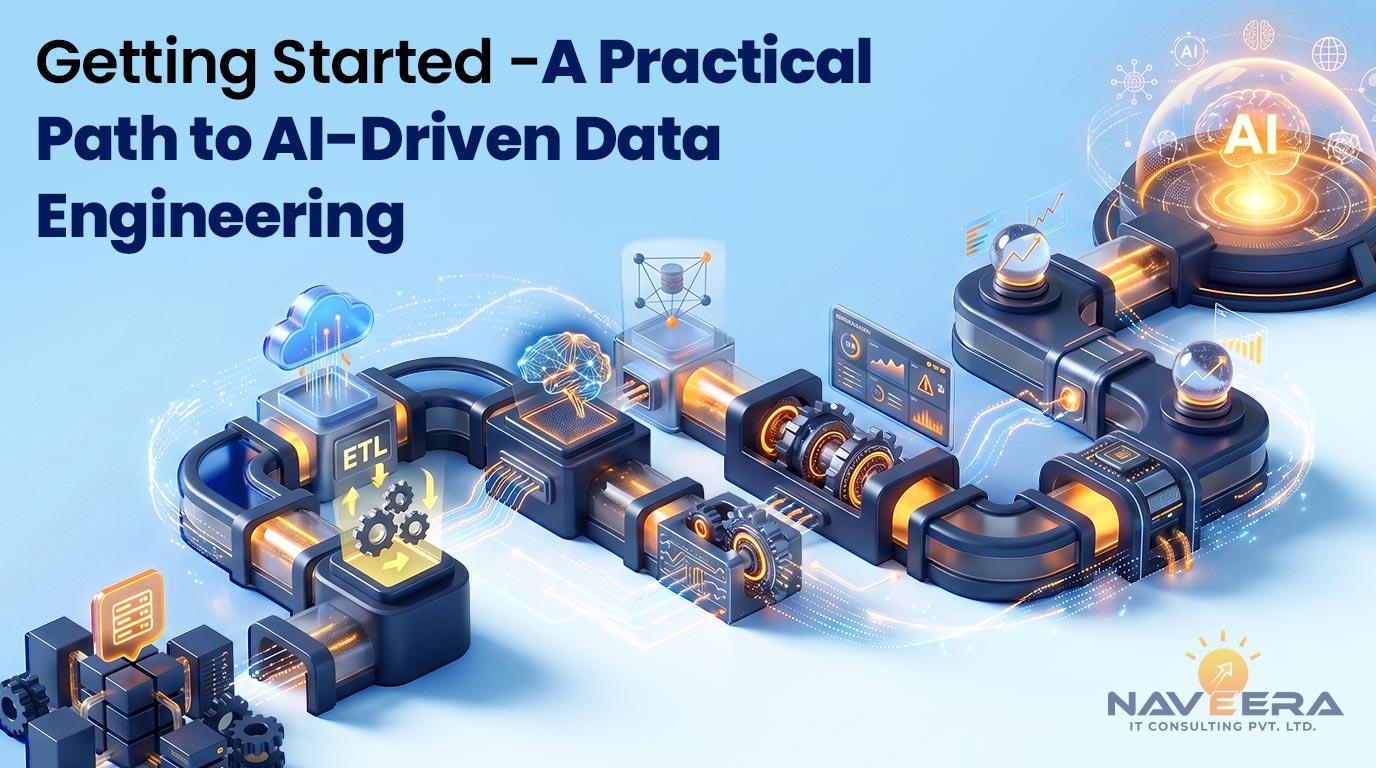
Getting Started — A Practical Path to AI-Driven Data Engineering
Enterprises do not need to transform every pipeline at once. They need a disciplined path that starts with measurable use cases and builds toward governed execution.
Step 1 — Identify tasks in your pipeline that take up a lot of time.
Start by figuring out where engineers waste time.
These tasks include:
- Setting up connectors
- Creating scaffolding for data ingestion
- Updating schemas
- Dealing with recurring failures
- Filling documentation gaps
- Creating tests
- Handling requests from stakeholders.
Focus on tasks that occur frequently, pose no risk, and are easy to track.
Step 2 — Start with assisted authoring and troubleshooting before autonomous changes
Begin with copilots and assistants who generate drafts, summarize errors, and propose fixes. Do not immediately give agents production authority.
This allows teams to build confidence while measuring productivity and quality.
Step 3 — Add lineage, tests, observability, and approvals before scale
Before we expand the Artificial Intelligence-assisted pipeline development, we need to strengthen the platform foundation. We have to add an important thing to the platform. These things are
- Lineage
- Data quality checks
- Deployment gates
- Audit trails
- Role-based access
- Data Loss Prevention controls
- Runtime monitoring.
An artificial intelligence-assisted pipeline development needs a solid foundation to work properly.
Sanctioned AI apps still need governance. A tool approved by IT can still leak sensitive data or produce unsafe changes if controls are weak.
Step 4 — Pilot one bounded workflow with clear success criteria
Choose one workflow. For example, you can pick automated documentation generation.
You can also consider AI-assisted failure triage, dbt test generation or ingestion pipeline scaffolding.
Define what success looks like before you start the pilot.
Think about cycle time.
What defect rate are you aiming for?
How much review effort do you want to save?
Do you want to reduce incidents?
What kind of cost impact are you expecting?
How much do you want engineers to adopt this workflow?
Step 5 — Expand only where automation improves both speed and reliability
Scale when automation makes things better. It should improve delivery speed and reliability. If AI speeds up output but causes problems, extra work, higher costs, or control issues, the program is not ready to grow.
Good automation makes the platform work smoothly. It should not make things more confusing.
What a 90-day AI data engineering modernization assessment looks like
A 90-day assessment plan should check how data engineering works today.
It should find workflows that take a lot of time and effort. The assessment must also look at governance. See where it is lacking. Additionally, it should evaluate how AI tools are being used. It needs to map data lineage and assess observability. The goal is to create a plan to automate things step by step. The plan should fix data engineering.
The data engineering lifecycle is very important. The assessment should improve the data engineering lifecycle.
For a company like Naveera Technology, this kind of work can include getting Naveera Technology ready for AI data engineering, taking a look at how Naveera Technology can use autonomous pipeline architecture, evaluating the AI infrastructure that Naveera Technology has, designing governance for Naveera Technology, and making a plan for what Naveera Technology should do first. The goal is not to “add AI” to the data stack. The goal is to make modern data engineering in 2026 faster, safer, and more production-ready.
AI replacing manual data engineering tasks is not a future theory. Things are already changing across pipeline authoring and other areas, such as troubleshooting, documentation, testing, refactoring, and maintenance. The big question is whether companies will take control of this change through pipeline authoring and other areas, or just let it happen on its own, with groups using AI in their own way without a plan.
The right path is governed by automation: sanctioned tools, controlled agents, strong identity, DLP-aware workflows, runtime governance, traceability, observability, and human approvals where risk demands them. Done well, AI becomes a force multiplier for data engineering teams. Done poorly, it becomes another source of invisible failure.
FAQ
Q1: Is AI really replacing manual data engineering tasks in 2026?
Yes. AI is taking over tasks that people do over and over. This includes things like setting up scaffolding for projects, helping with debugging, creating documentation, generating tests, and doing maintenance. Artificial intelligence is doing these tasks, so people do not have to. It is not replacing engineering judgment, architecture, governance, or production ownership.
Q2: What parts of the data engineering lifecycle can AI automate today?
AI can help with generating pipelines. It can also assist with SQL and transformation logic.
* Error summarization
* Schema mapping are areas where AI can help.
Additionally, AI can help with
* Documentation
* Tests
* Refactoring and troubleshooting.
Q3: What is the difference between a copilot and an autonomous data engineering agent?
A copilot assists the engineer. An agent can participate in workflows by generating, validating, documenting, and preparing changes with more project context and task continuity
Q4: What controls are needed before AI can modify production pipelines?
Enterprises need to track their data lineage. They also require testing, continuous integration, and delivery.
* Approval workflows are a must.
* Data loss prevention is important.
* They need identity controls for security.
* Observability helps them monitor their systems.
* Rollback procedures are necessary for errors.
* Audit trails help with compliance.
* Runtime policy enforcement is also needed.
Enterprises need all these to manage their data and systems effectively.
Q5: How should enterprises adopt AI in data engineering without increasing risk?
Start with workflows that are not too risky.
* Measure the results of these workflows.
* Add rules to make sure everything is done correctly.
Then only expand to areas if automation makes things:
* Faster
* More reliable
* Under better control
Workflows, with automation, should improve speed, reliability, and control together.