
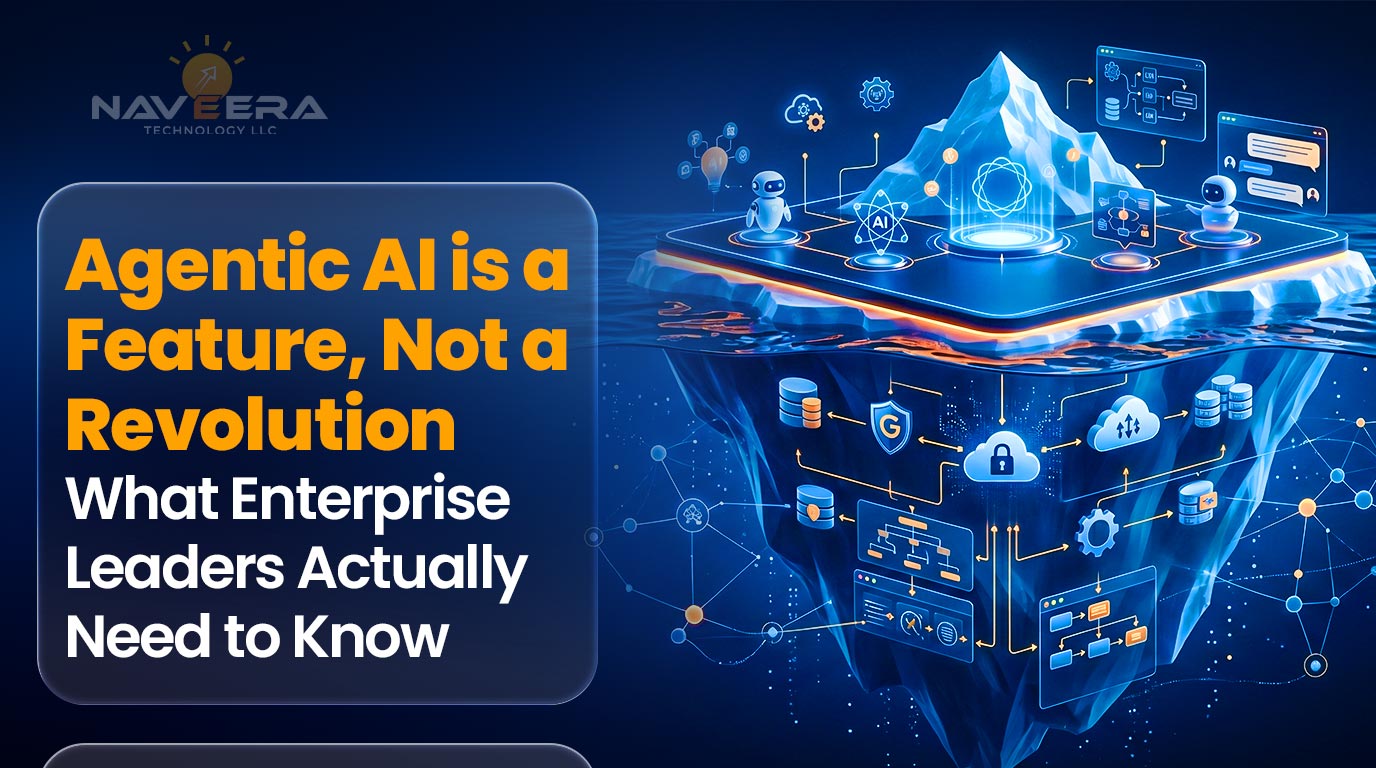
Shadow AI has already moved from a harmless productivity shortcut to a serious concern for security, governance, and operational accountability. Employees are using AI tools in browsers, SaaS platforms, plug-ins, IDEs, spreadsheets, help desk systems, and document workflows—often before security, legal, compliance, or architecture teams have defined what “approved AI usage” actually means. Now, agentic AI adds another layer: systems that do not simply generate answers, but call tools, retrieve context, delegate tasks, trigger workflows, and sometimes take action.
That is why agentic AI for enterprise needs a more grounded conversation. The real enterprise question is not whether agents are exciting. They are. The question is whether they can be designed as reliable, governed, cost-controlled workflow components inside real business systems.
McKinsey’s 2025 State of AI survey found that 23% of respondents said their organizations were scaling an agentic AI system somewhere in the enterprise, while another 39% were experimenting with AI agents. That means agentic AI is no longer theoretical—but it is also not universally production-ready. Microsoft’s 2025 Work Trend Index similarly reported that 81% of leaders expected agents to be moderately or extensively integrated into their company’s AI strategy within 12 to 18 months.
The market signal is clear: AI agents are entering enterprise roadmaps. The risk is equally clear: many organizations are treating agentic AI as a strategy before treating it as architecture.
Why Agentic AI Is Being Overframed — And Why That Creates Bad Enterprise Decisions
Agentic AI is being framed as if every enterprise process is about to become autonomous. That overstatement creates poor investment decisions, weak governance models, inflated expectations, and fragile implementations.
For enterprise leaders, the better framing is this: agentic AI is a capability pattern. It can be powerful when applied to the right workflow, with the right controls, context, and operating model. It becomes risky when it is treated as a universal replacement for deterministic systems, business rules, process automation, and human judgment.
The difference between an important capability shift and a business-model revolution
Agentic AI represents an important shift in capabilities because it changes how software can interact with tools, data, and workflows. Traditional automation follows predefined logic. Generative AI produces content or analysis. Agentic systems can combine reasoning, retrieval, planning, tool calling, function calling, and execution steps.
That does not automatically make it a business model revolution.
Most companies do not require agents who can work independently across systems. They need agents with limited autonomy for business tasks. These tasks include sorting tickets, summarizing insurance claims, drafting responses, resolving cases, verifying that policies are being followed, and updating information or alerting about potential risks. The benefit of using agents comes from managing and controlling how they work, not just letting them work freely on their own.
A good AI plan for businesses should consider this:
* Which tasks in a process can AI help with planning or doing?
* Which tasks still need rules, approval steps or people to oversee them?
An AI strategy that works well for a company needs to get this right. It should use AI where it helps and people or rules where they are needed. This way, AI helps make things better, not more complicated.
Why agent hype often outruns production reality
Agent demos are easy to admire because they compress complex interactions into a smooth experience. A user gives a goal, the agent reasons, calls tools, retrieves data, and completes a task. But production environments are not demos.
In production, the agent needs permission controls, identity-aware access, data classification, prompt injection resistance, retry ceilings, cost guardrails, retrieval quality checks, observability, tracing, audit logs, escalation policies, and failure handling. It also needs a clear owner when something goes wrong.
Reuters reported Gartner’s view that more than 40% of agentic AI projects may be scrapped by the end of 2027 due to rising costs, unclear business value, and immature implementations. The same report noted Gartner’s warning about “agent washing,” in which conventional AI tools are marketed as agentic without meaningful autonomous capability.
That is the production reality gap: many organizations can build an impressive agent prototype. Far fewer can operate one safely, repeatedly, and economically.
What enterprise leaders misunderstand when they treat agents as strategy instead of architecture
An agent is not a strategy. It is an architectural component.
The strategic objective may be faster claims processing, lower support cost, better engineering productivity, more resilient operations, improved customer experience, or reduced manual reconciliation. Agentic AI is only one possible implementation pattern.
When leaders treat agents as the strategy, they often skip the hard questions:
- Who owns the workflow outcome?
- What systems can the agent access?
- What data can it retrieve?
- What actions can it take without approval?
- How are failures detected?
- How are costs capped?
- How are prompts, decisions, tool calls, and outputs traced?
- How is sensitive data protected from leakage?
These are not secondary questions. They are the architecture.
This is where companies like Naveera Technology often help enterprise teams move from AI enthusiasm to production-ready agentic AI: defining the workflow architecture, access model, governance controls, observability requirements, and operating accountability before the build becomes expensive technical debt.
Why the real question is not “Should we adopt agentic AI?” but “Where does bounded autonomy create measurable value?”
The better question is not whether to adopt agentic AI. Most enterprises will adopt some form of agentic capability through SaaS platforms, internal copilots, development tools, service desk platforms, analytics systems, and AI-enabled business applications.
The real question is: where does bounded autonomy create measurable value without increasing operational risk?
Bounded autonomy means the agent has a defined scope, approved tools, restricted permissions, known data sources, clear escalation paths, and measurable outcomes. It does not mean the system is weak. It means the system is enterprise-ready.
This distinction matters because the strongest enterprise AI agents’ practical use cases are rarely broad and open-ended. They are narrow, repeatable, observable, and tied to business metrics.
What Agentic AI Actually Is — And What It Is Not
Agentic AI is not magic. It is not a digital employee in the legal or operational sense. It is not a replacement for process design. It is not automatically superior to workflow automation.
When we talk about AI in a real world setting agentic AI is about AI systems that can understand what we want them to do figure out what steps they need to take to get it done use the things they have available to them look at the situation they are, in make some basic choices and then do what they need to do within the rules we set for the agentic AI.
Agents, workflows, and automations — clarifying the operating model
The distinction between agentic AI and AI automation is important.
Automation does things in an order. If something happens, then something else happens. This way of doing things is easy to follow and understand when everything is working smoothly.
A workflow system manages tasks that involve people, computer programs, approvals, and business rules. Sometimes it uses automation. Most of the time, it is based on a set of processes that people have to follow.
An AI agent adds reasoning, language understanding, context interpretation, and tool use. It can decide which tool to call, which information to retrieve, which next step to attempt, or when to escalate.
The practical operating model is not “automation versus agents.” The better model is layered:
deterministic automation for stable logic,
workflow orchestration for process control,
AI assistance for interpretation and drafting,
agentic features for bounded tool-enabled tasks,
human oversight for judgment, accountability, and exceptions.
Where tool use, planning, and delegation start to matter
Agentic AI becomes meaningful when the system can do more than answer a question.
For example, a support assistant who summarizes a ticket is useful. But an agentic support workflow may classify the issue, retrieve the customer’s contract terms, check entitlement, search known incidents, draft a response, recommend a resolution path, and create an escalation if the risk score is high.
That requires tools, functions, and data retrieval, planning, and delegation. It also requires identity controls, data access boundaries, policy enforcement, and traceability.
The moment an AI system can touch systems of record, open tickets, update CRM fields, query financial data, create code changes, or send customer communications, it becomes a governance issue—not just an AI feature.
Why many enterprise use cases are better served by workflow systems than high-autonomy agents
Many enterprise workflows do not need high autonomy. They need better orchestration, cleaner data, faster retrieval, and less manual coordination.
A procurement approval process may not need an autonomous agent. It may require deterministic routing, policy checks, document extraction, anomaly detection, and a human-approval interface.
A finance close workflow may not require an agent to decide what to do next. It may need reconciliation logic, exception clustering, automated evidence collection, and analyst review.
A compliance review process may benefit from AI summarization and risk flagging, but final interpretation may need human judgment.
This is why agentic workflows vs autonomous agents is a critical distinction. A workflow can include agentic features without becoming fully autonomous.
The difference between embedded product features and enterprise operating transformations
Many agentic capabilities will be embedded in enterprise software agents within platforms that companies already use: CRM, ERP, ITSM, DevOps, cybersecurity, analytics, collaboration, and cloud management tools.
That does not mean the enterprise has transformed its operating model.
An embedded agent that drafts a sales email is a feature. An agentic operating model that coordinates sales operations, legal review, data enrichment, pricing checks, and customer risk scoring is a much larger transformation.
Enterprise leaders should separate product-level convenience from operating-model change. Both can be useful. They require different governance, architecture, and investment discipline.
Where Agentic AI Creates Real Enterprise Value
Agentic AI is helpful when it makes employees’ work easier. It does this by reducing the hassle in work processes where staff already spend a lot of time understanding data, moving between systems, following rules, creating outputs, and dealing with exceptions.
The business benefits are greatest when the AI agent speeds up work, improves accuracy, increases productivity, ensures consistency, or improves how well the company follows regulations.
Task-specific agents inside support, operations, finance, and engineering workflows
The best early enterprise use cases are task-specific agents.
In support, an agent can classify incoming requests, retrieve account context, summarize history, recommend next actions, and prepare responses for review.
In operations, an agent can monitor incidents, correlate signals, open tickets, recommend runbooks, and escalate based on severity.
In finance, an agent can support invoice matching, variance explanation, policy checks, and exception documentation.
In engineering, an agent can assist with code review, test generation, incident summaries, documentation updates, and pull request analysis.
In security, agentic workflows can support alert enrichment, investigation summaries, evidence collection, and response recommendations—but autonomous remediation should be carefully bounded.
These are practical use cases because they are measurable. They also have clear inputs, outputs, systems, owners, and escalation points.
Why the strongest near-term use cases are narrow, repeatable, and measurable
Agentic AI works best when the workflow has enough variation to benefit from reasoning, but enough structure to be governed.
A broad instruction like “improve customer operations” is not a good use case for an agent. A bounded instruction like “review new Tier 2 support tickets, retrieve the customer’s entitlement data, summarize the issue, classify urgency, and recommend the next response for human approval” is much stronger.
Narrow use cases make evaluation possible. Teams can measure accuracy, escalation quality, time saved, cost per completed task, policy violations, hallucination rates, tool failure rates, and user acceptance.
That is how agentic AI becomes an enterprise capability rather than a lab experiment.
Embedded agents vs standalone agent products
Standalone AI agent products are helpful. Enterprises must be careful when adding another separate AI tool. This is because it can lead to fragmented AI systems. Enterprises should think carefully about their AI tooling.
Alternatively
- Standalone agent products are useful.
- Enterprises must be careful.
- They should not create another layer of AI tools.
Enterprises need to be cautious with AI tooling.
Embedded agents are really useful because they fit into existing workflows, permissions, and data models, and they also work with the user interface we already have. But with approved artificial intelligence applications, we still need to have some control over what they can do,, so we need governance controls for these artificial intelligence apps. A vendor-provided agent can still expose sensitive data, inherit excessive permissions, create audit gaps, or execute actions without enough oversight.
This is where AI app discovery, sanctioned versus unsanctioned app classification, AI security posture management, DLP, access governance, and runtime governance become important. Enterprises need to know which AI tools are in use, what data they access, what actions they can take, and whether their behavior is observable.
IBM’s 2025 Cost of a Data Breach analysis highlighted a governance gap in rapid AI adoption, noting that 63% of the breached organizations studied lacked AI governance policies, while only 37% had approval processes or oversight mechanisms in place.
How agentic features augment software systems rather than replace them
The strongest enterprise pattern is not agent replacement. It is agent augmentation.
Agentic features can be embedded within existing systems to reduce cognitive load, accelerate handoffs, and improve execution quality. They can help users search, summarize, compare, draft, reconcile, escalate, and document work.
But they should not bypass enterprise architecture. They should inherit identity controls, permissions, logging, policy enforcement, and data governance from the systems they augment.
In other words, the agent should become a governed workflow component rather than a shadow process.
Why Enterprise Success Depends More on Architecture Than on Autonomy
The maturity of agentic AI is not determined by how autonomous the agent appears. It is determined by whether the architecture can support reliable execution.
A low-autonomy agent with strong architecture may deliver more enterprise value than a high-autonomy agent with weak controls.
Data quality, retrieval, and system access as the real constraints
Most agent failures are not purely model failures. There are lots of things that can go wrong. We have context failures and data failures, permission failures, integration failures, and process failures.
If the retrieval layer gets policies, the agent will give bad advice.
If customer data is fragmented across systems, the agent will generate incomplete conclusions.
If access controls are too broad, the agent becomes a security risk.
If access controls are too narrow, the agent cannot complete the task.
If source systems lack clean APIs, the agent becomes brittle.
This is why enterprise AI agent architecture starts with data engineering, integration design, identity, retrieval quality, and context freshness. Without those foundations, autonomy only amplifies weakness.
Tool permissions, approvals, and action boundaries
Every agentic workflow should define what the agent can see, what it can suggest, and what it can do.
A support agent may be allowed to retrieve customer history and draft a response, but not issue a refund.
A finance agent may be allowed to flag invoice anomalies, but not approve payment.
A DevOps agent may be allowed to recommend a remediation, but not deploy to production without approval.
A security agent may enrich alerts and prepare response steps, but high-impact actions may require human authorization.
These boundaries should be implemented technically, not merely documented in policy. Tool permissions, scoped API access, approval checkpoints, action tiers, and runtime policy enforcement should be part of the design.
Evaluation, observability, and runtime control
Agentic AI needs evaluation before deployment and observability after deployment.
Pre-deployment evaluation should test task success, factual accuracy, retrieval relevance, tool selection, policy compliance, adversarial prompts, indirect prompt injection, cost behavior, and escalation quality.
Runtime observability should capture prompts, retrieved sources, tool calls, intermediate steps, outputs, user overrides, approval events, errors, latency, token usage, and cost.
OWASP’s LLM Top 10 identifies prompt injection, insecure output handling, model denial of service, supply chain vulnerabilities, and other risks that are especially relevant when LLM applications are connected to tools and enterprise systems. OWASP also defines prompt injection as the manipulation of model responses through crafted inputs that can alter behavior or bypass safeguards.
For agentic AI, that risk is magnified because the system may not only respond incorrectly—it may take the wrong action.
Why reliability and governance matter more than “agent personality”.
In consumer AI, personality can improve engagement. In enterprise AI, reliability matters more.
The agent does not need to sound clever. It needs to perform within policy, cite the appropriate context, request approval when needed, avoid unauthorized actions, control costs, and maintain an audit trail.
Governance is not a blocker to agentic AI. Governance enables agentic AI to scale.
NIST’s AI Risk Management Framework helps organizations manage AI risks to individuals, organizations, and society. The NIST Generative AI Profile extends that risk-management thinking to generative AI-specific concerns. For enterprise leaders, this reinforces a practical point: AI systems need structured governance, not informal trust.
The production gap between a good demo and a dependable workflow component
A good demo proves the possibility. A dependable workflow component proves repeatability.
Production-ready agentic AI requires:
- Clear workflow ownership,
- Data lineage and source grounding,
- Identity-aware access,
- Least-privilege permissions,
- Runtime monitoring,
- Human intervention design,
- Retry ceilings,
- Cost guardrails,
- Model routing,
- Fallback paths,
- Audit-ready traces,
- Measurable business outcomes.
This is the gap many organizations underestimate. Naveera Technology’s role in these programs is often to help teams close that gap: turning promising AI concepts into governed workflow architectures that can operate inside real enterprise environments.
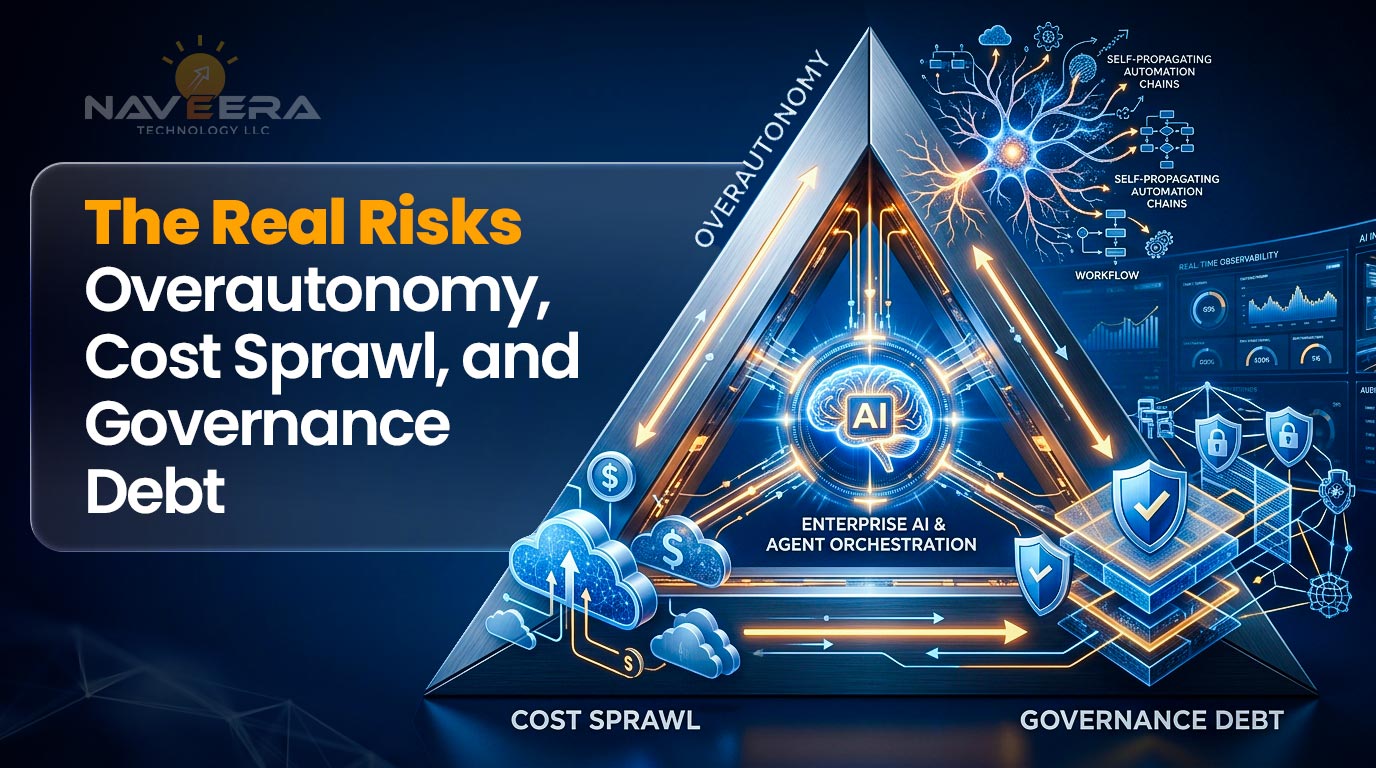
The Real Risks — Overautonomy, Cost Sprawl, and Governance Debt
The largest risks in agentic AI are not limited to hallucination. They include overautonomy, unmanaged tools, cost sprawl, duplicated workflows, shadow agents, sensitive data leakage, and unclear accountability. These are enterprise operating risks.
Why recursive loops and unmanaged tool use create cost and control problems
Agentic systems can create unexpected cost patterns.
An agent may retry failed tasks repeatedly, call expensive models unnecessarily, retrieve too much context, trigger redundant workflows, or loop through planning steps without completing the task.
Without retry ceilings, budget limits, model routing, and FinOps for AI, usage can become difficult to predict. This is especially risky when agents are embedded into high-volume workflows such as support, sales operations, IT operations, or engineering pipelines.
The cost issue is not only token spend. It includes cloud infrastructure, API calls, vector retrieval, monitoring, logging, human review time, compliance review, vendor licensing, and operational support.
Agent sprawl, duplicated workflows, and invisible operational risk
Agent sprawl happens when teams create agents independently without shared architecture, governance, or visibility.
One team builds a support agent. Another builds a sales research agent. Another builds a finance review agent. Another installs a browser agent. Another test of an IDE agent. Soon, the enterprise will have dozens of AI-enabled workflows that touch sensitive data, with inconsistent controls.
This is the new version of shadow IT. But it is more complex because AI tools may process prompts, documents, source code, customer records, credentials, meeting transcripts, and business plans.
AI app discovery and AI security posture management are becoming necessary because enterprises need visibility into both sanctioned and unsanctioned AI usage. Blocking everything is rarely realistic. Providing secure, approved pathways is more effective.
Why human oversight must evolve from approvals to intervention design
Many enterprise teams say they have “human-in-the-loop” controls. But in practice, that often means a person clicks approval without enough context.
Human oversight needs to mature into intervention design.
That means figuring out when humans review things, what evidence they consider, what decisions they can change, how exceptions are handled, and how feedback improves the system.
Some workflows require human approval before actions occur.
Others need humans to keep an eye on things, so humans monitor what agents do and step in when certain limits are reached.
The design should match the risk level. A low-risk internal summary may not need the same approval model as a customer-facing action, financial adjustment, access change, or production deployment.
The hidden cost of turning simple business logic into unnecessary agents
Not every workflow needs an agent.
If a rule is deterministic, use deterministic logic.
If a process is stable, use workflow automation.
If the output must be exact, use validated systems.
If the decision is regulated, keep explicit approval and evidence.
Turning simple business logic into an agentic process can increase cost, reduce predictability, and complicate governance. It may also make audits harder because the organization now has to explain probabilistic behavior where a simple rule would have been sufficient.
This is one of the most common mistakes in early agentic AI programs: using agents because they are fashionable, not because they are architecturally justified.
Why “agent-first” thinking can damage ROI
Agent-first thinking starts with technology. ROI-first thinking starts with the workflow.
Agent-first programs often ask, “Where can we deploy agents?” Better programs ask, “Where do we have high-friction, high-volume, measurable work that requires context, judgment support, and tool interaction?”
The difference is significant.
Agent-first thinking can make pilots costly. It can also lead to tools. This approach often results in adoption rates. Unclear ownership and governance debt are issues. On the other hand, ROI-first thinking supports selective integration. It provides outcomes. Better production discipline is another benefit of this approach.
The Enterprise Decision Framework — When Agentic AI Is a Feature, When It Is a Platform Capability, and When It Is the Wrong Tool
Enterprise leaders need a decision framework that separates hype from fit.
Agentic AI may be a feature, a platform capability, or the wrong tool depending on the workflow.
Use agentic features for bounded, repetitive, tool-enabled tasks.
Use agentic features when the task is repetitive but requires interpretation.
Good candidates include ticket triage, document review, policy lookup, customer history summarization, incident enrichment, code review assistance, test generation, invoice exception support, and knowledge-base maintenance.
The common pattern is bounded execution. The agent has a defined job, approved data sources, limited tools, measurable outputs, and escalation paths.
This is where AI agents’ business value and risk can be clearly evaluated.
Use platform-level agent patterns when orchestration, context, and governance are mature.
Platform-level agent patterns make sense when the enterprise already has mature orchestration, access governance, data platforms, observability, and security controls.
For example, a platform-level agent architecture may coordinate multiple task-specific agents across customer operations, IT operations, or engineering workflows. But this requires strong supervision, policy enforcement, shared telemetry, model routing, and operational accountability.
Multi-agent systems should not be the starting point for most enterprises. They should be used as advanced patterns when simpler architectures are insufficient, and governance maturity is strong.
Avoid agentic design when deterministic workflows are simpler and safer.
Agentic design is not an idea for workflows that are based on rules.
These workflows do not change much. They are also very risky. They already work well with automated systems that always produce the same result. In cases, you should avoid using agentic design. The workflow is already well handled by a system that follows set rules. So agentic design is not needed there. It is better to stick with what’s already working.
Examples include simple approval routing, fixed compliance checks, standard data transformations, exact calculations, system provisioning based on predefined rules, or workflows where explainability and repeatability are more important than flexible reasoning.
The best enterprise AI architecture is not the most autonomous. It is the architecture that delivers the required outcome with the lowest acceptable complexity and risk.
Evaluate by business value, risk, observability, and operating cost.
When we look at each Artificial Intelligence chance, we should think about it in four different ways.
Business value is one of these ways: we need to ask if the work process really changes things that we can measure, like how much something costs, how we can do it, how much money we can make, what risks are involved, how good the quality is, or how it affects the people who buy from us.
Risk: What data does the agent touch? What actions can it take? What happens if it is wrong?
Observability: Can we track what happens with prompts, content, tool calls, decisions, approvals, and results in our organization?
Operating cost: What does it really cost to run inference, manage workflows, use tools, monitor performance, review, provide support, and ensure governance?
If a use case fails this test, it is not production-ready.
Why the winning pattern is selective integration, not blanket adoption
The winning enterprise pattern is selective integration.
Agentic AI should be embedded where it strengthens existing systems. It should not be spread everywhere simply because the technology is available.
Selective integration is really helpful. It helps us control costs, reduce risks, make adoption smoother and build confidence within our organization.
It also gives governance teams a manageable way to handle things.
This includes:
- Discovering how AI is being used
- Figuring out which risks are involved
- Setting rules for what’s allowed
- Putting controls in place
- Watching how things work in time
- Growing what works well with selective integration.
FAQ
Q1: Is agentic AI really a revolution for enterprises?
Not on its own. Artificial intelligence, with agency, is a change. But for companies, its value comes from how it sets up the rules that govern it how well it fits into existing processes, and results that can be measured.
Q2: What is the difference between agentic AI and workflow automation?
Workflow automation is a set of rules we follow. The thing about Agentic AI is that it can understand what we want to achieve, get the information, use the right tools, and take specific actions in a more flexible way. This makes Agentic AI really useful for workflow automation.
Q3: When should an enterprise use an AI agent instead of a simpler workflow?
When you have a task that needs someone to understand the situation, know what people mean when they talk, and handle things, you should use an AI agent. If you have a task where the rules never change and always work the same way, it is better to use simpler automation.
Q4: What are the biggest risks of deploying agentic AI in production?
There are some security risks we need to consider. Key risks include data leakage. Another key risk is injection. We also have to consider permissions. Then there is the problem of unmanaged tool use. Key risks also include cost sprawl and agent sprawl. We have to deal with the issue of observability. Finally, key risks include unclear accountability.
Q5: How should enterprise leaders evaluate whether agentic AI is worth the investment?
Evaluate the business value of a workflow. Consider the risks involved and how exposed the business. Check if the data is ready for deployment. See if we can observe the workflow in action. Think about the operating costs. How will they affect the business? Assess the governance maturity level. Determine if we can measure the workflow’s performance after deployment.