
AI agents are quietly connecting to third-party apps inside your organization. Most IT and security teams do not know this is happening. Like people who used unauthorized cloud tools and software, we are now seeing a new wave of unauthorized integrations with AI workflows. These integrations can read your data, trigger actions. Make decisions without any oversight.
The Security Risk Is Not Just the AI Model – It Is the Connected App Layer Around It:
Conversations about AI security focus on the AI model itself. That is only half the story. The real risk is in everything your AI agent is connected to. This includes the connections to apps, the plugins and the APIs running in the background. Most people overlook these connections entirely and this gap is exactly where things start to go wrong.
Why AI agents inherit the permissions, token, and exposure of connected tools:
The moment an AI agent plugs into a tool, it quietly takes on everything that tool carries, including its weaknesses. This means a single connection with many permissions can give an AI agent more access than intended. Most teams do not realize this until something goes wrong.
How shadow AI and unsanctioned SaaS apps expand the agent attack surface:
Every time an employee connects an app to an AI workflow, they are adding a new security risk that IT teams cannot see. Unauthorized AI is not about rogue chatbots. It is about all the apps and integrations operating outside the enterprise AI security controls. The attack surface grows with every tool that the security team does not know about.
Why visibility gaps create more risk than most teams realize:
You cannot protect what you cannot see. Most enterprises have blind spots in their AI agent security and auditability. These gaps are not a policy problem. They are a risk because AI agents are taking real actions with real data in real time. By the time a visibility gap becomes obvious the damage is usually already done.
How seemingly helpful integrations become enterprise control failures:
That connector between Slack and your customer relationship management system may seem helpful… It can operate with too many permissions and no oversight. These tools may seem harmless. They can quietly erode the security boundaries that enterprises depend on.
Why This Risk Is Escalating in 2026:
AI agents have become a part of operational infrastructure… Most enterprise security models have not kept up. The threats associated with AI agents have evolved into something serious. In 2026 this is not a problem. It is one that needs to be addressed.
AI agents are moving from experiments to operational workflows:
A year ago, most AI agents were in pilot programs with access. Today they are embedded in finance, human resources, customer service and IT workflows. They touch data and make decisions at scale. This shift from experimental to changes the entire risk calculation for AI agent security.
Security leaders are shifting from chatbot risk to agent-runtime risk:
The old approach was to watch what users typed into a chat interface. The new approach must account for AI agents that call APIs, move data between systems and act without oversight. Security leaders who have not updated their thinking are already behind.
Why access attribution, revocation, and runtime control are now board-level concerns:
When an AI agent takes an action, someone has to answer for it. Boards are now asking questions about who owns AI agent identity, how access gets revoked and what oversight exists to stop bad behaviour. These are not just questions. They are governance questions.
The market shift from isolated copilots to connected, action-taking agents:
Early AI systems were essentially smart tools that suggested actions. The AI agents being deployed today are different. They take actions, trigger workflows and connect to live systems without approval. This shift from suggestion to execution makes the connected AI security model critical.
What Actually Sits Behind an Enterprise AI Agent:
Most people think of an AI agent as a model and a chat interface. Underneath that is a complex web of connections that most enterprises have never fully mapped. These connections include OAuth clients, APIs, plugins and internal data systems. Each one is a security risk that rarely gets the scrutiny it deserves.
OAuth connections, APIs, plugins, SaaS apps, and internal data systems:
Every enterprise AI agent is a hub of integrations OAuth connections, API calls, plugins and internal database access. The problem is that each connection comes with its permissions, data exposure and potential for misuse. Most enterprises do not have an inventory of these connections.
Tool access, external resources, and hidden permission chains:
AI agents do not just use tools. They chain them together. Each handoff carries permissions forward in ways that are not always visible. A tool that seems limited can become a backdoor to systems when it is part of a larger AI workflow. These hidden permissions are a source of AI agent security risks.
Why app-to-app data movement matters as much as model outputs:
Everyone focuses on what the AI agent says. What it moves is just as important. App-to-app data movement can quietly expose data, cross compliance boundaries or trigger data leakage risk. The data in transit deserves the scrutiny as the output on screen.
The difference between sanctioned agent workflows and unsanctioned agent behaviour:
A sanctioned workflow has defined boundaries, approved integrations and a clear owner. Unsanctioned AI agent behaviour is what happens when someone builds around those boundaries, connecting apps and creating abandoned or anonymous agents. In practice, that boundary gets crossed more often than security teams would like to acknowledge.
Why agent identity must become a first-class architecture boundary:
Most AI agents operate under borrowed credentials or shared service accounts. There is no concept of nonhuman identity security for AI agents. That means when something goes wrong attribution is murky and revocation is messy. Treating AI agent identity as a first-class boundary is not good hygiene. It is a prerequisite for any zero-trust strategy.
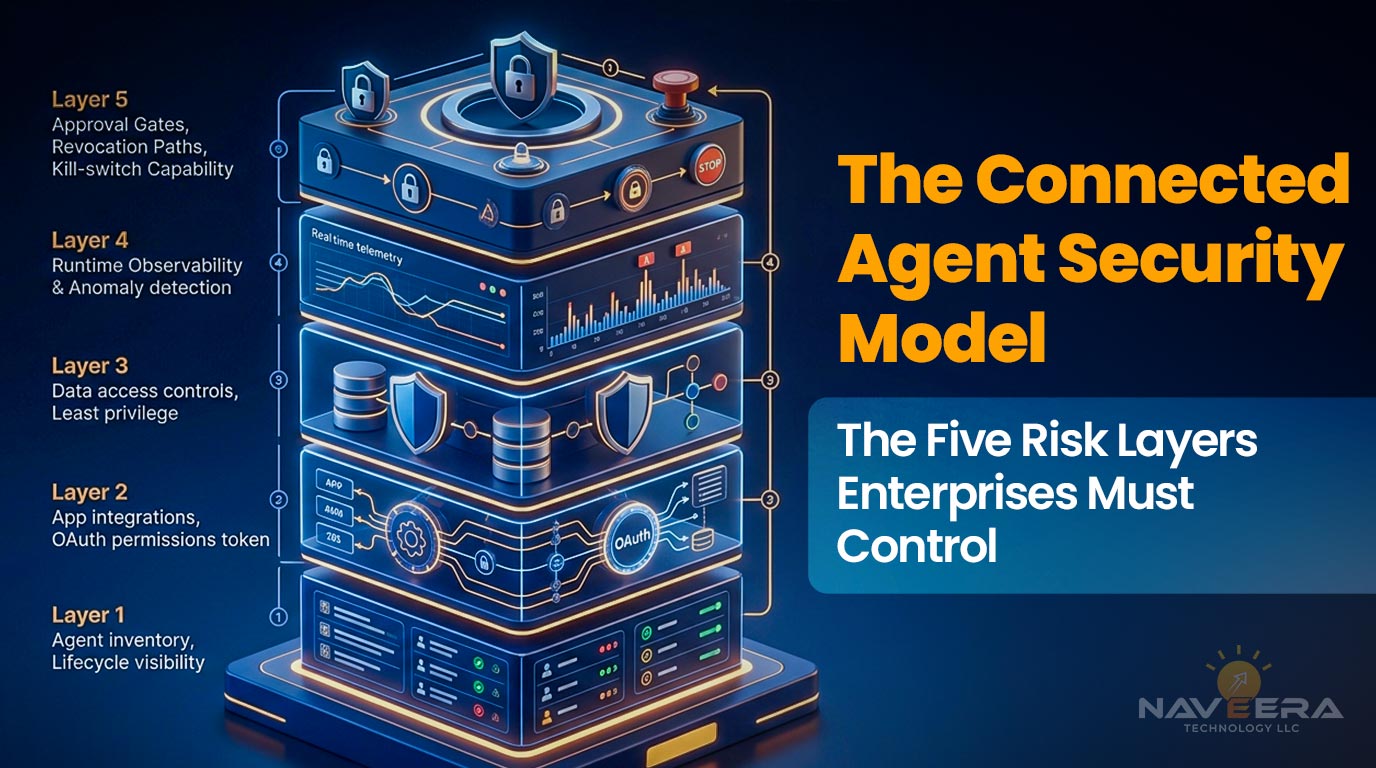
The Connected Agent Security Model – The Five Risk Layers Enterprises Must Control:
Securing enterprise AI agents is not a problem. It has five overlapping problems, each requiring its controls and visibility. The connected AI agent security model gives teams a way to think about where risk lives and what it takes to manage it. Skipping any one of these layers leaves gaps that attackers and accidents will eventually find.
Layer 1 – Agent inventory, ownership and lifecycle visibility:
You cannot govern what you have not catalogued. The first layer is knowing what AI agents exist, who owns them, what they are connected to and where they are in their lifecycle. Without that inventory every other security control is built on guesswork.
Layer 2 – App integrations, OAuth clients and permission mapping:
Once you know what AI agents exist the next question is what they are allowed to touch. This layer is about mapping every OAuth client, API connection and integration to understand the permission footprint. AI agent governance and access control start here.
Layer 3 – Data Access, Least Privilege and Sensitive-Path Control:
Give your AI agent access to everything and eventually it will touch something it shouldn’t. Least-privilege access is not an idea but applying it to AI agents in dynamic workflows takes intentionality. This layer is where you define the paths, set the boundaries and enforce them consistently.
Layer 4 – Runtime Observability, Action Tracing and Anomaly Detection:
This is where you shift from configuration-time security to real-time security. Runtime governance for AI agents means having the instrumentation to see what actions are being taken, trace them to a trigger and flag behaviour that does not match expected patterns. Without this layer you are essentially flying blind.
Layer 5 – Approval gates, revocation paths and kill-switch capability:
The best-designed AI agent will eventually do something unexpected. When it does you need to be able to stop it. This final layer is about having human-in-the-loop approvals for high-risk actions, clean revocation paths, for compromised credentials and a reliable AI agent kill switch that actually works under pressure.
The New Enterprise Threat Model for AI Agents:
The way we protected companies from threats five years ago is not good enough for today. Then we did not think about autonomous agents and now that is a big problem. Today the risks are not about fake emails or servers that are not set up correctly. They are about agents that have much power and are moving data around without anyone watching. We need a way of thinking about threats that includes how agents really work.
Tool misuse, excessive permissions, and lateral movement risk:
When an agent has more power than it needs, the damage from any mistake or attack can be much bigger. Sometimes tool misuse does not look like it was done on purpose. It might just be an agent doing what it was made to do. With permissions that were not set up correctly. That is how the risk of agents moving laterally can become a problem across the whole company.
Prompt injection through connected tools and indirect data sources:
Prompt injection is not just a problem with the model. It is a problem with the pipeline. When an agent gets content from emails, documents or outside APIs any of those sources can have instructions that can take control of what the agent does next. Prompt injection through tools is one of the trickiest and least defended ways that attackers can get into enterprise AI.
Anonymous agents, abandoned agents, and weak attribution:
Every agent that is built and then forgotten is a liability that is still connected and still has permissions. No one is responsible for it. Agents that are not known and agents that are no longer used are like service accounts that can take actions not just have access. When no one owns an agent, incidents turn into guesswork, you’re chasing logs instead of answers.
Data exfiltration through unofficial apps and unauthorized integrations:
No vetting, no controls, no audit trails, just vetting. When an agent connects to one, that gap in security becomes a problem for the company. Data theft through integrations often looks like a normal workflow, which is what makes it so hard to catch.
Why runtime security now matters more than state policy documents alone:
A policy document can say what the rules are but it cannot enforce them when an agent is running a workflow on its own. Runtime governance for AI agents is what fills that gap giving us a view of what is happening not just what was planned. In 2026 having a policy without runtime enforcement is not a security strategy, it is a false sense of security.
How Mature Teams Reduce Agent Risk Without Slowing Innovation:
The security teams that are doing this well are not stopping AI adoption; they are shaping how it happens. Of saying no to every agent deployment, they are building the rules that let innovation happen quickly without creating unnecessary exposure. The goal is not to slow things down, it is to make sure that speed does not come at the cost of AI agent governance and access control.
Start with one governed workflow instead of broad autonomous access:
The mistake most teams make is trying to secure everything at once after agents are already everywhere. A smarter approach is to pick one workflow and get the governance right there first. That workflow becomes the proof of concept for scaling AI across the organization.
Classify which agents can observe, recommend, or act:
Not every agent needs to take action and the ones that do need scrutiny than the ones that just provide information. Classifying agents by what they can do gives us a way to apply the right controls. It is a difference that makes a big difference in how much risk we are actually taking.
Apply least privilege and time-bounded access by default:
The default for any new agent integration should be the minimum access needed for the shortest time required. Keeping access tight and time – limited won’t stop every problem, but it keeps a bad day from turning into a disaster. It’s not a trust issue. It’s just good engineering; you build for the moment things don’t go as planned.
Add human approvals for irreversible or high-risk actions:
Some actions are easy to undo. Others are not. For anything that touches data or makes changes that cannot be quickly reversed, human approvals are not optional, they are necessary. Building that checkpoint into the workflow before deployment is always easier than trying to add it.
Instrument audit trails, tracing, and runtime policy enforcement before scale:
Getting observability and tracing in place before scaling is one of those things that sounds obvious. Almost never happens early enough. Audit trails and runtime policy enforcement need to be part of the foundation, not features that are added later. Building the visibility infrastructure first makes everything that comes after easier to govern.
The 2026 Pattern – Identity-Centric, Runtime-Enforced, and Agent-Aware Security:
The security architectures that are working in 2026 have three things in common: they take agent identity seriously as human identity, they enforce controls at runtime and they are built with the assumption that agents will behave in unexpected ways. This is not a tweak to existing security models, it is a fundamentally different approach.
Why zero trust now has to include agents and nonhuman identities:
Zero trust was designed around the idea that we cannot blindly trust a user just because they are inside the network. The same logic applies to agents even more so given how much access they can have and how autonomously they operate. Nonhuman identity security for AI agents is not an extension of zero trust, it is a requirement for zero trust to actually mean anything.
How agent governance is converging with SaaS governance and API security:
What is becoming clear is that agent governance does not live in its silo; it overlaps heavily with how we manage SaaS sprawl and secure API traffic. An agent connecting to a SaaS app through an undocumented API is a SaaS governance problem, an API security problem and an AI agent security risk all at once.
Why secure agent adoption depends on architecture, not just policy:
Policies tell people what to do but architecture determines what is actually possible. If our systems are built in a way that makes it easy to spin up agents with access and no observability, no policy document can consistently prevent that from happening. Secure agent adoption has to be designed into the architecture from the start.
The shift from static IAM to dynamic, risk-aware control planes:
Traditional identity and access management was built for stable predictable access patterns. AI agents break that model entirely because their access needs are dynamic and sometimes impossible to predict in advance. The shift to risk-aware control planes is about building identity and access management that can keep up with how agents actually operate.
What “production-ready” security should mean for enterprise AI agents:
Production-ready used to mean that the code works reliably at scale. For enterprise AI agents it needs to mean something: the agent has a defined identity, scoped permissions, observable runtime behaviour and a clear path to revocation if something goes wrong. If we cannot answer those questions before deployment the agent is not production-ready.
Getting started – A 90-Day Path to Safer Agent Adoption:
Ninety days is time to go from reactive to structured when it comes to enterprise AI agent security if we focus on the right things in the right order. This is not about achieving security before anyone can use anything, it is about building the foundational controls that let adoption continue without the risk of quietly compounding.
Step 1 – Inventory agents, apps, permissions and unsanctioned tools:
We cannot manage what we have not mapped. The first 30 days should be about getting a clear picture of what exists. That means cataloguing every agent, every connected app, every OAuth client and especially every unsanctioned AI tool and unauthorized integration that is already in use.
Step 2 – Identify sensitive data paths and high-risk integrations:
Once we know what is connected the next step is understanding which connections actually matter from a risk perspective. Not every integration carries the exposure the ones touching sensitive data deserve a very different level of scrutiny.
Step 3 – Add runtime tracing, approval gates and policy controls:
With the inventory done and the risk landscape understood this is where we start putting controls in place. Runtime tracing gives us visibility into what agents actually doing approval gates create friction, for high-risk actions and policy controls ensure behaviour stays within defined boundaries.
Step 4 – Reduce excess permissions and define revocation mechanisms:
The final step is to reduce the permissions that agents have and define how we can revoke access if something goes. You should now have an idea of where permissions are too broad and it is time to fix them. Cutting back on access is not just about reducing risk it is about making your environment more predictable and easier to check. It is also very important to define how you take away access when an AI agent is no longer needed, broken or compromised.
Step 5 – Scale only after visibility, attribution and governance are measurable:
The temptation to scale up fast is real. Expanding AI agent deployment before your governance infrastructure can keep up is how manageable risk becomes unmanageable exposure. Before you push for adoption make sure you can answer three questions: can you see what every AI agent is doing, can you attribute every action to a specific AI agent and owner and can you enforce policy consistently at scale. If the answer to any of those is no, that is your priority.
What a 90-day AI agent security assessment looks like (soft CTA):
If you are not sure where your organization actually stands on any of this a structured 90-day AI agent security assessment is a way to find out. It is not about finding everything that is broken, it is about getting a picture so you can prioritize the right things in the right order. Most teams come out of it not overwhelmed, but focused, which is the position you want to be in before the next wave of AI agent deployments lands.
FAQ
Q1: Why are AI agents creating new enterprise security risks?
AI agents are different from the tools enterprises have secured before because they do not just store or display data they act on it autonomously across multiple connected systems. The risk is not just in the AI agent itself it is in every connection, integration and API the AI agent touches without reviewing each step. When you combine that level of autonomy with the number of apps most enterprises already have you get an attack surface that traditional security controls simply were not designed to handle.
Q2: What is the connection between shadow AI and AI agent security?
Shadow AI, which is the tools and integrations employees spin up outside of ITs visibility becomes a much bigger problem the moment it is connected to an AI agent. A rogue app on its own is a compliance headache. That same app feeding data into or receiving actions from an autonomous AI agent is an active security risk with real potential for damage. The connection is simple: shadow AI expands the AI agent’s attack surface into territory your security team does not even know exists.
Q3: Why do enterprises need identity and access controls for AI agents?
Now most AI agents operate under borrowed credentials, shared service accounts or permissions that were never properly set which means when something goes wrong you cannot easily trace what happened or shut it down cleanly. Treating AI agent identity as a priority means every AI agent has a defined owner, a documented permission scope and a clear revocation path. Without that foundation your access control model has gaps that are invisible until they are suddenly very visible.
Q4: What does runtime governance mean for agentic AI systems?
Runtime governance means having visibility and control over what your AI agents are doing while they are doing it, not just setting policies at deployment and hoping for the best. It includes things like action tracing, anomaly detection, approval gates for high-risk decisions and the ability to intervene or kill a workflow in time if something looks wrong. In a world where AI agents are executing -step tasks autonomously across live systems, runtime governance is the difference between a security program that is responsive and one that is purely reactive.
Q5: How should enterprises secure AI agents without slowing innovation?
The teams doing this well are not choosing between security and speed they are building the governance infrastructure that makes speed sustainable. That means starting with one governed workflow rather than locking everything down, applying least-privilege access by default and getting observability in place before scaling. Security does not have to be a blocker, when it is built into the architecture from the start rather than added later it actually gives teams the confidence to move faster with fewer surprises.