

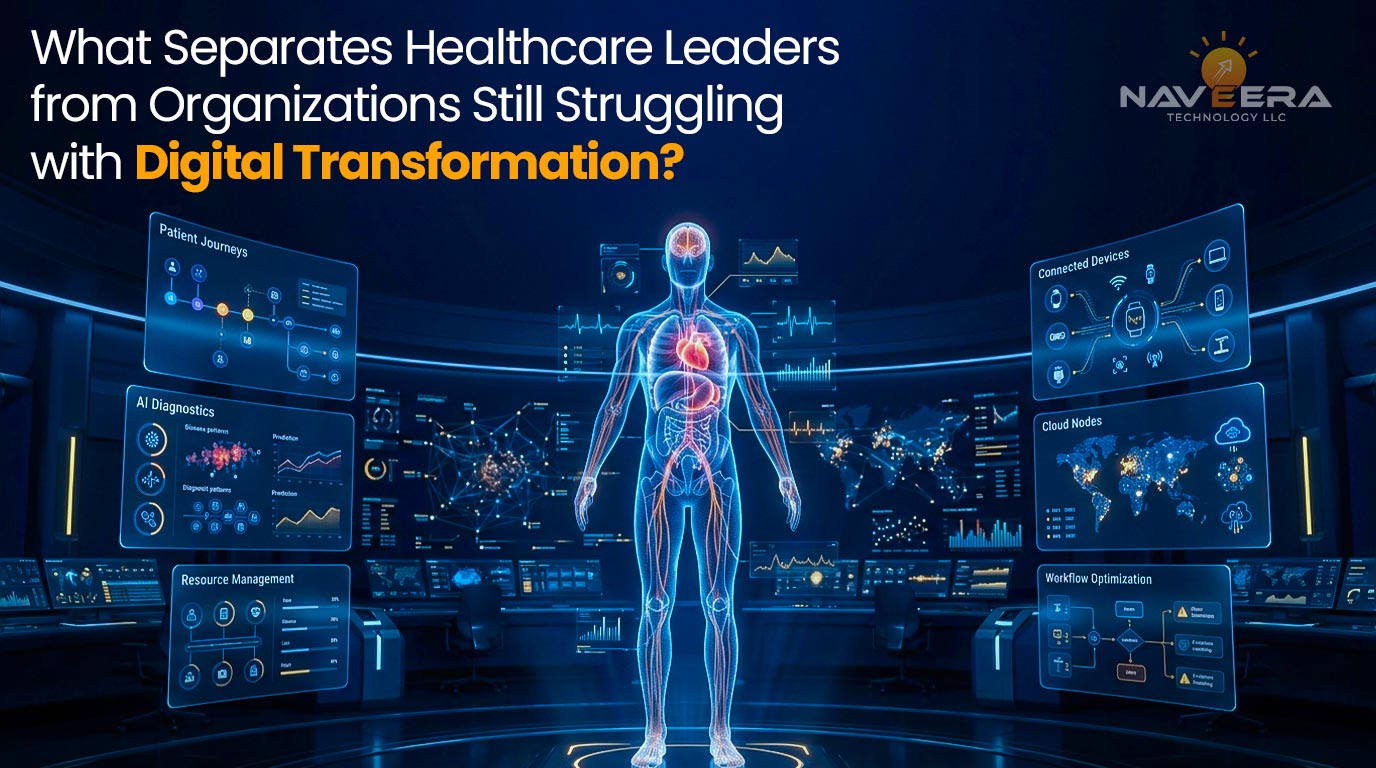
Healthcare organizations have embraced digital transformation with unprecedented urgency. Yet despite significant investments in cloud technologies, artificial intelligence, data platforms, and modern healthcare applications, the outcomes continue to vary widely. While some providers are reshaping patient care and operational excellence, others remain constrained by fragmented systems, rising operational costs, and disconnected digital initiatives.
According to McKinsey & Company, healthcare organizations have the potential to unlock between $200 billion and $360 billion in value through AI and advanced analytics. At the same time, industry research shows that many digital transformation initiatives fail to achieve their intended business outcomes not because the technology is inadequate, but because organizations struggle to integrate digital capabilities into the way healthcare is delivered and managed.
This growing divide raises an important question for healthcare executives.
What distinguishes organizations that consistently realize measurable value from digital transformation from those that continue to struggle?
The answer extends beyond technology adoption.
Healthcare leaders approach transformation as an enterprise-wide strategy that connects data, people, processes, and technology around a common objective: delivering better patient outcomes while building resilient, intelligent, and future-ready healthcare organizations.
Organizations that continue to view digital transformation as a series of independent IT projects often find themselves modernizing systems without fundamentally improving the way the business operates.
The difference lies in perspective.
Digital Transformation Begins with Purpose, Not Technology
Across the healthcare industry, digital transformation is often associated with implementing electronic health records, migrating applications to the cloud, deploying artificial intelligence, or introducing automation into administrative workflows.
These initiatives are important. Yet, on their own, they rarely transform an organization.
Healthcare leaders begin with a different conversation.
Instead of asking which technology should be implemented next, they define the business outcomes they want to achieve. Their priorities focus on improving patient access, strengthening clinical quality, increasing operational efficiency, enhancing workforce productivity, and building resilience against future challenges.
Technology becomes an enabler of those objectives rather than the objective itself.
This distinction shapes every investment decision.
When digital initiatives are aligned with strategic priorities, organizations create lasting enterprise capabilities instead of isolated technology upgrades.
Data Is the Foundation of Every Intelligent Healthcare Enterprise
Healthcare generates extraordinary volumes of information every day. Clinical records, laboratory results, diagnostic imaging, wearable devices, pharmacy systems, revenue cycle platforms, and patient engagement applications collectively produce an ecosystem of data with immense potential.
Yet many healthcare organizations continue to operate in environments where critical information remains dispersed across multiple systems.
Clinical teams often navigate several applications to obtain a complete patient view. Operational leaders depend on reports compiled from disconnected sources. Executive decisions may rely on historical information rather than real-time insights.
These challenges are not simply technical limitations. They influence every aspect of healthcare delivery—from patient safety and care coordination to financial performance and regulatory compliance.
Organizations leading digital transformation recognize that trusted, accessible, and well-governed data is one of their most valuable strategic assets.
They invest in modern data engineering, interoperable architectures, enterprise data governance, and scalable analytics platforms that enable information to move securely across the organization.
When data becomes connected, organizations gain the ability to anticipate demand, identify operational inefficiencies, support clinical decision-making, and respond more effectively to changing healthcare needs.
Artificial intelligence, predictive analytics, and intelligent automation all depend on this foundation.
Without it, digital initiatives often generate additional complexity rather than measurable value.
The Most Successful Healthcare Organizations Design Connected Ecosystems
Healthcare is inherently collaborative.
Patients interact with physicians, specialists, nurses, laboratories, pharmacies, insurers, diagnostic centers, and increasingly, virtual care platforms. Every interaction contributes to a broader care journey.
However, many digital environments remain fragmented.
Legacy applications, incompatible systems, and inconsistent data standards create barriers that affect both caregivers and patients. Information is duplicated, communication slows, and opportunities for coordinated care diminish.
Healthcare leaders are addressing this challenge by building connected digital ecosystems.
Application modernization, cloud-native platforms, healthcare interoperability standards, and secure data integration enable organizations to create a unified flow of information across clinical, operational, and financial functions.
This connected approach transforms the healthcare experience.
Clinicians gain timely access to relevant information. Administrative teams reduce manual effort. Executives develop a clearer understanding of organizational performance. Patients experience more coordinated, responsive, and personalized care.
Technology delivers its greatest value when it enables every part of the healthcare ecosystem to work together.

Artificial Intelligence Is Delivering Results—But Only Where the Foundation Exists
Artificial intelligence has become one of healthcare’s most influential technologies.
Organizations are exploring AI to enhance diagnostic accuracy, optimize workforce planning, improve patient engagement, accelerate medical documentation, and strengthen operational forecasting.
Yet successful AI adoption follows a consistent pattern.
Healthcare organizations generating meaningful outcomes from AI rarely begin with algorithms.
They begin with data quality.
Reliable datasets, strong governance, modern infrastructure, and clearly defined business objectives create the conditions necessary for AI to generate trustworthy insights and support confident decision-making.
Without these foundational capabilities, artificial intelligence often remains confined to isolated pilot projects with limited enterprise impact.
Healthcare leaders understand that AI should complement clinical expertise, strengthen operational intelligence, and enable more informed decisions across the organization.
Its value lies not in replacing people, but in expanding the organization’s ability to respond to increasingly complex healthcare challenges.
From Digital Transformation to Enterprise Transformation
Healthcare is entering a decade where digital capability will shape clinical excellence, operational resilience, and long-term competitiveness. The organizations that lead this transformation will not necessarily be those with the largest technology budgets, but those with the clearest strategic vision and the discipline to execute it.
Enterprise transformation requires more than implementing new technologies. It calls for rethinking how data flows across the organization, how clinical and operational decisions are made, how teams collaborate, and how technology supports measurable business outcomes.
Healthcare leaders are building connected enterprises where data informs every decision, artificial intelligence augments clinical expertise, cloud platforms enable agility, and modern applications create seamless experiences for both caregivers and patients. These capabilities strengthen operational performance while preparing organizations to respond to evolving patient expectations, regulatory changes, and emerging innovations.
As healthcare continues to evolve, transformation should not be viewed as a destination with a defined endpoint. It is an ongoing capability that enables organizations to adapt, innovate, and deliver greater value in an increasingly complex healthcare landscape.
Naveera’s Perspective: Partnering for Enterprise Transformation
Every healthcare organization begins its transformation journey from a different starting point. Some are modernizing legacy applications, others are establishing enterprise data platforms, while many are exploring how artificial intelligence can improve clinical and operational performance. Regardless of where they are today, sustainable transformation depends on aligning technology investments with business strategy and executing that vision with confidence.
At Naveera, we work alongside healthcare organizations as an Enterprise Transformation Partner, helping them navigate complexity and accelerate meaningful change. Our approach brings together AI, Data Engineering, Cloud Modernization, Application Engineering, Analytics, Intelligent Automation, and Global Technology Talent to create connected digital ecosystems that support both immediate priorities and long-term strategic goals.
Rather than addressing technology challenges in isolation, we help organizations build the capabilities that drive enterprise-wide transformation. From creating trusted data foundations and modernizing healthcare applications to enabling AI-ready architectures and cloud-native operations, our focus is on delivering solutions that strengthen operational resilience, improve decision-making, and enhance patient experiences.
Transformation is most successful when strategy, technology, and execution move together. By combining deep engineering expertise with a business-first perspective, Naveera helps healthcare organizations unlock the full value of digital innovation while building a foundation for continuous growth.
The future of healthcare belongs to organizations that can transform information into intelligence, intelligence into action, and action into measurable outcomes. As healthcare continues to evolve, Naveera remains committed to helping enterprises move beyond digital adoption and build the capabilities required to lead with confidence in the next era of healthcare.