
For decades, SAP was primarily viewed as the system of record for finance, supply chain, procurement, HR, and enterprise operations. It powered transactions. It standardized processes. It became the operational backbone of some of the world’s largest organizations.
That identity is changing.
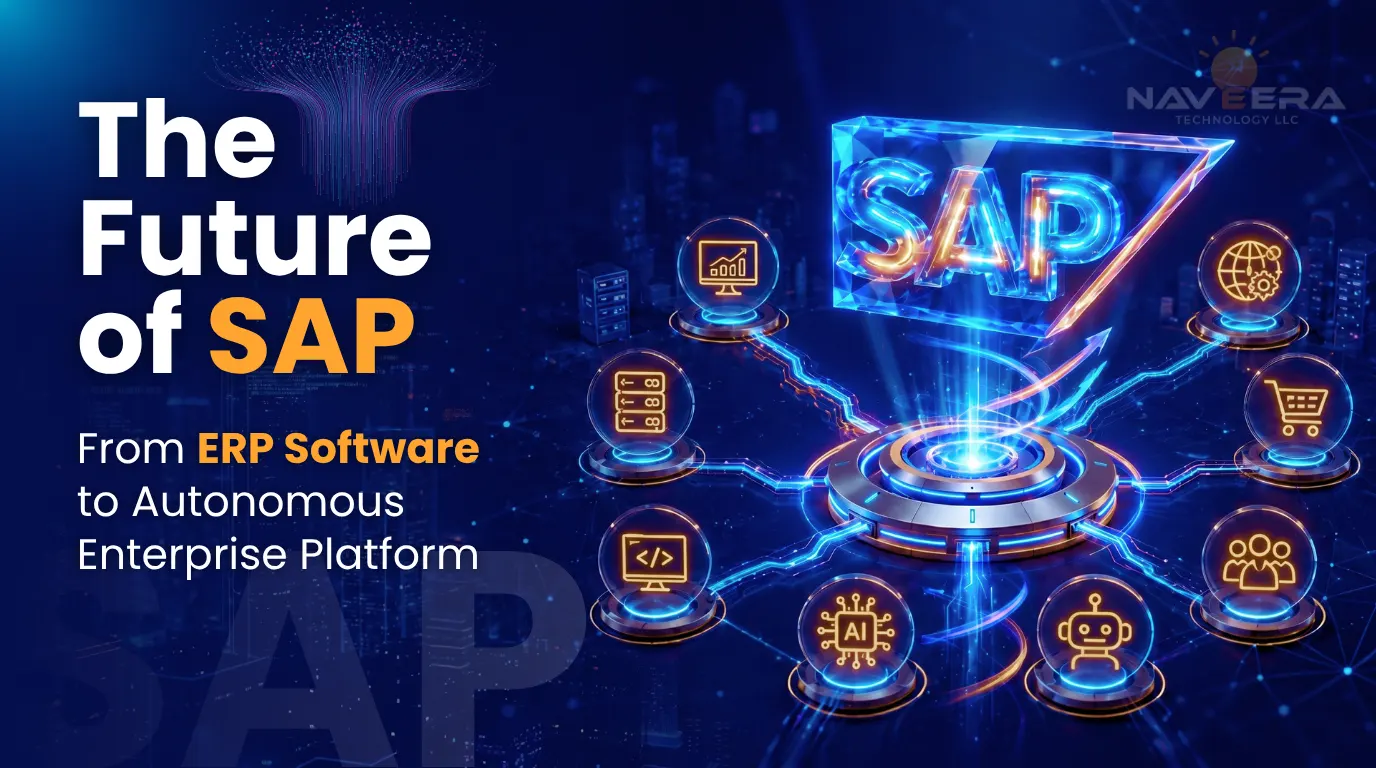
SAP’s strategic direction is no longer centered only on ERP modernization. The company is repositioning itself as an autonomous enterprise platform — one where AI agents, contextual business data, workflow orchestration, and platform-native intelligence become deeply embedded into daily operations.
This is not merely a product evolution.
It represents a broader architectural and strategic shift that affects how CIOs, CTOs, CFOs, and boards think about long-term enterprise operating models, governance, dependency risk, AI adoption, and platform economics.
The future of SAP is not just about migrating from ECC to S/4HANA.
It is about deciding how deeply enterprises want to commit to SAP’s emerging autonomous ecosystem over the next 3–5 years.
- SAP is evolving from an ERP vendor into an AI-centric autonomous enterprise platform.
- The shift combines SAP Business AI, Joule, AI agents, Business Data Cloud, and platform orchestration into a unified operating model.
- For enterprises, this is a board-level strategic decision — not simply an IT upgrade.
- The opportunity is operational automation at scale. The risk is deepening platform dependency and long-term lock-in.
- CIOs should separate what SAP is shipping today from what remains a long-term vision.
- Enterprises need roadmap discipline, governance-by-design, reversibility planning, and measurable outcome frameworks before deepening commitment.
- The smartest organizations are planning for optionality, not vendor timelines.
What SAP’s “Autonomous Enterprise” Direction Actually Signals
The phrase “autonomous enterprise” is becoming central to SAP’s messaging.
But behind the terminology is a larger transformation in enterprise software itself.
Traditional ERP systems were designed to capture transactions and enforce process consistency. Autonomous enterprise platforms aim to go further — continuously interpreting data, orchestrating workflows, recommending decisions, and eventually executing actions with minimal human intervention.
SAP’s future roadmap increasingly revolves around this transition.
Key components include:
- SAP Business AI
- SAP Business Data Cloud
- Joule
- Joule Studio
- SAP AI Agent Hub
- RISE with SAP
- GROW with SAP
- Clean core architecture
- Platform-native workflow orchestration
- Embedded AI automation across business functions
The direction is clear:
SAP wants enterprises to operate inside a tightly connected ecosystem where data, AI, workflows, analytics, and governance are deeply integrated.
How SAP is repositioning from ERP software to an AI platform — in plain terms
Historically, SAP implementations focused on transactional consistency.
Finance teams closed books.
Procurement teams processed invoices.
Supply chain teams managed inventory.
HR teams handled workforce operations.
The next phase changes the role of the platform itself.
Instead of simply recording what happened, SAP now aims to:
- predict operational outcomes
- recommend next-best actions
- automate routine workflows
- orchestrate cross-functional decisions
- deploy AI agents across enterprise processes
- unify business context through shared data models
This is the transition from “systems of record” to “systems of orchestration.”
For CIOs, that changes the nature of SAP investments entirely.
The platform becomes not just infrastructure — but an operational intelligence layer.
What is committed product direction versus stated long-term vision
One of the biggest mistakes enterprises make is treating vendor vision statements as guaranteed roadmap outcomes.
There is a critical distinction between:
What SAP is actively shipping now
Examples include:
- S/4HANA modernization
- Joule integrations
- Business AI copilots
- AI-assisted workflow automation
- Business Technology Platform capabilities
- Embedded analytics
- Clean core guidance
What remains directional vision
Examples include:
- Fully autonomous workflows
- Enterprise-wide AI agent orchestration
- Self-optimizing operational networks
- Broad agent-to-agent interoperability
- Deeply autonomous decision systems
This distinction matters because enterprise roadmaps cannot be built purely on aspirational narratives.
A vendor strategy shift is a roadmap input — not your roadmap itself.
Why a vendor strategy shift is a roadmap input, not a roadmap
Every major technology vendor presents an ambitious future-state narrative.
But enterprise architecture decisions must account for:
- Maturity timelines
- Operational readiness
- Governance capability
- Organizational change capacity
- Reversibility
- Pricing evolution
- Integration dependencies
- Regulatory exposure
The future of SAP may ultimately validate its autonomous enterprise vision.
But CIOs cannot assume:
- Every capability will mature on schedule
- Every pricing model remains favorable
- Every AI workflow becomes production-ready
- Every governance challenge resolves cleanly
Roadmaps built entirely around vendor optimism often create long-term technical and operational rigidity.
The strategic question this shift forces a CIO to answer
The real question is not:
“Should we adopt SAP AI?”
The real question is:
“How much operational dependency are we willing to place inside a single evolving enterprise platform over the next decade?”
That is the strategic core of the autonomous enterprise discussion.
Because once workflows, agents, analytics, business logic, governance models, and data layers become deeply platform-native, reversibility becomes significantly harder.
Why This Is a Board-Level Planning Decision, Not an IT Upgrade
Enterprise AI adoption has moved beyond experimentation.
Boards increasingly expect:
- Measurable operational outcomes
- Governance accountability
- AI risk management
- Financial clarity
- Long-term investment justification
That changes the calculus entirely.
Why the move from experimentation to accountability changes the calculus
In the pilot phase, enterprises tolerate ambiguity.
In production environments, ambiguity becomes expensive.
Executives now expect:
- Measurable productivity gains
- Lower process cycle times
- Reduced operational overhead
- Improved forecasting accuracy
- Faster compliance reporting
- Audit-ready governance
What deepening platform dependency commits you to over 3–5 years
A deeper SAP autonomous strategy often implies commitment to:
- SAP-native data architectures
- SAP AI tooling
- SAP governance models
- SAP integration layers
- SAP release cycles
- SAP pricing evolution
- SAP-specific workflow design
- SAP-centric security posture
This affects:
- Total cost of ownership
- Exit cost
- Vendor leverage
- Procurement flexibility
- Future architecture decisions
These are not short-term implementation considerations.
They are multi-year operating model commitments.
Why “stay current with the vendor” is a decision with a cost
Many enterprises frame modernization as:
“We simply need to stay current.”
But “staying current” increasingly means aligning with:
- Cloud-first architecture
- AI-native workflows
- Platform consumption models
- Recurring platform services
- Evolving licensing structures
- Accelerated release cadences
That carries operational and financial implications far beyond infrastructure upgrades.
The reversibility question most roadmaps never ask
One of the most overlooked enterprise architecture questions is:
“If we needed to change direction in 5 years, how difficult would it be?”
This is the reversibility test.
Organizations often measure implementation speed.
Fewer measure:
- Exit complexity
- Dependency depth
- Migration friction
- Interoperability flexibility
- Data portability
- Governance portability
In autonomous enterprise planning, reversibility matters as much as capability expansion.
The Strategic Tensions SAP’s Direction Creates for Enterprises
Every platform transformation creates trade-offs.
SAP’s autonomous enterprise direction is no exception.
Capability gain versus deepening lock-in — the core trade
The more platform-native capabilities enterprises adopt:
- The greater the automation potential
- The greater the operational dependency
This is the central strategic tension.
Organizations gain:
- Tighter integration
- Shared business context
- Operational intelligence
- Centralized governance
- Workflow acceleration
But they may lose:
- Architectural flexibility
- Vendor optionality
- Modular substitution capability
- Pricing leverage
The question is not whether lock-in exists.
The question is whether the operational value justifies it.
Vendor release cadence versus your own change capacity
SAP’s move toward faster innovation cycles creates another tension.
Enterprise adoption capacity rarely moves at vendor speed.
Most large organizations still face:
- Change management complexity
- Training overhead
- Integration dependencies
- Regulatory review cycles
- Internal governance approvals
- Regional operational variation
A biennial release cycle may still outpace enterprise readiness.
Roadmaps fail when vendor velocity exceeds organizational absorption capacity.
Platform-native AI versus retaining architectural optionality
Platform-native AI delivers advantages:
- Contextual data access
- Embedded workflows
- Lower integration friction
- Unified governance
But open ecosystems preserve:
- Interoperability
- Vendor flexibility
- Architecture independence
- Modular AI adoption
This becomes especially important as:
- A2A interoperability evolves
- Sovereign AI requirements increase
- Regulatory expectations tighten
- Multi-model AI strategies mature
The future may not belong entirely to closed enterprise ecosystems.
Why the data and process foundation still gates every projected benefit
Autonomous enterprise narratives often focus heavily on AI capability.
But the real bottleneck remains foundational maturity.
Poor:
- Master data quality
- Process standardization
- Governance consistency
- Integration hygiene
- Workflow clarity
can undermine every projected AI benefit.
AI amplifies operational maturity.
It does not replace it.
A Roadmap Lens for SAP’s Autonomous Enterprise Direction
The most effective enterprise roadmaps separate near-term certainty from long-term speculation.
A useful framework is horizon-based planning.
Horizon 1 — Commit only to what is shipping and reversible now
Focus on:
- Clean core modernization
- Measurable workflow automation
- Governed AI copilots
- Analytics modernization
- Operational visibility improvements
Prioritize:
- Clear ROI
- Operational governance
- Reversible architecture decisions
- Measurable business outcomes
Avoid irreversible dependency expansion early.
Horizon 2 — Stage dependencies you can govern and cost-forecast
This phase may include:
- Broader SAP Business AI adoption
- Workflow orchestration expansion
- AI-assisted operational processes
- Platform-wide data harmonization
But governance maturity must scale alongside capability adoption.
This includes:
- Audit posture
- SOC 2 alignment
- NIST AI RMF mapping
- Access governance
- Model monitoring
- Residency controls
- AI accountability frameworks
Horizon 3 — Hold optionality where the vision is still unproven
Long-term autonomous enterprise visions remain partially unproven at scale.
This includes:
- Broad AI agent orchestration
- Self-governing workflows
- Fully autonomous operations
- Large-scale cross-enterprise AI collaboration
Enterprises should preserve:
- Architectural escape routes
- Interoperability standards
- Modular integration layers
- Data portability
- Governance independence
Optionality is strategic resilience.
Why this lens plans for scenarios, not for the vendor’s timeline
Vendor roadmaps optimize for platform adoption.
Enterprise roadmaps must optimize for:
- Business resilience
- Governance sustainability
- Operational continuity
- Investment flexibility
- Measurable outcomes
Those priorities are not always identical.
What This Looks Like in Two Enterprise Contexts
Multi-entity manufacturer setting a 5-year SAP platform roadmap
A global manufacturer may see major value in:
- Predictive supply chain orchestration
- AI-assisted procurement
- Manufacturing intelligence
- Cross-entity financial harmonization
- Operational automation
But it must also evaluate:
- Regional data residency laws
- Operational downtime risk
- Factory integration complexity
- Partner interoperability
- ERP customization debt
The platform opportunity is significant.
So is the dependency depth.
US financial services firm balancing platform AI with audit constraints
A financial services organization faces different pressures.
AI capability may improve:
- Compliance workflows
- Fraud analysis
- Reporting automation
- Operational monitoring
But governance expectations are far stricter.
Questions include:
- Model explainability
- Audit traceability
- Sovereign processing
- Retention policies
- AI accountability
- Regulator transparency
Autonomous workflows in regulated industries require governance-by-design from day one.
How to read vendor roadmap commitments without overcommitting
The smartest enterprise leaders separate:
- Platform capability from
- Platform inevitability
A strong vendor direction does not eliminate the need for independent architectural judgment.
Roadmaps should evaluate:
- Operational fit
- Governance maturity
- Exit cost
- Interoperability
- Commercial flexibility
- Measurable value realization
Not simply feature expansion.
Measuring a Platform Strategy Bet — ROI and Governance Over Time
Traditional ERP ROI models are no longer sufficient.
Autonomous enterprise platforms require broader measurement frameworks.
The KPIs that matter — realized value vs roadmap promise
Important indicators include:
- Workflow completion time
- Operational exception reduction
- AI-assisted productivity gain
- Cost-per-completed-process
- Governance incident frequency
- Dependency concentration
- Process automation rate
- Adoption consistency
The unit economics to track — cost-per-completed-process over the horizon
AI platform economics can become difficult to forecast.
Costs may expand through:
- Platform consumption pricing
- Model execution usage
- Orchestration services
- Integration overhead
- Governance tooling
- Monitoring requirements
This creates a more realistic long-term economics model.
What the board will ask before approving a multi-year platform commitment
Boards increasingly ask:
- What measurable outcomes justify the investment?
- What dependency risk are we accepting?
- What governance controls exist?
- How reversible is this decision?
- What happens if pricing changes?
- How mature are the AI controls?
- What is the fallback strategy?
These are no longer purely IT questions.
Governing platform-native AI against NIST AI RMF and SOC 2 over time
As AI becomes embedded into core workflows, governance frameworks become operational requirements.
Enterprises should align platform-native AI against:
- NIST AI RMF
- SOC 2 controls
- internal risk frameworks
- audit governance
- access monitoring
- model accountability processes
Governance cannot be retrofitted after automation scales.
Common Mistakes Planning Around a Vendor’s Autonomous Vision
| Common Mistake | What It Means | Strategic Risk | Recommended Approach |
| Treating the vendor roadmap as your roadmap | Following the vendor’s future vision without validating enterprise-specific priorities and realities. | Business strategy becomes overly dependent on external timelines and assumptions. | Use vendor direction as an input, not the primary roadmap driver. Align decisions to business outcomes, governance readiness, and operational priorities. |
| Committing irreversibly to capabilities still in early adopter | Deeply embedding emerging AI or automation capabilities before they mature operationally. | Creates long-term lock-in, rework costs, and architecture rigidity if capabilities evolve or change direction. | Preserve architectural flexibility and phased adoption until platform maturity stabilizes. Prioritize reversible decisions wherever possible. |
| Underpricing the governance and consumption cost of platform AI | Assuming AI costs are limited to licensing or implementation. | Governance overhead, monitoring, compliance, and consumption pricing can significantly increase TCO over time. | Build long-term cost models that include governance, audit controls, AI monitoring, security, and operational consumption costs. |
| Ignoring the data and process readiness that gates every benefit | Expecting AI to compensate for fragmented processes, inconsistent data, or operational inefficiencies. | AI outcomes remain inconsistent, inaccurate, or low-value despite platform investment. | Strengthen master data quality, process standardization, and governance foundations before scaling AI-led operations. |
| No scenario plan if the vision slips or pricing shifts | Building a roadmap assuming the vendor strategy, pricing, and timelines will remain constant. | Enterprises become vulnerable to roadmap delays, pricing changes, interoperability limitations, or regulatory shifts. | Develop scenario-based planning models covering delayed capability maturity, pricing evolution, vendor restructuring, interoperability shifts, and regulatory expansion. |
How to Set the Roadmap Before You Deepen the Commitment
Decision criteria that separate a sound platform bet from a costly lock-in
Strong platform decisions typically include:
- Measurable operational outcomes
- Governance maturity
- Reversibility planning
- Interoperability safeguards
- Commercial visibility
- Phased dependency expansion
- Clear accountability structures
Questions to put to SAP and your integrator about the multi-year path
Ask:
- Which capabilities are GA versus roadmap vision?
- What interoperability standards exist?
- What data portability guarantees apply?
- What governance tooling is native?
- How will pricing evolve?
- What operational dependencies increase over time?
- What are the exit implications?
These questions shape long-term resilience.
Where an independent roadmap and optionality review fits
Independent architecture reviews help enterprises:
- Validate assumptions
- Identify hidden dependency risk
- Evaluate governance readiness
- Model reversibility
- Stress-test roadmap scenarios
- Forecast operational economics
This becomes increasingly important as enterprise platforms become more autonomous.
Final Perspective
The future of SAP is no longer only about ERP modernization.
It is about whether enterprises want their operational intelligence, workflow automation, governance models, AI orchestration, and business decision layers increasingly centralized inside a single evolving enterprise ecosystem.
For some organizations, that may unlock substantial operational leverage.
For others, the long-term dependency model may require more caution.
The organizations that succeed over the next decade will not simply adopt autonomous enterprise platforms faster.
They will adopt them more deliberately.
They will distinguish:
- Production reality from roadmap vision
- Measurable outcomes from platform narratives
- Strategic leverage from irreversible dependency
Because the future of enterprise platforms will not be defined only by how intelligent they become.
It will be defined by how governable, adaptable, and resilient they remain over time.
FAQ
Q1: What is SAP’s autonomous enterprise strategy?
SAP’s autonomous enterprise strategy focuses on embedding AI, workflow orchestration, business data integration, and AI agents into enterprise operations to automate and optimize business processes at scale.
Q2: Is SAP still an ERP company or an AI platform company?
SAP remains an ERP leader, but its strategic direction increasingly positions it as an AI-driven enterprise platform company that combines ERP, analytics, automation, and AI orchestration into a unified ecosystem.
Q3: What are the risks of committing to SAP’s autonomous enterprise direction?
Key risks include:
- Deepening vendor lock-in
- Higher long-term platform dependency
- Governance complexity
- Evolving pricing models
- Interoperability limitations
- Reduced architectural optionality
Q4: How should a 3–5 year IT roadmap account for SAP’s AI shift?
Organizations should separate near-term production-ready capabilities from long-term vision, prioritize reversibility, build governance-by-design, and maintain optionality in architecture and data strategy.
Q5: Does deeper SAP AI adoption increase vendor lock-in?
Potentially, yes.
The more enterprises rely on SAP-native AI workflows, orchestration, data layers, and governance tooling, the deeper the platform dependency may become over time. The decision depends on whether the operational value outweighs the loss of flexibility.