

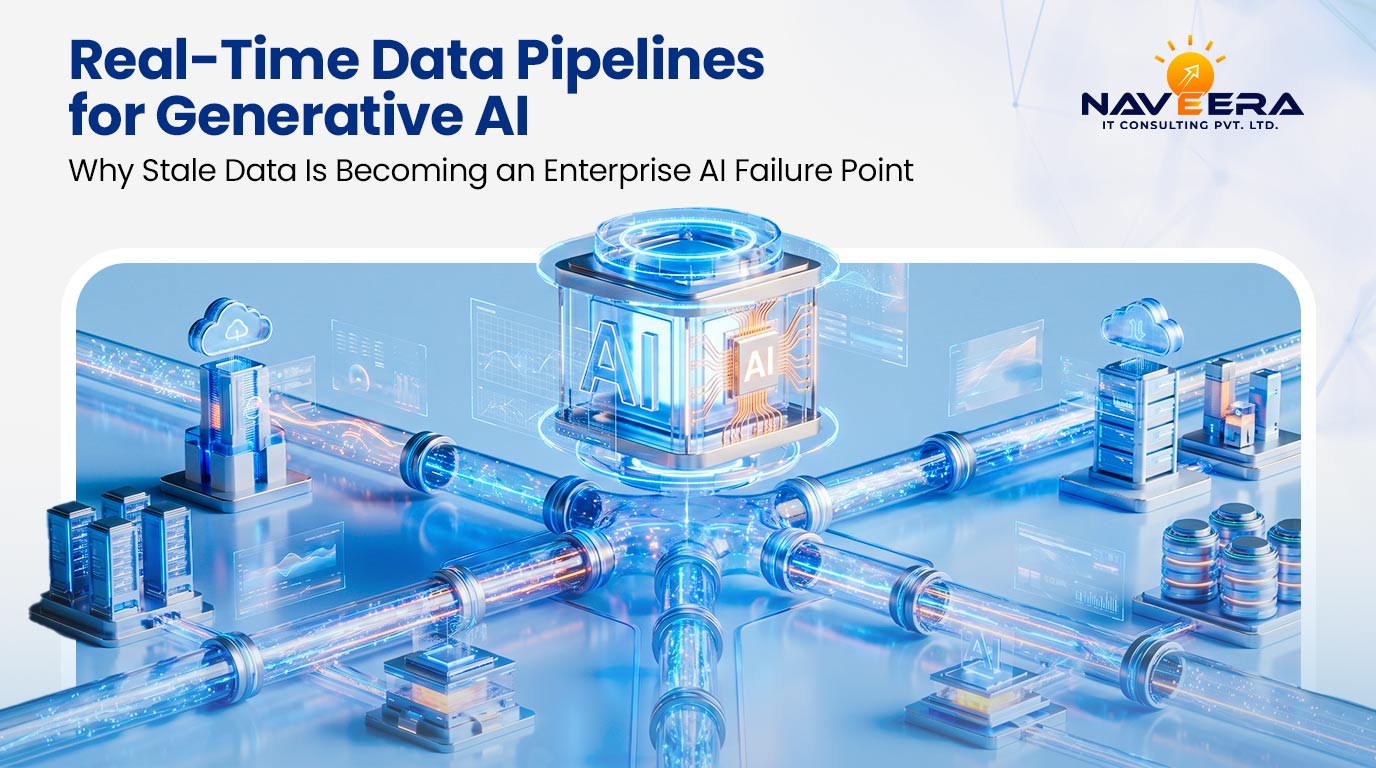
Here is a truth that most enterprise AI teams learn the hard way: a brilliant model fed yesterday’s data will still give you yesterday’s answers. And in a business environment where decisions happen in minutes, not days, yesterday’s answers are increasingly the wrong ones.
Generative AI has matured rapidly. The models are powerful. The retrieval patterns are well understood. The infrastructure options are broader than ever. But across enterprise after enterprise, a quieter failure mode has emerged—one that has nothing to do with model selection or prompt engineering. It is data freshness. The information that you use to make your RAG systems and AI agents work is often old. It can be hours or days behind what’s really happening. This is a problem. It causes your systems to make mistakes based on the information they have. Your customers get answers that are not correct because they are based on old records. Your agents also do things based on situations that’re no longer true. The RAG systems and AI agents are not working with information that reflects reality, what is happening now.
Real-time data pipelines for generative AI are how leading enterprises are closing that gap. Not by replacing batch infrastructure wholesale, but by adding streaming capabilities exactly where freshness determines outcome quality. This article is written for CTOs, data engineering leaders, and AI architects who want to understand where batch pipelines fall short, what a hybrid batch-and-streaming AI pipeline looks like in practice, and how to build real-time data infrastructure for LLMs without overengineering or overspending. If your AI systems are producing answers that feel slightly behind the world they operate in, the problem is almost certainly upstream of the model.
The New Bottleneck in Enterprise GenAI Is Not Always the Model — It Is Data Freshness
Why model quality cannot compensate for stale enterprise context
There is a persistent belief in enterprise AI that upgrading the model will fix quality issues. Sometimes that is true. But when a support copilot tells a customer their order is “in processing” three hours after it shipped, no model upgrade will fix that. The answer was based on facts. It was already old news. This is what happens when we use information in real life, and it is more common than people think. The quality of the model determines how well the AI system works. How fresh the data is decides if it does the thing at the right time. When the system gives us documents, records or information, even if the model is working perfectly, it will still give us wrong answers that it thinks are right. The model quality is important. The data freshness of the AI system is also crucial because it relies on model quality and data freshness to work properly. Data freshness ensures the AI system does the right thing, and model quality ensures it does it well.
The shift from warehouse-era reporting latency to AI-era decision latency
The company’s data system was made for a time when it was okay to wait a while for things to happen. This was a time when people did things like load data at night and update reports every hour or every week. The enterprise data infrastructure was built for this kind of world. That cadence worked because humans were the consumers, and humans could accommodate lag. But generative AI has changed the way we consume data. Now it is models making inferences, agents taking actions, and copilots advising humans in real time. The latency tolerance has collapsed from hours to seconds. An AI agent that checks inventory before placing an order cannot wait for a batch job that runs at midnight.
A RAG system answering compliance questions needs to reflect the policy updated 20 minutes ago, not the version indexed last Tuesday. This shift from warehouse-era reporting latency to AI-era decision latency is the fundamental reason real-time data pipelines for generative AI have moved from a nice-to-have to an architectural requirement.
How stale context quietly degrades RAG, copilots, and agentic workflows
The insidious thing about stale data is that it quietly degrades AI quality. There is rarely a loud error message. Instead, the system returns plausible answers that turn out to be wrong, and users gradually lose trust. RAG systems retrieve chunks that no longer reflect the current state. Copilots offer suggestions based on yesterday’s metrics. AI agents do lots of things in a series of steps using information that has changed since they started. The problem is that you cannot see what is going wrong when you look at the basics. Everything seems fine. The person using it can see that something is wrong because they know what is supposed to happen. This makes people trust AI systems less and less over time, leading them to go back to doing things by hand. The strange thing is that the AI agents are actually doing what they were supposed to do. It was never given current data.
Why “better prompts” often fail when the underlying data is late
Prompt engineering has become a reflex for teams facing quality issues. When outputs are inaccurate, the first instinct is to rewrite the system prompt, add instructions, or adjust retrieval parameters. These are valid optimizations, but they cannot fix a freshness problem. If the underlying data is stale, a better prompt just produces more eloquent wrong answers. The distinction matters for how teams allocate engineering effort. Prompt tuning is really helpful in changing how a model behaves.
Sometimes the problem is that the information is based on old data.
In that case, the solution is to update the data pipeline, not the template.
This changes the focus from designing prompts to building a data system.
That’s where we can make lasting changes.
The conversation now is about data architecture, not prompts.
We should focus on improving the data pipeline.
Batch Still Matters — But Batch Alone No Longer Supports Real-Time AI Workloads
Where batch remains the right pattern — historical analytics, offline enrichment, and backfills
Let us be clear: batch processing is not going anywhere. For historical analytics, training data preparation, periodic enrichment, large-scale backfills, and any workload where completeness matters more than immediacy, batch remains the most cost-effective and operationally simple pattern. Nightly ingestion from data warehouses, scheduled regeneration of embedded static knowledge bases, and periodic recomputation of derived features are all workloads where batch is not just adequate—it is optimal. The mistake is not using batch. The mistake is using only batch for workloads where freshness determines outcome quality.
Where batch starts to fail — dynamic retrieval, live support, and event-driven decisions
Batch starts failing the moment your AI system needs to reflect changes since the last batch run. Customer service copilots that need current ticket status, fraud detection agents that need to act within seconds, supply chain AI that needs to reflect inventory changes as they happen, clinical decision support that needs the latest lab results—these are not edge cases. They are the high-value use cases that enterprises are investing in most heavily. In each case, batch-era latency introduces a gap between what the AI knows and what is actually true. That gap is where hallucinations, missed opportunities, and operational errors live.
Why “batch vs streaming” is the wrong architecture debate
The industry spent a lot of time talking about batch and streaming as if they were two completely different things. In reality, it is not usually one or the other. The real question is what data needs to get to us away and what can wait a bit. A good system uses batch to get a lot of information and streaming to get the information. Apache Beam is an example; it supports both batch and streaming because most jobs need both. We should not be trying to pick one over the other. It should be about identifying the minimum viable streaming surface area your AI workloads require and building infrastructure that cleanly supports both patterns.
The rise of hybrid data platforms for enterprise AI
Hybrid batch-and-streaming AI pipelines are becoming the standard architecture for enterprise generative AI. These platforms keep batch processing reliable and cost-efficient for high-volume data. They also add event-driven streaming for the subset of data where freshness really matters.
Cloud-native platforms, such as Google Cloud Dataflow, make this hybrid approach more accessible. This allows teams to run both batch and streaming pipelines with a single framework.
The teams can now handle types of data in one place. They benefit from both batch processing and event-driven streaming.
This hybrid pattern helps teams to be more flexible. They can choose the approach for each type of data.
Google Cloud Dataflow and similar platforms make it easier to implement this approach. The teams can focus on getting insights from their data.
Naveera Technology’s data engineering services help enterprise teams design and implement these hybrid architectures, ensuring that the streaming layer is scoped to actual freshness requirements rather than over-provisioned for workloads that do not need it.
Why Freshness Has Become a Core AI Performance Metric
RAG systems are only as current as their retrieval layer
The Retrieval-Augmented Generation is only as good as what it retrieves. If the vector database has information from documents that were put in there days ago, the Retrieval-Augmented Generation models’ answers will be old too. The Retrieval-Augmented Generation model will give answers because it is using old information from the documents in the vector database. Real-time RAG architecture closes this gap by continuously updating embeddings and vector indexes as source data changes, leveraging change data capture and streaming pipelines to propagate updates within seconds or minutes rather than hours. For enterprises that rely on RAG for customer-facing applications, the freshness of the retrieval layer directly determines answer accuracy and user trust. Feature freshness and context freshness are not abstract metrics—they are the difference between an AI that is helpful and one that is dangerously outdated.
Copilots need live operational context, not yesterday’s snapshot
Enterprise pilots need to help with what’s happening right now. This includes writing responses to customer inquiries currently coming in. They also need to summarize what is happening with incidents and recommend actions based on the current state of the system. The problem is that when enterprise copilots work with data, they give advice that is not quite right. This is because they are not working with the information. Enterprise copilots give advice when they use old snapshots of data. The user notices, mentally corrects the copilot, and gradually stops relying on it. This is not a model failure—it is a data pipeline failure. Streaming data pipelines for generative AI feed copilots the live operational context they need to remain useful in real-time workflows, keeping the context window current as the underlying systems change.
AI agents depend on event-to-context latency, not just inference latency.
For AI agents, latency has two dimensions. Inference latency—how quickly the model responds—gets most of the attention. But event-to-context latency—how quickly a real-world change becomes available to the agent’s retrieval or tool layer—is often the more important metric. An agent that responds in 200 milliseconds but reasons over data that is four hours old is fast and wrong. Event-to-inference latency, the total time from a source event to the agent’s action, is the metric that actually matters for agentic workflows. Reducing this end-to-end latency requires real-time data ingestion for AI agents, not just faster GPUs.
From data latency to business risk — when delayed context changes outcomes
Data latency becomes a business risk when delayed context changes the correct answer. A pricing recommendation based on competitor data that is six hours old might lose a deal. A clinical alert based on lab values that have not propagated might delay treatment. A compliance check based on a policy document that was updated but not re-indexed might expose the organization to regulatory risk. These are not hypothetical scenarios—they are the failure modes that enterprise teams encounter once AI systems are embedded in operational workflows. The business case for real-time data pipelines for generative AI is ultimately a risk management argument, not just a technology preference.
Context freshness, answer quality, and user trust
When we use Artificial Intelligence systems, we trust them because what they tell us matches what we already know is true. When the Artificial Intelligence system gives us an answer that is clearly old, we start to doubt it. Once we doubt the Artificial Intelligence system, it is really hard to trust it. It costs a lot more to regain our trust in the Artificial Intelligence system than it would have cost to keep it in the first place. Context freshness is therefore not just a technical metric—it is a user experience metric and, ultimately, an adoption metric. Enterprises that invest in freshness infrastructure are driving sustained adoption of their AI tools. Those that do not will find that their AI systems are technically functional but practically unused.
The Reference Architecture for Real-Time GenAI Data Pipelines
Source systems, CDC, event streams, and message transport
The real-time data pipeline starts with the source. This includes databases, SaaS platforms, IoT streams, and operational systems. The system uses change data capture to find changes in the database. It looks for entries, updates, and deletions.
It does all this without requiring changes to the application.
These changes are then sent to event streaming platforms like Apache Kafka.
Apache Kafka is a scalable platform for moving messages.
The main idea here is to find changes as close to the source, as possible.
Then we move these changes through a system that keeps producers and consumers separate.
This system is called an event-driven architecture.
The real-time data pipeline uses this architecture to work reliably.
It is what enables the rest of the pipeline to operate with low latency and high reliability.
The real-time data pipeline and event-driven architecture are important for this to work.
Stream processing, transformation, enrichment, and filtering
Raw events from source systems are not usually ready for artificial intelligence to use. We need to improve these events so artificial intelligence can use them. This is where stream processing comes in. Stream processing changes the events. Adds more information to them. It also filters out unimportant events and puts the remaining events in the right order.
This layer is like a filter that improves the events. It adds information to the events from other sources. It removes unnecessary events. It also does calculations on the events. Handles the events that arrive late. Apache Beam and Google Cloud Dataflow are often used for this. They can handle events that come in one at a time or in a group. They ensure that each event is processed only once.
The result of this layer is structured data. This data is ready for use by artificial intelligence. It is also ready for use. The data is now ready to proceed to the next steps.
Real-time embedding and vector index update patterns
Once the data is transformed, it must reach the retrieval layer. For RAG systems, this means generating new embeddings and updating vector indexes in near real time. Time indexing patterns are different. Some systems embed every time something changes, then put those embeddings directly into the vector database. Other systems make frequent updates to keep costs down. The way you do it depends on how many changes you have, how much it costs to make new embeddings, and how up-to-date the AI application needs the information to be. When teams work with Naveera Technology on AI infrastructure and cloud architecture, they often find that updating embeddings in real time is better, than always doing it right away or in batches. This way, they get a balance between having the most recent information, not spending too much money, and making sure everything works properly.
Serving fresh context to RAG systems, copilots, and AI agents
The serving layer is where fresh context meets the model. For RAG systems, this means querying a vector database that reflects recent updates. For copilots, it may mean retrieving live data from APIs or caches in addition to vector search. When we talk about AI agents serving, it’s much more about using tools to get things done. This means the AI agent asks for information while running, and the answer it receives must be up to date. We can use caching, including semantic caching, to avoid retrieving the same information repeatedly, which helps keep costs down. But we have to make sure these caches are designed so they do not reveal information, so we need rules about when this information is no longer valid. The serving layer is the step that delivers information to the AI model in real time, and how it is designed will determine whether all the work we put into getting the information to the model actually pays off. The AI model needs the serving layer to work well. The serving layer is very important for AI agents.
Observability, fault tolerance, retries, and failure isolation
Time-based pipelines are much harder to manage than batch pipelines. They are always. When something goes wrong, we need to find out and fix it right away. We need to be able to see what is happening at every step of the way, with intelligence from when something first happens through how the pipeline processes it, makes an embedding, retrieves information, and responds with a model.
We should be tracking how long it takes for events to turn into answers at each stage. We should get alerts if things are not happening quickly enough. If something cannot be processed, we need a plan for what to do with it, such as putting it in a queue. We also need to make sure that if one part of the pipeline isn’t working right, it doesn’t mess up the whole thing.
The artificial intelligence pipeline needs rules about what can be taken, and we need to monitor it to ensure it operates within those rules. This way, we can make sure the time pipeline is working smoothly. These operational requirements are why streaming infrastructure demands stronger discipline than batch analytics.
Where batch pipelines still fit — historical depth, training, and recomputation
Even in a real-time architecture, batch pipelines serve critical roles. Historical data does not change often. Examples include product catalogs, regulatory frameworks and training data.
These are best processed in batches.
Model training and fine-tuning use amounts of this kind of data.
It does not need to be up to date.
Recomputing all embeddings periodically ensures they remain consistent.
It also helps catch any changes that might have been missed with updates.
This approach ensures that the data remains reliable.
It helps to identify any drift over time.
The model stays accurate as a result. The reference architecture is not all-streaming. It is a hybrid batch and streaming architecture where each pipeline pattern is applied to the workloads it serves best.
The Freshness-Critical AI Framework — When Batch Is Enough, When Hybrid Wins, and When Real-Time Is Mandatory
Batch-sufficient workloads — low-volatility, non-urgent, and offline use cases
Some artificial intelligence tasks do not require current information, and it is crucial to acknowledge this truthfully. For example, internal databases that have documents which are updated every week or every month, research tools that work with information that has already been published and training systems that use data. These artificial intelligence tasks are fine with using old data.
If we spend a lot of money on systems that provide the most up-to-date information for artificial intelligence tasks that don’t need it, we will waste money and make things more complicated without improving anything.
Part of being an engineer is knowing when not to use systems that provide the most up-to-date information for certain artificial intelligence tasks. Hybrid workloads — historical depth plus streaming updates for retrieval freshness.
The majority of enterprise AI workloads fall into the hybrid category. They need a deep historical foundation—indexed knowledge bases, product information, policy documents—supplemented by streaming updates for the subset of data that changes frequently. A customer support system, for example, might update its knowledge base every night while tracking ticket status and customer interactions as they occur.
This way of combining updates gives these systems a history and up-to-date information without having to pay for a fully real-time system.
The customer support RAG system benefits from this.
It gets the best of both worlds, knowing what happened in the past and what is happening now.
Hybrid systems like this help with customer support.
Real-time-critical workloads — live service operations, event-triggered AI, and agentic automation
Some workloads are genuinely real-time-critical. Fraud detection agents that must act within seconds. Live service operations where AI assists human operators during active incidents. Event-triggered workflows where an incoming signal—a transaction, a sensor reading, a customer action—must propagate through the pipeline and reach the model before the window for useful action closes. For these workloads, event-driven AI data pipelines are not optional. The freshness SLA is measured in seconds, and the cost of stale data is not just a quality issue—it is a missed intervention, a lost transaction, or a safety risk.
Choosing the minimum viable streaming surface area
The pragmatic approach to real-time data infrastructure for LLMs is to stream only what needs to be fresh. This means identifying the specific data sources, events, and context elements where freshness creates measurable value, and leaving everything else on batch. The “minimum viable streaming surface area” is the smallest set of real-time pipelines that delivers the freshness your highest-value AI workloads require. This keeps infrastructure costs manageable, reduces operational complexity, and focuses engineering effort where it matters most. Naveera Technology’s generative AI services help teams identify this surface area through structured assessments that map freshness requirements to business outcomes.
Matching freshness requirements to business value, risk, and cost
Every investment in freshness should be justified by the business value it brings. What is the cost of having data when it comes to making wrong decisions, losing revenue, taking on more risk or losing the trust of users? How much money do we spend on real-time infrastructure in terms of the computers we need, the engineers we have to hire and the people who keep everything running smoothly? The intersection of these two curves determines the right level of streaming investment. FinOps for AI plays a critical role here—controlling spend unpredictability across ingestion, processing, retrieval, and inference while ensuring that freshness investments deliver measurable returns. This is an architectural decision, but it is also a business decision, and it should be made with both lenses in mind.
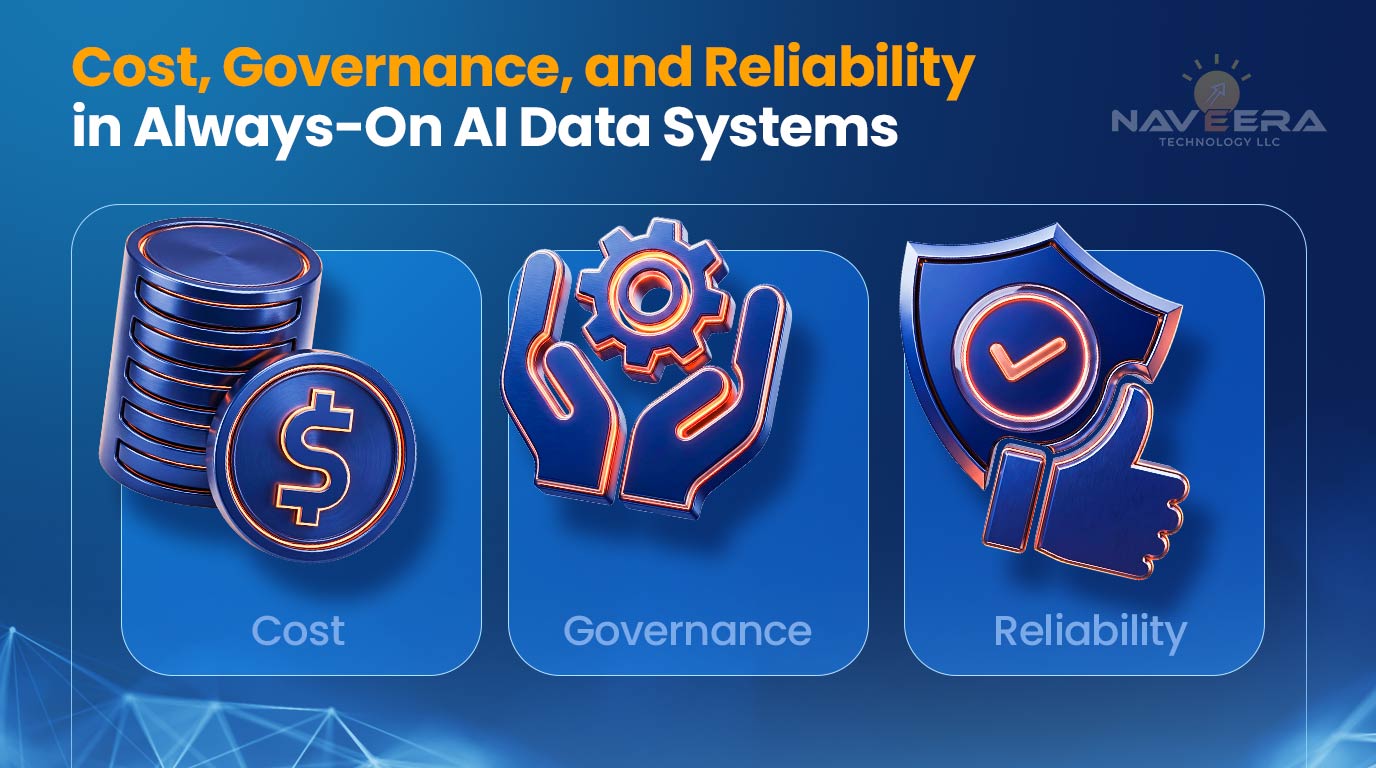
Cost, Governance, and Reliability in Always-On AI Data Systems
Why low latency creates new infrastructure and operating cost pressure
Always-on streaming infrastructure costs more than batch. It requires continuously running compute, persistent message brokers, real-time monitoring, and on-call engineering support. These costs are predictable but higher than equivalent batch workloads. The trade-off makes sense when the freshness of the data creates value that exceeds the extra cost. Teams that use streaming infrastructure without thinking it through often run into budget problems and face pushback from finance. It is really important to understand the costs, including those associated with using old data to build a real-time Artificial Intelligence infrastructure that will last.
FinOps for AI — controlling spend across ingestion, processing, retrieval, and inference
Spend unpredictability is one of the biggest operational challenges in streaming AI architectures. Ingestion costs scale with event volume. Processing costs scale with transformation complexity. Embedding generation scales with the rate of change. Retrieval and inference costs scale with query volume. Without following FinOps practices, these costs can quickly spiral out of control and be hard to predict.
- Effective FinOps for AI requires tracking costs at every stage of the pipeline.
- This includes setting up alerts for spending based on how fresh the data is and the serving strategies used, which focus on getting the most value.
- It is not about making things fast, but about making sure we get the best value from our AI spending.
- FinOps helps us make choices about AI costs.
- We need to ensure FinOps is part of our AI process.
Governance and policy controls for real-time data movement
Real-time data movement is a challenge when everything is done correctly. When data is constantly moving through event streams, transformation layers, and vector databases, we need to ensure that secret data is protected and accessible only to authorized users, hidden. We also need to keep track of what’s happening with the data. This is harder to do with real-time data movement than it is with batch pipelines. We need to have rules in place that can keep up with the speed of the data. This means we need to be able to look at the data in time and decide who can see it. We also need to be able to track the source of the data. Real-time data movement requires real-time data classification and access control that changes based on who’s using the data. We need to be able to follow the path of the data, from where it started to where it ends up. Real-time data movement needs governance built into the pipeline itself.
Observability across the full AI path — event, pipeline, retrieval, model, and response
End-to-end observability is not optional in real-time AI systems. Each stage of the path—from source event to pipeline processing to embedding update to retrieval to model inference to user response—must be instrumented with telemetry that captures latency, throughput, error rates, and freshness metrics. Distributed tracing should link a user query back through the retrieval results to the pipeline events that produced them. This level of observability is what enables teams to diagnose freshness violations, identify bottlenecks, and maintain quality under production load. Teams that have engaged Naveera Technology’s case studies and insights resources frequently cite observability as the capability that transformed their streaming investments from fragile experiments into reliable production systems.
Prompt caching, streaming responses, and cost-aware serving strategies
Prompt caching and semantic caching reduce redundant computation by storing and reusing model responses for similar queries. Streaming responses—delivering partial results as they are generated—improve end users’ perceived latency. Cost-aware serving strategies route queries through different tiers of freshness and model capability based on the query’s requirements and the organization’s cost policies. These methods are really important for running large-scale, real-time intelligence systems without spending too much money. The main thing is to design rules for when to discard information and update it so that the system stays current and does not revert to old information, which is what the system was made to fix. This way, using a cache to store information helps to reduce costs. Artificial intelligence systems like these need caching rules to work well.
Why do always-on AI systems need stronger operational discipline than batch analytics?
Batch analytics systems run on schedules. If a job fails, the job can be rerun before the reporting cycle. Real-time Artificial Intelligence systems, like the ones used in real-time systems, do not have that luxury because they need to keep running continuously. A pipeline failure means stale context is being served to production models right now. This changes the operational posture from scheduled oversight to continuous monitoring and rapid response. It requires runbooks, on-call rotations, automated alerting, rollback controls, and clear freshness SLAs with defined degradation policies. The operational discipline required for always-on AI data systems is closer to site reliability engineering than traditional data engineering, and teams should plan for this from the outset.
Getting Started — How to Move from Batch-Only Pipelines to Hybrid Real-Time AI Infrastructure
Step 1 — Audit AI workloads by freshness sensitivity
Begin by cataloging every AI workload and classifying it by freshness sensitivity. Which workloads currently fail or degrade because data is stale? Which workloads operate fine on batch cadences? Which are planned workloads—agents, copilots, real-time RAG—that will require streaming data from day one? This audit produces a heat map of freshness requirements that drives every subsequent architecture decision. Without it, teams either over-invest in streaming or under-invest, leaving a production gap.
Step 2 — Identify which events actually need real-time propagation
Not every data change needs to stream in real time. A product description update can wait for the next batch index. A customer’s support ticket status change needs to propagate immediately. Map each data source to the AI workloads it feeds and determine the freshness requirement for each connection. The result is a targeted list of event sources that need change data capture and streaming pipelines, scoped to actual business needs rather than architectural ambition.
Step 3 — Pilot one RAG or agent workflow with streaming updates
Start with one process.
- Pick a system that uses RAG or an AI helper where how up-to-date the information is really matters, for the results.
- Then create a pipeline that constantly updates its data in real time.
- This pipeline will help keep the AI helpers’ information up to date.
- The AI helper’s output will be better because it uses the current data.
Measure the impact: Does answer accuracy improve? Do users report better experiences? Does the agent complete tasks more reliably? A focused pilot demonstrates value, builds operational knowledge, and builds organizational confidence to expand streaming to additional workloads. Teams leveraging Naveera Technology’s AI infrastructure and cloud architecture expertise often use this pilot phase to establish the patterns and tooling that scale to broader deployment.
Step 4 — Add observability, freshness SLAs, and rollback controls before scaling
Before expanding beyond the pilot, invest in the operational foundation. Implement observability that tracks freshness metrics at every pipeline stage. Define freshness SLAs for each AI workload—what is the maximum acceptable context lag?—and build alerting that fires when SLAs are violated. Add rollback controls that allow the system to fall back to a batch-loaded context if the streaming pipeline fails. These safeguards are not overhead. They are what make streaming infrastructure production-grade rather than experimental.
Step 5 — Expand only where freshness creates measurable performance or business value
Scale streaming infrastructure deliberately. Each new real-time pipeline should be justified by measurable improvement in AI performance, user outcomes, or risk reduction. Avoid the temptation to stream everything because the infrastructure exists. The organizations that get the best return on streaming investment are those that expand methodically, measure the impact of each addition, and maintain the discipline to keep batch pipelines for workloads where batch is sufficient.
What a 90-day AI pipeline modernization engagement looks like
Naveera Technology does a 90-day engagement. This engagement includes things. It assesses how fresh the workload is and where events originate. It also includes designing and setting up a pilot pipeline, ensuring everything is visible, and planning to expand.
Naveera Technology works with data engineers and AI teams at companies to deliver this engagement. They make a plan to move from old infrastructure to new hybrid real-time AI pipelines. These pipelines are designed to work well with each company’s workloads and business requirements.
The engagement is practical and focused on getting a return on investment. Each part of the engagement gives progress. Naveera Technology and the company can see how the Naveera Technology engagement is designed to help companies like this.
Teams ready to explore this path can start with Naveera’s data engineering services or generative AI services pages for detailed engagement models.
FAQ
Q1: Why is batch processing no longer enough for generative AI?
Batch processing is fine when you can use data, and it does not matter. For RAG systems, copilots, and AI agents, you need the most current data to get the right answers. When you use AI systems for tasks that need to happen now, like helping customers or making quick decisions based on old data, it is a problem. This is because the AI system does not know what is going on at that moment, so it gives you old answers. This makes people trust the AI system less. It can also cause problems.
Q2: What is a real-time data pipeline for generative AI?
They use allowlisted tools, schema-constrained execution, least-privilege permissions, approval gates, retrieval governance, access controls, policy enforcement layers, and full tracing across agent behavior.
Q3: Do RAG systems need real-time data updates?
It depends on the use case. RAG systems that serve static knowledge bases with infrequent changes can operate effectively on batch-updated indexes. But RAG systems that answer questions about operational data—customer records, ticket statuses, inventory levels, policy documents—benefit significantly from real-time or near-real-time index updates. The freshness requirement for our data should be determined by how the underlying data changes and how much it costs the business when we give stale answers. We need to consider the speed of data change to meet the freshness requirement and the cost of providing answers to meet it. This will help us understand what the freshness requirement should be for our data.
Q4: When should enterprises use streaming instead of batch for AI workloads?
Enterprises should use streaming when the data that feeds an AI workload changes often and when old data leads to results. Bad results include incorrect answers, missed interventions, reduced user trust, or increased risk. For some workloads, data changes little, or a slight delay is acceptable. In these cases, batch remains a viable option because it is cheaper and easier to manage. Most businesses that use AI achieve results from both batch and streaming. They use batch to get a lot of information and streaming to get up-to-date information.
Q5: How do real-time data pipelines improve AI agent performance?
AI agents make decisions based on the information they have. If that information is old, agents make choices. For example, they might check inventory that has already been updated, respond to issues with status, or follow workflows with expired settings.
Real-time data pipelines help ensure agents have the information they need. This reduces mistakes in agent tasks. Improves completion rates.
The important thing to measure is how fast changes in the world are reflected in the agent’s information. This is called event-, to-context latency.
Real-time data pipelines help agents make decisions by providing up-to-date information.
Agents can then take actions based on what’s happening now, not what happened earlier.
This makes AI agents more effective and reliable.