
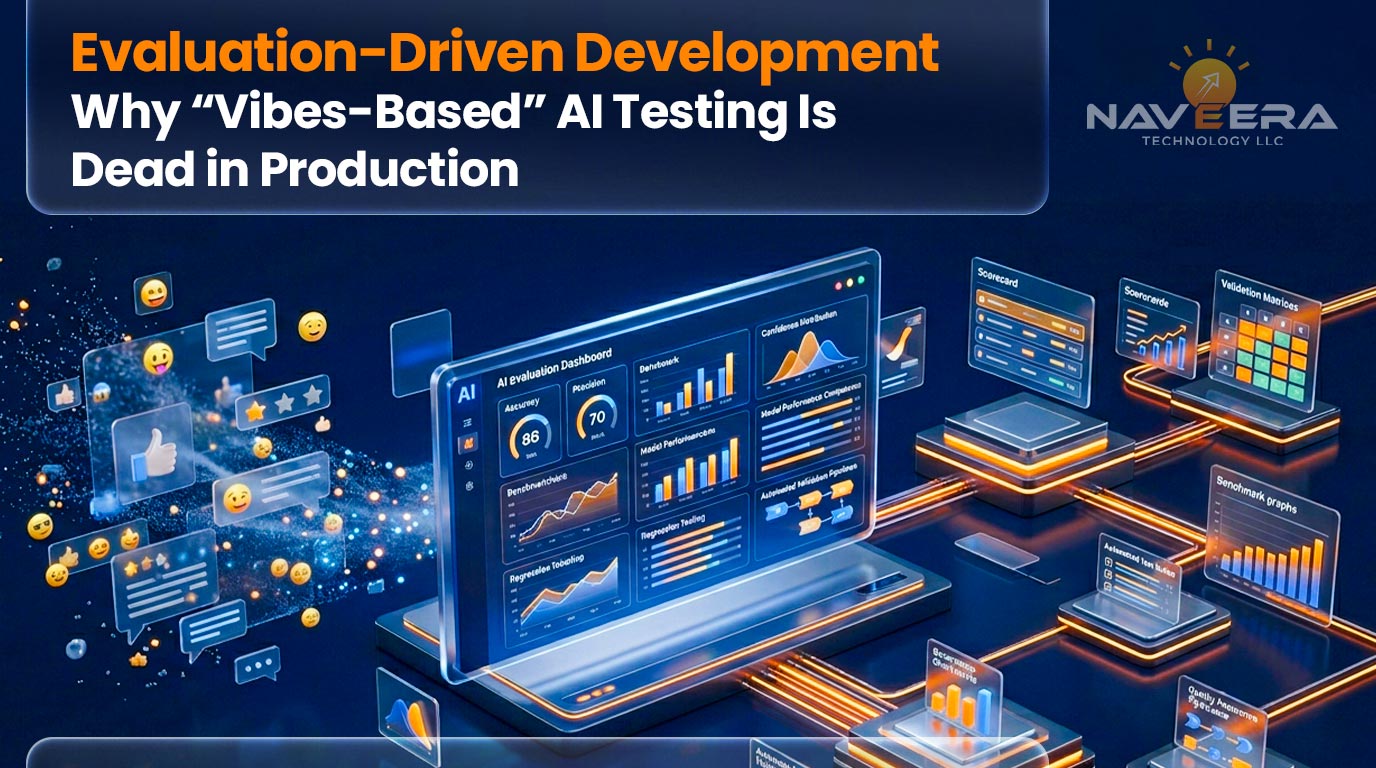
Enterprise AI has entered a phase where testing discipline matters as much as model capability. McKinsey’s 2025 State of AI report states that 88% of organizations use AI in at least one business area. 23% Of companies are already using AI systems in some parts of their business. Another 39% are testing AI systems. Gartner thinks that over 40% of AI projects will be stopped by the end of 2027. The reason is that they cost a lot, or it’s not clear if they add value, or they can’t control the risks. This situation is a deal for 2026: AI use is growing fast. Using AI without control is causing problems with reliability, management, and readiness for use. AI systems, AI projects and AI use are all increasing. AI projects and systems must be managed properly.
That is exactly why evaluation-driven development for AI is becoming a necessary engineering and governance discipline. In early-stage pilots, teams can still get away with prompt tweaking, a few manual spot checks, and subjective judgments about whether the answers “look good.” In production, that approach fails. Enterprise systems now involve retrieval, tools, agents, workflow orchestration, access boundaries, and business-critical decisions. OpenAI’s own documentation states that writing evals to understand how LLM applications perform against expectations is an essential component of building reliable applications, especially when trying or upgrading models. Gartner now goes further at the category level, defining AI evaluation and observability platforms as tools for managing the nondeterminism and unpredictability of AI systems by combining evals, logs, metrics, and traces into a feedback loop for reliability and alignment.
For enterprise leaders, this is not a narrow developer concern. It is a production-quality issue, a governance issue, and increasingly a commercial issue. Deloitte’s 2026 enterprise AI reporting shows that while many organizations are using AI for productivity and redesigning processes around it, successful scale depends heavily on governance, oversight, and operational discipline rather than experimentation alone. That means AI evals in production are no longer optional QA exercises. They are part of the control system that determines whether enterprise AI adoption becomes scalable, trustworthy, and auditable.
Why Informal AI Testing Breaks the Moment a System Meets Real Users
Why “it looked good in the demo” is not a production standard.
A demo is a curated environment. It usually contains a small number of carefully chosen prompts, a controlled system state, and an observer who already knows what “good” is supposed to look like. Production is really different. Real users bring in things, incomplete directions, messy data, mixed goals and unexpected problems. What seems to work in a perfect test often breaks when used in real work with weird input. OpenAI’s evaluation guidance is clear that evals exist to test whether model outputs meet style and content criteria you define, specifically because production reliability cannot be inferred from intuition alone.
How manual spot-checking hides regressions in prompts, models, and tools
Manual review can catch obvious problems, but it is poor at detecting subtle regression. A prompt revision may improve tone while hurting task adherence. A model change may raise answer quality in common cases but reduce groundedness in harder cases. A tool contract change may quietly alter the sequence of actions an agent takes without creating a visibly bad final answer every time. This is why prompt and model regression testing now matters in enterprise delivery. When quality depends on multiple moving parts, a handful of spot checks cannot reveal whether the system actually improved or simply changed.
Why agents make quality assurance harder than simple chat use cases
Agents increase the testing burden because they do more than produce a single response. They choose tools, call systems, manage intermediate state, recover from failure, and sometimes coordinate across multiple steps or multiple agents. Gartner’s AEOP category definition explicitly includes support for observability across multistep agentic workflows, not just request-response interactions. Google Cloud’s Vertex AI agent evaluation framework likewise distinguishes between evaluating the final response and evaluating the trajectory the agent followed, including tool calls and sequence accuracy. That is a major shift from traditional chatbot QA. In agentic systems, the path is often as important as the answer.
The shift from intuition-led iteration to measurable AI system quality
The practical change in 2026 is that AI teams are moving from intuition-led iteration to measurable quality management. Instead of asking whether the output “feels better,” mature teams ask whether the system improved on task completion, task adherence, hallucination control, latency, tool-call accuracy, and business-relevant thresholds. Anthropic’s 2026 agent eval guidance captures this well: for agent systems, a single successful run is not enough, because the same task may pass once and fail on another attempt. Consistency has to be measured, not assumed.
What Evaluation-Driven Development Actually Means for AI Systems
Moving from ad hoc testing to repeatable eval harnesses
Evaluation-driven development for AI means replacing informal testing with a repeatable eval harness. That harness includes representative inputs, scoring logic, graders, pass criteria, and reporting that can be rerun as prompts, models, tools, or workflows change. This is not merely a tooling preference. It is the mechanism that lets engineering teams separate perceived improvement from actual improvement. OpenAI’s Evals API is built precisely around this model of structured, repeatable testing.
Offline evals, online evals, and why both matter
Offline evals and online evals solve different problems. Offline evals help teams validate behavior before release against curated datasets. Online evals and runtime observability help teams understand how the system behaves under real traffic after release. Gartner’s current category definition explicitly calls for both offline and online evaluation. Microsoft’s monitoring guidance similarly treats production quality monitoring as an ongoing discipline, with thresholds for groundedness, relevance, coherence, and fluency in deployed systems. In other words, offline evals protect releases, while runtime monitoring protects operations.
Golden datasets, synthetic cases, and scenario coverage
A serious LLM evaluation framework needs representative test coverage. Golden datasets provide trusted examples for critical scenarios. Synthetic test sets help teams expand coverage into long-tail or edge cases that may not appear often in historical production data. The goal is not just volume. It is coverage of the failure modes that actually matter in the target workflow. For enterprise AI quality assurance, that often means combining real traces, curated hard cases, negative examples, and structured synthetic scenarios into a single evolving test base.
Why evals should measure task success, not just text quality
Text quality is only one part of system quality. Enterprise systems exist to complete tasks, follow policy, use the right tools, resolve intent, and support business decisions. Vertex AI’s agent evaluation framework reflects this by supporting both final-response and trajectory-based evaluation metrics. That distinction matters. A fluent answer can still be operationally wrong if it reached the answer through the wrong tools, skipped required steps, or violated a workflow constraint. Evals should therefore measure task success, not only output elegance.
How evaluation becomes part of the software delivery lifecycle
In mature teams, evaluation becomes part of CI/CD for AI. It runs before release, during model migration, after prompt changes, and throughout production monitoring. Gartner’s AEOP definition explicitly says these platforms can use evals as quality gates to prevent regressions and unexpected outputs from reaching production. That language is important because it frames evaluation not as a research artifact, but as part of enterprise release control. This is the shift from AI experimentation to a production AI evaluation strategy.
The Core Evaluation Stack for Production AI
Dataset design and representative test cases
The first layer is dataset design. Teams need representative cases that reflect actual enterprise usage: standard tasks, hard cases, ambiguous inputs, policy-sensitive requests, and edge conditions. A weak dataset produces false confidence. A strong one exposes where the system breaks before users do. Anthropic’s guidance is useful here because it emphasizes that tasks must be clearly specified and passable; otherwise, the evaluation measures ambiguity rather than agent capability.
Response quality, accuracy, and safety checks
The second layer focuses on classic quality dimensions: accuracy, groundedness, coherence, fluency, relevance, and safety. Microsoft’s monitoring framework explicitly supports aggregated pass-rate thresholds for groundedness, relevance, coherence, and fluency. These are not cosmetic metrics. In enterprise settings, they signal whether the system is aligned with available evidence, speaks consistently, and stays within acceptable response quality boundaries.
Tool-use, task-completion, and agent-behavior evaluation
The third layer is what separates agent evaluation and observability from traditional LLM testing. Here, the focus shifts to tool selection, task adherence, tool-call correctness, and completion quality. Vertex AI’s agent evaluation metrics include trajectory matching, precision, recall, and tool-use checks against a reference trajectory. That gives enterprises a concrete way to evaluate not just outcomes but also the system’s operational behavior.
Trace grading, runtime monitoring, and regression detection
The fourth layer extends evaluation into runtime. Logs, traces, and production events serve as inputs for grading, anomaly detection, and regression analysis. Gartner specifically describes AEOPs as creating a feedback loop where observability data flows back into evals to improve system reliability and alignment. This is one of the most important current trends in AI testing in production systems: evaluation is no longer a pre-launch exercise; it is a live operating loop.
Release gates, rollback decisions, and continuous improvement
The fifth layer turns evals into operating policy. Teams define acceptable thresholds, link them to release decisions, and use them to support rollbacks or remediations when quality falls below an agreed standard. This is also where evaluation becomes governance. If AI systems are allowed to change without measurable gates, then neither engineering nor risk teams can confidently defend production quality. For organizations moving beyond pilots, that is not sustainable.
Why Agentic Systems Make Evals a Hard Requirement, Not a Nice-to-Have
Agents create variability across steps, tools, and outcomes.
Agents are inherently more variable than simple request-response systems. They may choose different tool sequences, encounter different retrieval states, or recover from failure differently across runs. Anthropic’s guidance shows why consistency matters: a system with a 75% per-trial success rate may still fail frequently when the requirement is repeatable correctness across multiple runs. For enterprise deployment, that makes informal confidence a dangerous proxy for reliability.
Why identical prompts can still produce different valid or invalid paths
The same prompt may lead to different paths. Some may be acceptable. Others may be wasteful, unsafe, or noncompliant. Vertex AI’s trajectory metrics exist because enterprises need a way to assess whether the agent used the correct sequence of actions, not merely whether it arrived at a plausible final answer. This is especially relevant in environments with strict policy enforcement, tool boundaries, or audit requirements.
Tool selection, task adherence, and completion quality as new evaluation surfaces
These are now first-class evaluation surfaces. Did the system use the correct tool? Did it complete the required task? Did it follow the right instruction hierarchy? Did it stop or escalate appropriately? These questions matter in knowledge workflows, approval flows, security operations, and customer-facing systems alike. They are also where enterprise AI quality assurance intersects directly with runtime governance.
Why long-running and multi-agent systems need stronger harness design
As workflows grow longer and more distributed, the importance of harness design increases. Multi-step agents and multi-agent systems create more state transitions, more handoffs, and more opportunities for drift. The evaluation harness, therefore, has to cover temporal behavior, not just final outputs. This is one reason Gartner now treats evaluation and observability as a combined category rather than separate concerns.
The difference between evaluating outputs and evaluating workflows
Output evaluation asks whether the answer is acceptable. Workflow evaluation asks whether the system behaved acceptably while producing it. Mature enterprise teams need both. For organizations working with a partner like Naveera Technology, this is often where the real implementation value lies: designing the eval-driven system, runtime observability, and governance workflow together rather than treating them as isolated tooling decisions.
The Metrics That Actually Matter in Production
Accuracy, groundedness, and hallucination risk
Accuracy is necessary, but groundedness often matters even more in enterprise use cases tied to internal knowledge, policy, or regulated data. Microsoft’s production monitoring guidance includes groundedness as a thresholded signal, which is a strong indicator of where enterprise measurement is heading. The question is no longer only “Is it correct?” but also “Is it supported by the right evidence?”
Task completion, adherence, and tool-call correctness
For agentic systems, these are core quality signals. Task completion shows whether the workflow actually finished. Task adherence shows whether it followed the intended process. Tool-call correctness shows whether the system used the platform as designed. These are more operationally meaningful than generic benchmark scores because they reflect the actual job the system is supposed to do.
Latency, retries, and cost-per-successful-task
Production quality is not just semantic quality. It is also operational performance. A system that succeeds only after excessive retries, long delays, or inflated costs may still be a production problem. AI testing in production systems increasingly includes cost and efficiency signals alongside quality signals, as enterprise leaders care about throughput, reliability, and operational economics simultaneously. Gartner’s AEOP definition even includes cost measures such as token costs within the observability scope.
Regression detection across prompt, model, and orchestration changes
Regression detection is one of the most important uses of automated AI evaluations. Prompt changes, model upgrades, retrieval changes, and orchestration edits can all degrade performance in non-obvious ways. Evals should therefore be treated as both comparison and scoring tools. They help teams answer the production question that actually matters: did this change improve the system, leave it unchanged, or make it worse?
Why business-aligned quality thresholds matter more than generic benchmark scores
Enterprise systems should be evaluated against business-relevant thresholds, not leaderboard vanity metrics. A support agent, a policy assistant, a security copilot, and a finance workflow agent all have different quality tolerances and different failure costs. Deloitte’s 2026 findings reinforce that enterprises are rethinking workflows and governance together as AI scales. That means quality thresholds must map to business consequences, not abstract model performance.
How Mature Teams Build an Eval-Driven AI Delivery Process
Add evals before scale, not after incidents.:
Teams that wait until incidents occur are already behind. Evals should be designed before scale, when the system boundaries are still understandable, and the workflows are still narrow enough to be instrumented well. That is the point at which evaluation-driven AI development has the greatest leverage.
Connect evals to CI/CD, release reviews, and rollback policy.
The mature pattern is straightforward: every meaningful prompt, model, or workflow change triggers evaluation; every release review includes quality evidence; every rollback decision has threshold logic behind it. Gartner’s use of the term “quality gates” is especially useful here because it conveys the control objective in language that enterprise stakeholders understand.
Use production traces to improve datasets and test coverage.
Production traces are one of the best sources of new test cases. Real failures show us where the system is most likely to break. They point out task instructions. Also, they highlight missing edge conditions in our dataset. This turns runtime observability into dataset improvement, which then improves future offline evals. That feedback loop is now central to production AI evaluation strategy.
Combine human review with automated scoring where it matters.
Automation is very important. We should not rely only on machine scores. Some workflows are risky, some cases are unclear, and some outputs are highly sensitive to policy changes. In these situations, human review is still necessary. The best approach is to combine automation and human review. Automation can improve coverage and speed, while humans can review cases and make critical governance judgments. This hybrid model is the one.
Treat evals as an operating loop, not a one-time certification step.
This is the mindset shift the client is pointing toward. Evals are not a one-time checkbox. They are an operating loop: define expectations, test, release, monitor, detect regressions, improve datasets, and test again. That is what makes AI delivery reliable enough for enterprise production. It is also where Naveera Technology can credibly position itself: not as a generic AI vendor, but as an implementation partner that helps enterprises operationalize evaluation, observability, and secure AI delivery together.
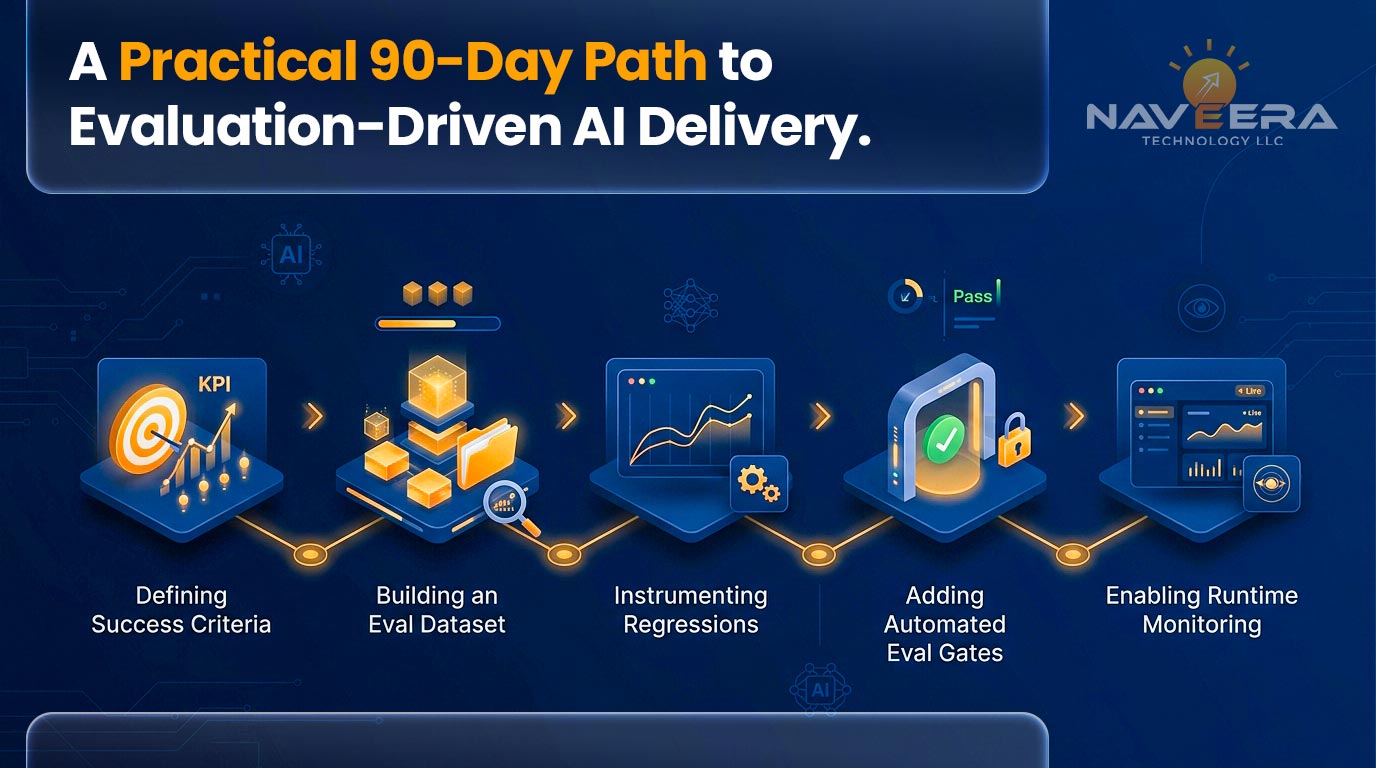
Getting Started — A Practical 90-Day Path to Evaluation-Driven AI Delivery.
Step 1 — Define what “good” means for one high-value use case
Choose one important workflow and define what success means in business terms. That could be grounded policy retrieval, high-confidence support resolution, correct document extraction, or task-complete analyst assistance. Without this definition, evaluation has no anchor.
Step 2 — Build a small but representative eval dataset
Create a compact dataset that includes standard cases, hard cases, and failure-prone edge conditions. Add synthetic cases only where they improve meaningful coverage. The goal is not size first. It is relevant first.
Step 3 — Instrument prompt, model, and tool regressions
Track changes in prompts, models, tool definitions, and workflow logic. Then evaluate those changes against the same harness so regressions become visible before users feel them.
Step 4 — Add automated eval gates before production releases
Introduce release gates tied to meaningful quality thresholds. If the new version fails, it does not ship until the issue is understood. This is how evals become part of production control rather than post-launch analysis.
Step 5 — Expand into runtime monitoring and continuous improvement
Once pre-release gates are in place, extend runtime monitoring to include groundedness, trace anomalies, retries, latency, tool misuse, and live failure patterns. Then feed those findings back into the dataset. That is the loop that creates durable, high-quality production.
FAQ
Q1: What is evaluation-driven development for AI?
It is the practice of building AI systems around repeatable evaluations, measurable thresholds, and release controls rather than informal testing.
Q2: Why is manual or “vibes-based” AI testing not enough for production?
AI systems are not always predictable. When we do manual checks, we can miss problems that have worsened in the prompts, models, tools, and workflows of the AI systems.
Q3: What should enterprises measure when evaluating AI agents?
Measure task completion, task adherence, tool-call correctness, groundedness, latency, retries, and regression rates.
Q4: How do offline evals differ from runtime monitoring?
Offline evals test pre-release behavior on datasets; runtime monitoring measures live production behavior after deployment.
Q5: How should teams integrate evals into their AI delivery lifecycle?
Connect evals to CI/CD, release reviews, rollback decisions, and production trace analysis