
For VPs of Engineering, Chief Data Officers, and Data Platform Directors, with implementation detail for platform engineers later in this post.
The problem every data leader already knows
Ask any Head of Data Engineering how long it takes to onboard a single new data source, whether that is a new vendor feed, a new internal system, or a new regulatory dataset, and the honest answer is almost never “days.” It is weeks. Someone hand writes the ETL. Someone else writes the quality checks after the fact, usually after a downstream report breaks. The semantic layer gets updated manually, if it gets updated at all. Compliance review happens at the end, as a gate, rather than as part of the build.
None of this is truly a tooling problem. It is a sequencing problem. Architecture, governance, and code get built in the wrong order, by whoever happens to be available that sprint.
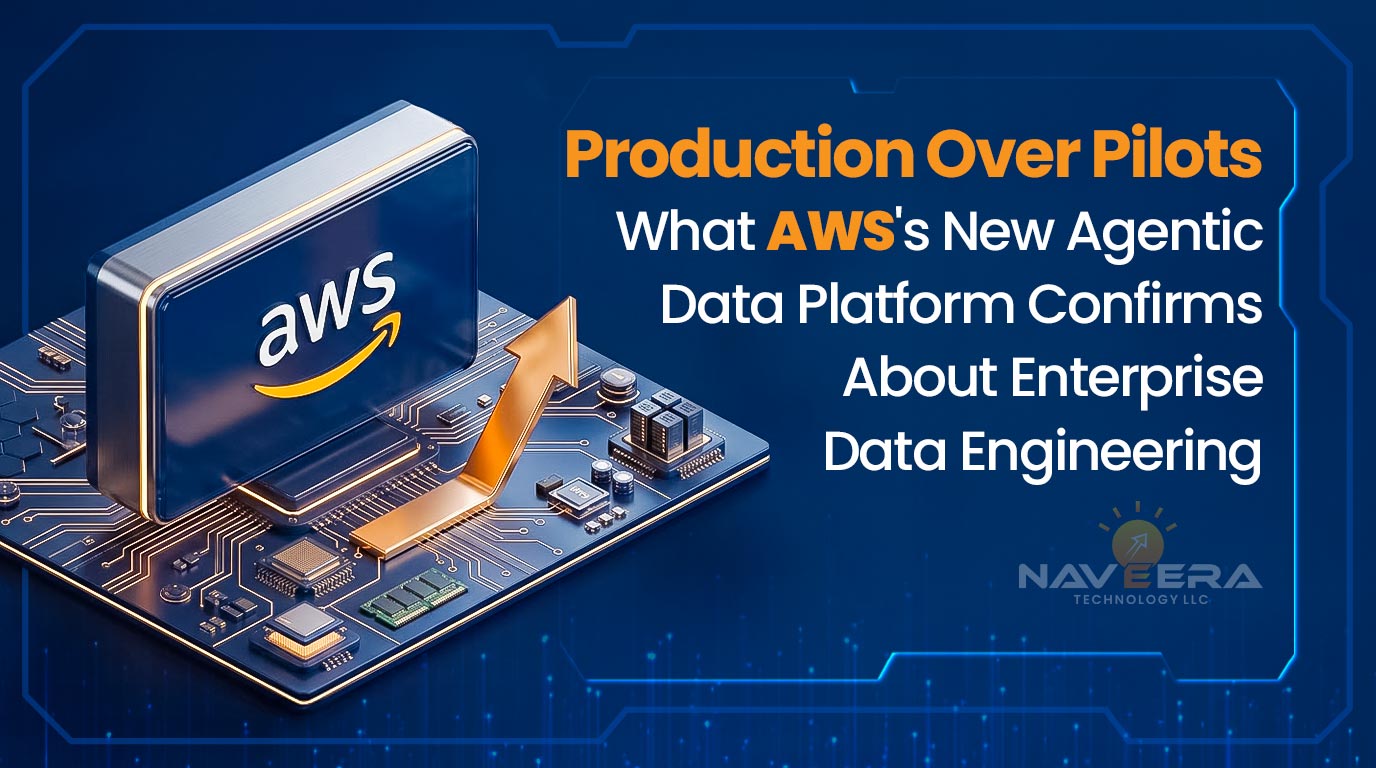
AWS’s newly published reference architecture, the Agentic Data Operations Platform (ADOP), is worth paying attention to. Not because it is the first agentic data tool to reach the market, but because of a specific design choice about where AI is allowed to operate. That choice happens to validate an approach Naveera Technology has built its delivery model around for years.
What ADOP actually does
ADOP uses a set of specialized AI agents, running on Amazon Bedrock and orchestrated through Claude Code, to automate the Bronze to Silver to Gold pipeline lifecycle. A user describes a new data source in natural language, and a coordinating agent spins up sub agents for each stage of the build: metadata inference, ontology mapping, quality rule generation, ETL transformation, and orchestration through Airflow or Step Functions.
The result, according to AWS, is that new source onboarding compresses from weeks to hours on subsequent sources, once an organization’s standards are encoded into the system a single time.
That claim matters. But the more important part of the architecture is not the speed. It is the boundary AWS drew around where the AI is allowed to act.
The design choice that matters: agents in development, artifacts in production
ADOP is explicit that it functions as a build time accelerator, not a runtime dependency. Agents reason, draft, and propose during development. A human reviews the output. Continuous integration then promotes the generated artifacts, meaning plain PySpark, SQL, Airflow DAGs, and IAM and Cedar policies, into staging and production. By default, production runs none of it through a model at inference time. It simply runs deterministic, auditable code.
This is the part of the announcement every data leader should internalize, independent of whether their organization ever touches ADOP itself. The purpose of the AI is to compress the drafting phase, not to sit inside the critical path of a production data platform.
That distinction addresses a real concern we hear constantly in client conversations. Teams are enthusiastic about what agentic tools can accomplish, yet uneasy about a language model making live decisions inside a regulated production pipeline. ADOP’s answer is straightforward. Let the agent draft the pipeline once, under review, then ship deterministic code. Model in the loop inference at runtime becomes a deliberate, separately governed extension rather than the default.
Why this matches what Naveera sees in the field
This is the same conclusion Naveera has reached independently, across data engineering engagements where the client’s real bottleneck was never the question of whether a pipeline could be built. The real question was always whether that pipeline could survive governance review, security sign off, and a production SLA without becoming a permanent science project.
Naveera’s capability, and why it matters here
Naveera Technology has spent more than fifteen years in IT services and consulting, and the last several years focused specifically on turning data and AI initiatives into systems that actually run in production, not systems that impress a demo audience and then stall. That focus shapes every one of our practice areas, and each one connects directly to the architectural lesson ADOP just validated publicly.
Data Engineering Services. This is our core discipline. We design and build reliable, scalable data pipelines that convert raw, siloed data into analytics ready assets, across batch, real time, and cloud native environments. When we talk about encoding an organization’s standards once so every new source inherits them automatically, that is not a hypothetical. It is the operating model behind our data pipeline design, ETL modernization, BI and analytics enablement, and streaming integration work. We have applied a governed metrics layer for a client and reduced analyst time per report by thirty percent, purely by removing the ambiguity that ungoverned pipelines, agentic or manual, both create when there is no single source of truth for a metric’s definition.
Generative AI Services. We design, train, and deploy generative AI solutions that are built to run continuously in a business, not sit in a sandbox. One of our ops copilot engagements reached first production deployment in under twenty five percent of the originally scoped timeline, because the team refused to treat “production ready” as a separate, later phase. Compliance, monitoring, and access control were part of the build from day one, exactly the sequencing ADOP encodes structurally through its guardrails and Decision Engine.
Artificial Intelligence Services. Beyond generative AI, we build predictive and prescriptive analytics, computer vision, natural language processing, and MLOps practices that keep deployed models honest over time. A retail client’s inventory planning engagement improved forecast accuracy by fifteen percent, a result that depends entirely on model monitoring discipline once a model reaches production, not just model quality at launch.
Application Development. Enterprise and SaaS platforms, UI and UX, cloud native microservices, and API integration work round out how we help clients turn a validated data or AI capability into something end users and internal teams actually touch. Many of our data and AI engagements begin as a pipeline or a model, and mature into a full application layer once the underlying data platform is trustworthy enough to build on.
IT Infrastructure Services. Cloud and on premises infrastructure, security, backup, disaster recovery, and network management are the unglamorous foundation that makes any of the above sustainable. After introducing service level objectives and alerting on one client’s data jobs, their incident rate shifted from priority one to priority zero, meaning the failure mode changed from a pipeline silently breaking in production to a pipeline warning the team before it broke.
Offshore Development Services and Extended Teams. Through our development center and a proven talent model built on university partnerships and continuous upskilling, we give clients dedicated, senior engineering capacity without the ramp up time or attrition risk that typically comes with scaling a data or AI initiative quickly. Our attrition sits below six percent industry wide, and our subject matter expert tenures regularly exceed seven years, which matters enormously when an organization is trying to encode standards that need to persist across years, not sprints.
Across every one of these practices, our internal standard is the same one ADOP encodes architecturally: production over pilots. We would rather ship one governed, monitored, adopted data product than five impressive proofs of concept that never survive contact with a compliance review.
Where we would extend the thinking
Strong thought leadership should challenge a vendor’s announcement as much as it agrees with it, so a few honest considerations are worth raising before any organization adopts this pattern.
ADOP is shaped specifically around AWS, Bedrock, and Claude Code. That is a reasonable choice for an organization already committed to that stack. Naveera’s own delivery philosophy generally favors open standards, including dbt, Terraform, Kubernetes, and Kafka, specifically so a client is never locked into one vendor’s orchestration model for how every future data source gets onboarded. Any organization adopting an ADOP style pattern should confirm that the architectural contract itself, meaning the standards, the guardrails, and the compliance prompts, remains portable, not just the pipeline code it generates.
Configurable compliance controls are not the same thing as compliance. AWS is careful to say this directly. Generated masking rules, retention policies, and access controls must be treated as unverified drafts until legal and compliance teams sign off. That posture should be non negotiable regardless of which agentic platform an organization chooses.
Consistency is only as strong as the standards encoded into the system. ADOP’s Decision Engine is described as an AI encoded version of an enterprise architect. That is powerful, but it also means the one time investment of getting an organization’s standards right at the outset matters more than the tooling itself. Rushing that step to reach the “hours, not weeks” outcome faster defeats the entire purpose.
The takeaway for data leaders
An organization does not need to adopt ADOP specifically to take the lesson from it. The lesson is architectural, not product specific.
First, let AI agents compress the drafting phase of data engineering, including schema inference, quality rules, ETL scaffolding, and semantic layer updates. Second, keep a human review gate before anything reaches production. Third, ship deterministic, auditable code to production rather than a live model making runtime decisions inside a regulated pipeline, unless that is a deliberate, separately governed choice. Fourth, encode governance and architectural standards once, so every future data source, and every AI coding tool an engineering team uses, inherits them automatically instead of reinventing them project by project.
That is the difference between a pilot that impresses a demo audience and a data platform that survives an audit.
Let’s build the version of this that fits your stack
If your organization is evaluating an agentic approach to data engineering and wants a partner who has already done the harder work of turning data and AI pilots into governed, production grade systems, Naveera Technology is ready to help. Our approach starts the same way every one of our engagements starts: pick one use case with a clear KPI and a real data path to production, ship that first, then generalize the pattern across the organization.
Schedule a technical deep dive with our team, and we will walk through exactly where your current data platform stands, what an agentic onboarding pattern would look like inside your existing stack, and what a realistic first thirty day path to production looks like for your organization.
Schedule a technical deep dive with Naveera Technology
Implementation notes for platform engineers
For those responsible for actually standing this up, not just deciding whether to.
Sub agent design. ADOP splits responsibility across metadata, ontology, quality, ETL, and orchestration sub agents, each validated locally before deployment with human in the loop approval. Whether or not an organization uses ADOP’s exact framework, this separation of concerns is worth replicating. A single monolithic pipeline building agent is harder to review and harder to constrain.
Guardrails as infrastructure, not prompts. Tool routing rules, authorization policies such as Cedar, invariants, and inline compliance prompts should live in a versioned architectural contract owned by the platform team, not scattered across individual engineers’ personal prompt habits.
Secrets and data isolation. Credentials should never enter agent context. Resolve them at deploy time through a secrets manager or an existing vault, and have agents reference ARNs or placeholders only. For data profiling, run it inside an isolated sandbox against a scoped subset, and return only summarized statistics to the agent rather than raw rows.
Observability from day one. Every agent decision, including intent, tool selected, outcome, and cost, should be traceable and exportable to an organization’s monitoring stack, whether that is CloudWatch, OpenTelemetry, or an equivalent system. This is what makes “an AI drafted this” defensible in an audit months later.
Start local, scale deliberately. Run the agent stack locally or inside a private network by default. Promote to a managed runtime only once scale genuinely demands it, and confirm the architectural contract does not change shape when that promotion happens.
Rollout sequencing. Pilot with one non critical source and two to three engineering champions before expanding further. Track first pass artifact acceptance rate and guardrail compliance rate as leading indicators, not simply time saved, which is easy to inflate by skipping review.