
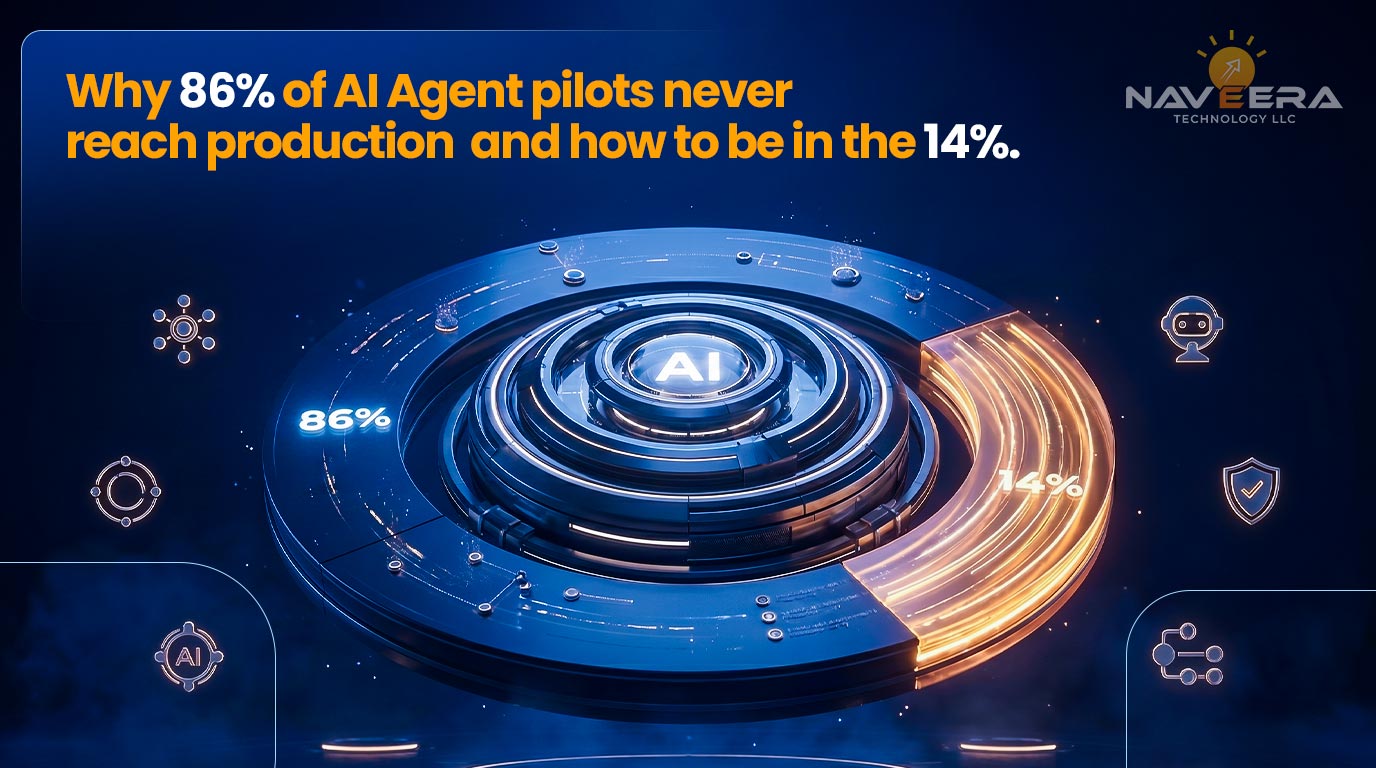
Ai agent pilots fail to make it to production. This is not because the technology does not work. Because of issues with strategy, data readiness and execution. Many organizations start testing AI without a plan or the right infrastructure.
Why AI Agent pilots stall before production and how to be in the successful:
Most enterprise AI agent pilots stall because they are not ready for production. They lack governance and good workflow orchestration.
Without AI agent evaluation, observability and reliability early success in demos rarely translates into scalable deployment.
Organizations that succeed focus on production AI architecture and build with bounded autonomy from day one.
The Pilot-to-Production Gap is Real – The Root Cause is Usually Not the Model:
Most failures are not due to the AI model itself. Gaps in data quality, system design and workflow integration.
Why impressive agent demos often collapse under production conditions:
AI agent demos perform well in controlled environments but fail in real-world scenarios due to inputs, scale and integration complexity.
Without observability, guardrails and error handling these systems struggle to maintain consistency and reliability in production.
The difference between a pilot, a prototype and a production workflow system:
A prototype proves possibility. A pilot validates limited use cases but a production system demands scalability, governance and seamless workflow orchestration.
Why quality, reliability and control matter more than novelty:
In production consistent performance outweighs innovation hype as failures directly impact business outcomes.
Enterprises prioritize reliability, bounded autonomy and policy enforcement to ensure AI agents operate safely and predictably.
The market is shifting from experimentation to accountability:
The market is shifting from experimenting with AI to focus on real accountability, where organizations are expected to deliver business results.
Why AI Agent Pilots Fail to Reach Production:
AI agent pilots look promising in a controlled environment but production exposes real-world complexity.
The biggest gap is not whether the demo works it is whether the agent can operate reliably cost-effectively at scale.
Weak workflow boundaries and unclear business ownership:
Many pilots fail because the agent is not tied to an owned business process.
When no one owns the outcome end to end the project stays trapped in experimentation of becoming part of daily operations.
Poor tool governance, permissions and action controls:
Agents may have much access or the wrong access, which creates security and compliance risk.
In production every tool call, permission and action path needs guardrails so the agent can act within approved boundaries.
Low evaluation maturity – teams measure outputs, not task success:
A lot of team judge agents by whether the response sounds good not whether the task was completed correctly.
Production readiness requires task-level evaluation, success criteria and repeatable testing against scenarios, edge cases and failure modes.
Missing observability, tracing and incident visibility:
If you cannot see what the agent did why it did it and what is cost you cannot manage it in production.
Observability helps teams trace decisions, spot failures early and investigate incidents with the context needed to fix root causes.
Cost unpredictability, retry sprawl and weak ROI discipline:
Agent pilots often underestimate the cost of retries tool calls and human oversight.
In production a weak ROI model can turn a pilot into an expensive experiment that is hard to justify at scale.
Governance and risk controls added late:
The common mistake is treating governance as a final checklist item instead of a design requirement.
By the time risk controls are added the pilot may already be built around assumptions making production rollout slow or impossible.
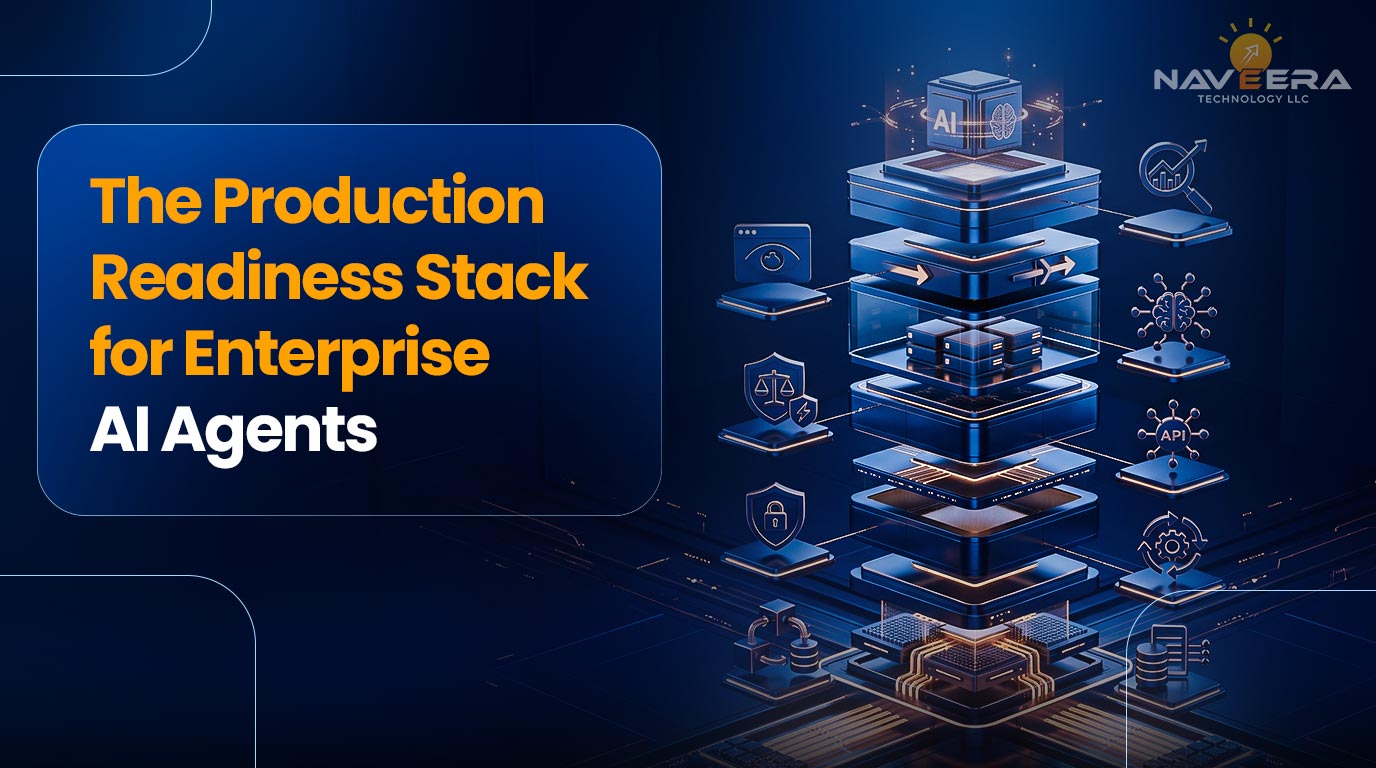
The Production Readiness Stack for Enterprise AI Agents:
Building enterprise AI agents isn’t about functionality it’s about ensuring they are reliable, secure and scalable in real-world environments.
A structured production readiness stack helps organizations move from pilots to stable high-performing systems with confidence.
Layer 1. Workflow Design and Bounded Autonomy:
Strong AI agents begin with defined workflows.
By setting boundaries on autonomy enterprises ensure agents act within predictable limits while still delivering efficiency and speed.
Layer 2. Data Access, Retrieval Quality and Context Governance:
Reliable outputs depend on high-quality data access and retrieval.
Proper context governance ensures that agents use relevant and secure information at every step.
Layer 3. Tool Permissions, Execution Controls and Approvals:
Giving agents access to tools requires permission systems.
Execution controls and approval checkpoints help prevent errors ensuring every action aligns with business rules.
Layer 4. Evaluation, Observability and Runtime Monitoring:
Continuous evaluation is key to trust.
With observability and real-time monitoring teams can track performance detect issues early and optimize agent behaviour effectively.
Layer 5. Cost Controls, Rollback paths and Operating Discipline:
Scaling AI without cost visibility is risky.
Smart cost controls combined with rollback mechanisms allow teams to quickly reverse failures and maintain discipline.
Production success comes from operational practices.
The Architecture Patterns That Survive Contact with Production:
Not every AI architecture works in real-world production.
The patterns that succeed are those designed for reliability, scalability and failure handling ensuring systems perform consistently under user and business pressure.
Single-agent patterns vs. multi-agent systems:
Single-agent systems actually perform better than complex setups with multiple agents.
Human in the loop for high risk actions:
Human involved in high risks actions isn’t optional rather than it’s essential to make sure the right decisions are made.
Event-driven orchestration, retries and failure isolation:
Production systems must handle failures gracefully.
Event-driven orchestration with mechanisms and failure isolation ensures that one issue doesn’t break the entire workflow.
When to use deterministic workflows instead of agentic reasoning:
Not every task needs AI-driven reasoning.
Deterministic workflows are more reliable for rule-based processes helping reduce unpredictability in production environments.
Why the best production systems separate reasoning from execution:
Separating reasoning from execution improves control and safety.
AI handles decision-making while execution systems enforce rules creating a robust and manageable architecture.
What Successful Teams Do Differently:
Successful teams don’t just build AI; they build it with purpose and discipline.
Their focus is on outcomes strong foundations and scaling only when systems prove reliable in real-world use.
Start with one narrow workflow tied to measurable business value:
Winning teams begin small with a focused use case.
By tying workflows to measurable business value, they ensure impact and clear ROI before expanding further.
Define task success, escalation rules and failure boundaries early:
Clarity from the start reduces confusion later.
Defining success metrics, escalation paths and failure limits helps teams manage risks and maintain control over AI behaviour.
Instrument evals, traces and auditability before scale:
Before scaling visibility is critical.
Teams invest in evaluations, tracing and auditability to understand system performance and ensure accountability at every step.
Add cost guardrails before deployment:
Cost management is not an afterthought.
Setting guardrails early prevents expenses and keeps AI deployments financially sustainable as they grow.
Expand after the operating model proves stable:
Scaling too early can lead to failure.
Successful teams expand after their operating model is tested, stable and consistently delivering reliable results.
The 2026 Pattern – From AI Agent Pilot to Governed Production System:
In 2026 success is no longer about launching AI pilots it’s about turning them into governed, production- systems.
Organizations are moving towards structured approaches that focus on reliability, better control and delivering long-term value.
Why governance-first is replacing demo- agent deployment:
Demo-first approaches often fail in environments.
A governance-first mindset ensures compliance, control and accountability are built in from the start reducing risks during scale.
How enterprises are moving from pilots to workflow-native AI:
Enterprises are integrating AI directly into core workflows of running isolated experiments.
This shift enables value delivery and smoother adoption across business operations.
The shift from chat interfaces to embedded agents:
AI is moving beyond chat-based tools into embedded systems that act within real workflows.
These operational agents automate tasks seamlessly improving efficiency without disrupting user experience.
Why production success now depends on architecture, not enthusiasm:
Early excitement alone doesn’t sustain AI success.
Strong architecture focused on scalability, monitoring and control is now the foundation of production systems.
What “ready for production” should actually mean in 2026:
Being production-ready means more than just working code.
It requires robustness, governance, cost control and the ability to handle real-world complexity with consistency.
Getting Started – A 90 – Day Path from Pilot, to Production Readiness:
The 90 days goal is to create a practical path for moving from pilot to production.
Steps to Achieve AI Agent Production Readiness:
Step 1 – Select one workflow with value and bounded risk
Start with a single workflow where the business value is obvious and the risk is contained. A narrow use case makes it easier to prove Return on Investment (ROI) reduce complexity and avoid the mistake of trying to automate everything at once with AI agents.
Step 2 – Map tools, data paths, approvals and ownership
Before building the AI agent define which tools it can use what data it can access and who approves each action. Clear ownership and workflow boundaries prevent confusion later. Help move the pilot towards production readiness for AI agents.
Step 3 – Add evaluation, tracing and policy controls
A pilot is not production-ready without evaluation and observability. You need to measure task success trace AI agent actions and apply policy controls so the system behaves safely and consistently in business conditions.
Step 4 – Pilot under production- constraints not demo conditions
Demo environments often hide the problems that appear in real usage. Test the AI agent with data, real permissions and operational constraints so you can see where reliability, cost or governance issues show up early.
Step 5 – Scale when reliability, cost and governance are measurable
Do not expand the pilot until performance is stable and the cost model is predictable. The goal is to scale only after you can prove that the AI agent works reliably stays within budget. Meets governance requirements.
What does a 90-day AI Agent Production-Readiness Assessment Actually Looks Like:
It’s about figuring out whether the AI agent is truly ready to roll out. By the end of it you should clearly know if the workflow delivers real value and you can also confidently move from experimentation to production.
FAQ
Q1: Why do many AI agent pilots fail to reach production?
Because they lack control, visibility and structured workflows. Not because of AI models.
Q2: What makes an AI agent production-ready in an enterprise setting?
Reliability, monitoring, cost control and strong control for AI agents.
Q3: How should enterprises evaluate AI agents before deployment?
Focus on task success and business results not just responses from AI agents.
Q4: What are the governance risks in agentic AI systems?
Security vulnerabilities, actions, Cost overruns, with AI agents.
Q5: How can teams move from agent demos to reliable business workflows?
By moving from trying things out to designing systems that work with AI agents.
Conclusion:
AI agents are no longer experimental tools. They are becoming core business infrastructure.
The organizations that succeed will not be the ones with the advanced models.
They will be the ones with the design, control and execution discipline.
At Naveera Tech Solution:
Most AI agent pilots fails because they stuck in the testing phase, without a clear path to scale, show real ROI, or build on strong data foundations.
At Naveera Tech, the focus is on building AI solutions that are ready for production from day 1, so pilots are turn into real, measurable business results.
To be in the successful 14%, companies need to align their strategy, data and execution with one goal deployment, not just experimentation.