Will the data platform you pick today be able to handle tomorrow’s AI workloads without blowing up your cloud budget? The choice between Databricks and Snowflake is no longer about picking a data lake or a cloud data warehouse. Companies now need a platform that can support data engineering, business intelligence, machine learning, real-time processing and generative AI—all, in one governed environment.
The stakes are growing for AI. McKinsey’s The State of AI in 2025 found that 88 percent of survey respondents reported AI use in at least one business function while about one third said that organizations had begun scaling AI programs across the enterprise. Meanwhile, Flexera’s 2026 State of the Cloud Reportt found that 85 percent of surveyed organizations identified managing cloud spend as a challenge. Together these findings highlight the pressures of expanding AI adoption and controlling cloud costs.
The snowflake databricks evaluation must therefore go beyond listing features. It should look at how each platform matches the organizations workloads, current systems, technical abilities, rules and goals, for the future. Even though their abilities are becoming more similar, Databricks and Snowflake have structures and ways of working. For business leaders the question is which platform or smart mix of both best helps their goals in a way that can be kept going without much cost.
What is Databricks?
Databricks is a data and AI system built around the lakehouse architecture. Databricks has roots in Apache Spark and open data technologies. Databricks supports data engineering, analytics, streaming, machine learning and generative AI workloads.
Databricks Lakehouse Architecture
A lakehouse combines scalable data-lake storage with warehouse-style reliability, performance and governance. Delta Lake adds transaction management, while support for technologies such as Apache Iceberg can improve interoperability. Engineering, analytics and AI teams can work from a shared data foundation.
Data Engineering, Streaming and AI
Databricks offers a focused engineering setting for batch processing, streaming, ETL, ELT and distributed transformation. I find Databricks very useful for this type of work. Databricks also backs data preparation, experimentation, model development and deployment. Unity Catalog brings access control, lineage, discovery and auditing across data and AI assets, as the official documentation explains.
What Is Snowflake Software?
Snowflake is a cloud‑native data platform that helps with data warehousing, SQL analytics, business intelligence and governed data sharing. Snowflake separates storage, compute and cloud services. Takes care of most of the underlying infrastructure.
Snowflake Architecture and Analytics
Snowflake keeps data stored in one place. It runs workloads using warehouses that work independently. Each department can use its warehouse without affecting others. This means no competition for computing power. The platform works with structured, semi-structured data and unstructured data. It also supports Apache Iceberg tables when data is stored externally in cloud storage. Snowflake describes this setup in its architecture documentation.
Snowpark and Cortex AI
Snowpark lets developers use Python, Java and Scala while processing data within Snowflake. Cortex adds AI and machine learning capabilities close to governed data. Enterprises should still confirm availability, costs and limitations for each required service.
Databricks vs. Snowflake: Key Differences
The following snowflake databricks comparison summarizes the platforms’ general positioning. It should be treated as a starting point, not a replacement for workload testing.
| Evaluation area | Databricks | Snowflake |
|---|---|---|
| Foundation | Lakehouse centered on data and AI workloads | Managed cloud platform with separated storage and compute |
| Traditional strength | Data engineering, streaming and machine learning | SQL analytics, data warehousing and business intelligence |
| Processing | Spark-based engineering ecosystem | SQL pipelines, Snowpark and managed services |
| AI | Integrated machine learning and generative AI workflows | AI capabilities close to governed Snowflake data |
| Governance | Unity Catalog for data and AI assets | Integrated security, metadata, governance and sharing |
| Administration | Flexibility may require deeper engineering skills | Managed infrastructure can reduce administration |
| Open formats | Strong alignment with open lakehouse technologies | Snowflake-managed tables and Apache Iceberg support |
Both now cover broad data and AI requirements. The important question is how well each approach fits the enterprise operating model.
Comparison by Enterprise Workload
Data Engineering and Streaming
Databricks may fit engineering-intensive pipelines, distributed transformations and streaming, particularly when teams have Spark expertise. Snowflake supports ingestion and transformation through SQL, Snowpark and managed services, potentially reducing infrastructure-management work.
SQL Analytics and Business Intelligence
Snowflake can appeal to SQL-focused organizations that need reporting and concurrency. Databricks SQL offers warehouse-style analytics, for lakehouse data. You might want to evaluate query complexity, latency, dashboard usage and existing BI tools before making a choice.
Machine Learning and Generative AI
Databricks may fit organizations developing custom machine learning and engineering-intensive AI. Snowflake may be compelling when AI must operate close to data already managed there. For generative AI and RAG, test retrieval quality, model access, governance, observability and inference cost.
Data Sharing and Interoperability
Both support governed sharing. The preferred approach depends on where authoritative data resides, who needs access and whether open-format interoperability is strategically important.
Databricks vs. Snowflake Pricing and Total Cost
Both platforms use consumption-based pricing, but one published rate will not reveal total cost.
Databricks charges according to the products and compute resources used. Storage, networking and other cloud-provider costs may also apply. Pricing varies by workload, region and cloud platform. Databricks recommends side-by-side testing to estimate total cost, as explained on its official pricing page.
Snowflake uses credits for compute consumption, with additional considerations for storage, data transfer, serverless services and specific features. Warehouse size, runtime and cluster count affect usage. The official Snowflake cost documentation explains these components.
A complete cost assessment should include:
- Platform implementation and migration
- Pipeline redevelopment
- Storage and data transfer
- Compute utilization
- Governance and monitoring
- Training, integrations and administration
A lower unit price does not guarantee a lower operating cost. Idle compute, inefficient pipelines, and duplicated data can increase spending.
Which Platform Fits Your Business?
Consider Databricks When
Databricks may be appropriate when data engineering, streaming, and custom AI are strategic priorities; teams have Spark or Python skills; open formats matter; or engineers need detailed control over complex processing.
Consider Snowflake When
Snowflake may be appropriate when SQL analytics and business intelligence are immediate priorities; the organization prefers managed infrastructure; many users require concurrent access; or governed data sharing is a major requirement.
Consider Both When
The platforms can play complementary roles—like using Databricks for engineering and machine learning and Snowflake for analytics. A dual-platform approach needs rules about data ownership, how data moves between systems, tracking data lineage, and who is responsible for costs. This helps avoid duplication and keeps everything organized.
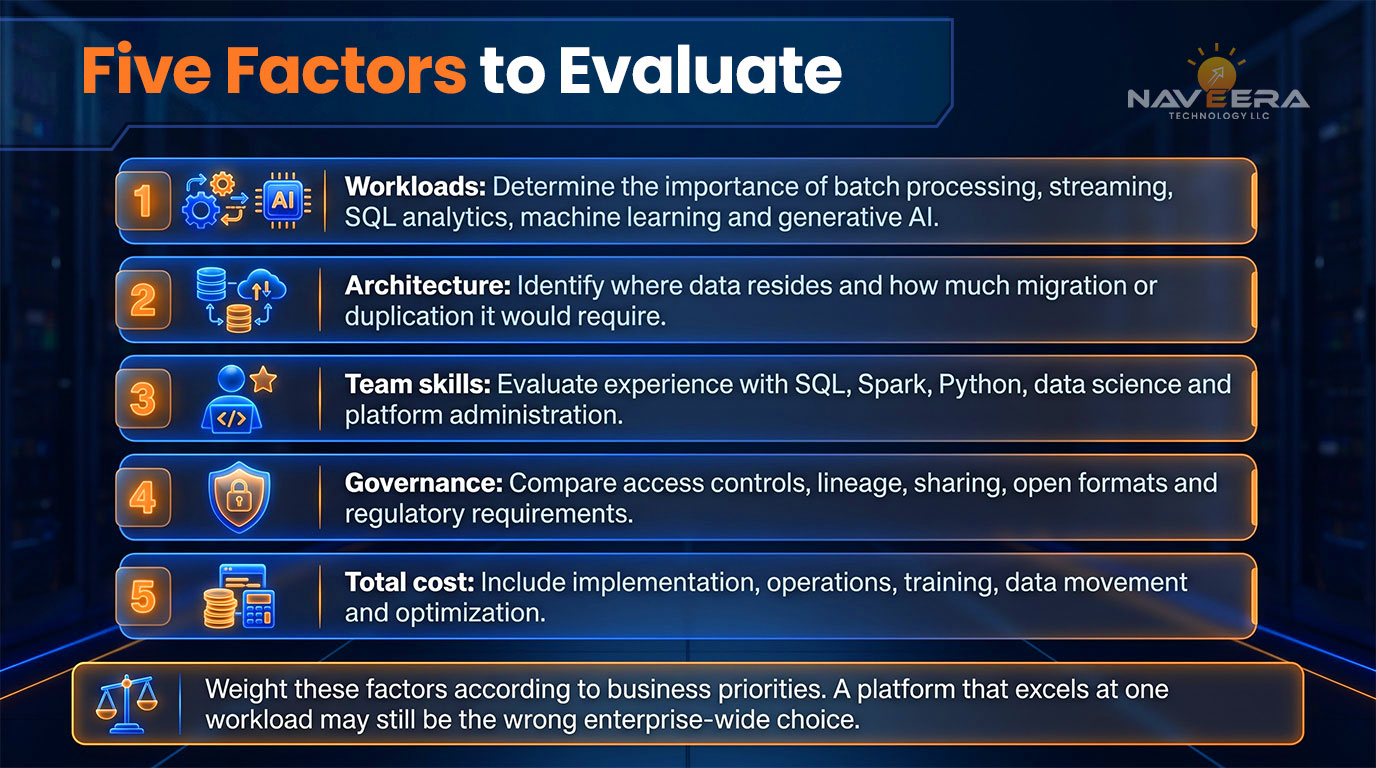
Five Factors to Evaluate
- Workloads: Determine the importance of batch processing, streaming, SQL analytics, machine learning and generative AI.
- Architecture: Identify where data resides and how much migration or duplication it would require.
- Team skills: Evaluate experience with SQL, Spark, Python, data science and platform administration.
- Governance: Compare access controls, lineage, sharing, open formats and regulatory requirements.
- Total cost: Include implementation, operations, training, data movement and optimization.
Weight these factors according to business priorities. A platform that excels at one workload may still be the wrong enterprise-wide choice.
Run a Databricks vs. Snowflake Proof of Concept
A credible proof of concept should test representative production workloads rather than vendor demonstrations.
Test a complex pipeline, high-concurrency BI workload, streaming use case and AI application with comparable data and service expectations. Measure performance, cost, scalability, freshness, security, recovery and administration. Document the configurations so results remain comparable.
End with a weighted decision matrix connected to business outcomes. The goal is to identify the platform that best fits the organization’s workloads and operating model.
How Naveera Technology Can Support Your Decision
Naveera Technology helps enterprises evaluate platform requirements before committing to a major migration or implementation.
Through its data engineering services, Naveera can support workload assessment, architecture, pipeline planning, integration, governance and proof-of-concept execution. Its generative AI services can help evaluate RAG and production AI requirements.
The objective is a defensible decision based on technical evidence and business priorities—not brand familiarity or isolated benchmarks.
Final Takeaway: Databricks, Snowflake or Both?
Databricks is often a strong candidate for lakehouse, engineering, streaming, machine learning and custom AI workloads. Snowflake remains compelling for managed SQL analytics, data warehousing, concurrent reporting and governed collaboration.
Their expanding capabilities make workload-specific evaluation more important. Test realistic workloads, measure total cost, evaluate team readiness and define governance responsibilities before choosing one platform or adopting both.
FAQ
What is the main difference in a Databricks vs. Snowflake evaluation?
A Databricks vs. Snowflake comparison shows that Databricks is rooted in lakehouse, data engineering and AI workloads, while Snowflake is rooted in managed cloud data warehousing and SQL analytics. Both platforms now extend beyond these traditional strengths.
What does the snowflake databricks search refer to?
The keyword snowflake databricks generally refers to comparisons between the two platforms involving architecture, workloads, pricing, governance and suitability for enterprise data and AI requirements.
Is Databricks better for data engineering?
Databricks may suit complex Spark processing and streaming. Snowflake can support managed SQL and Snowpark pipelines. The right option depends on workload complexity and team capabilities.
Which platform is better for machine learning?
Databricks may suit custom machine learning workflows. Snowflake may fit businesses that want AI capabilities close to data already governed within Snowflake.
Is Snowflake easier to operate?
Its managed architecture may reduce infrastructure work for SQL-focused teams. Actual operational effort depends on workload design, governance and existing skills.
How do their pricing models differ?
Databricks pricing is based on product usage and compute needs, along with cloud-related expenses. Snowflake uses a credit system for compute, with charges for storage, data transfer and specific features.
Can both platforms be used together?
Yes. They can help with work, but who owns the data, how things fit together, how things are managed and how much it costs must be clearly explained.
What should a proof of concept measure?
It should measure performance, cost, scalability, freshness, governance, reliability, administration and user experience using workloads.