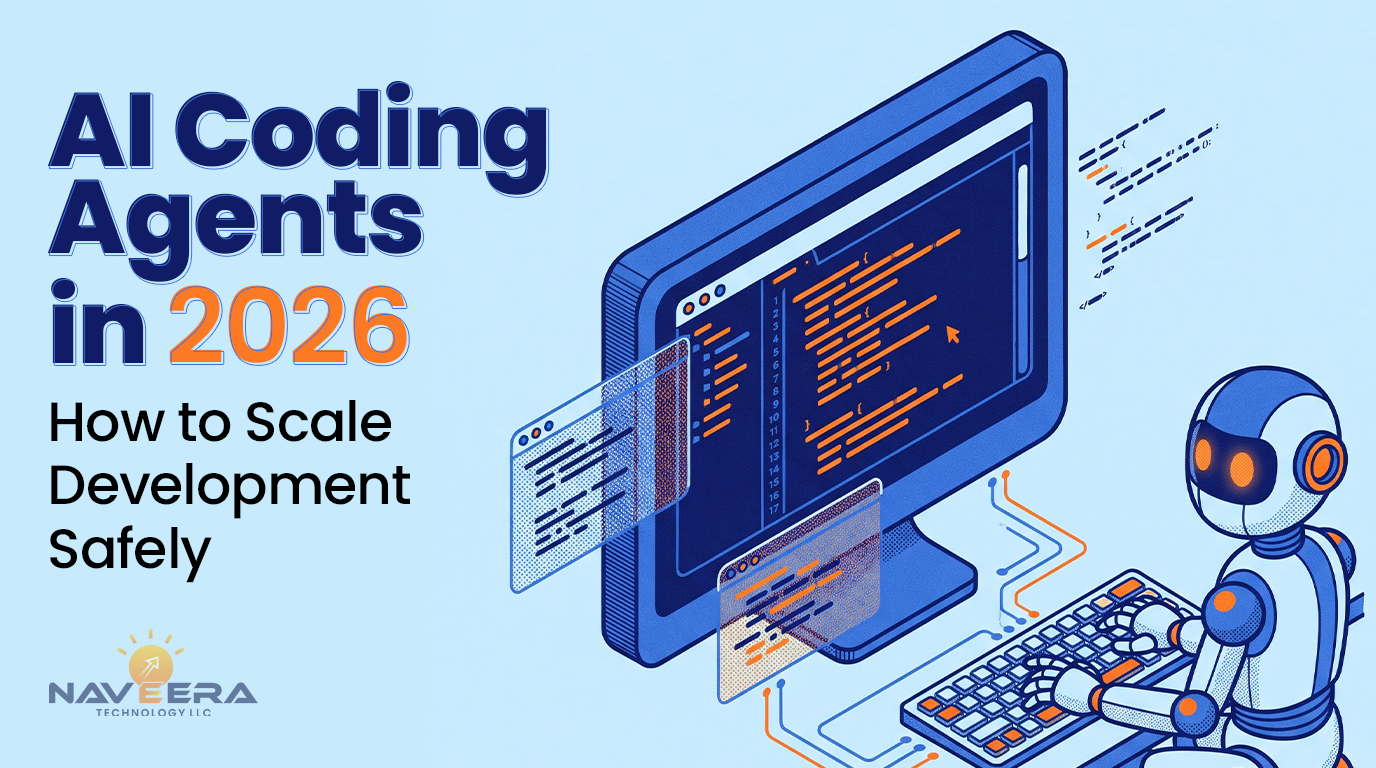
A bug fix can now start with a prompt: AI coding agents inspect the repository, edit files, run tests and prepare a pull request. But passing tests does not answer every question. Did the agent preserve business logic and stay within its access permissions?
Stack Overflow’s 2025 Developer Survey found that approximately 70% of agent users reported spending less time on specific development tasks, while 81% of respondents to its agent-challenges question expressed data security and privacy concerns.
For enterprises, scaling safely requires limited permissions, isolated execution, meaningful tests and accountable human review. This guide explains how to establish those controls and measure when broader autonomy is justified.
What Are AI Coding Agents?
AI coding agents are software systems that can plan and execute multi-step development tasks with a degree of autonomy. Unlike tools that just offer code suggestions, an agent can actually look at the project change files, use development tools, run commands, check the results and keep trying until it reaches a clear goal.
Platforms like GitHub Copilot, OpenAI Codex, Claude Code, Cursor, Amazon Q Developer and Gemini Code Assist each take an approach to helping with software development. Since their features and controls are not the same, companies should carefully review each one based on their needs, for security and how they deliver software.
AI Coding Agents vs. Coding Assistants
An AI coding assistant generally responds to an immediate developer request. It might complete a function, explain existing code or suggest a test while the developer remains in direct control.
An AI coding agent can receive a broader objective, such as correcting a defect or updating an API integration, and then determine the intermediate steps. The distinction is not simply better code generation. It is the agent’s ability to take actions across a development environment.
The more actions a system can perform, the more carefully its identity, permissions and operating environment must be governed.
How Coding Agents Work
A typical coding agent follows a loop:
- It interprets the requested outcome.
- It examines approved repository context.
- It produces or internally follows an implementation plan.
- It modifies the relevant files.
- It runs tests, linters or other validation tools.
- It reviews failures and revises the implementation.
- It prepares the change for human review.
GitHub’s documentation, for example, describes coding agents that can perform research, planning and coding activities within established development workflows. OpenAI similarly describes Codex as supporting tasks such as writing, reviewing and debugging code. These capabilities make governance part of implementation—not a separate consideration after deployment.
Where Can Enterprises Use AI Coding Agents?
Enterprises should begin with tasks that are clearly defined, testable and reversible. Coding agents can be useful across development, modernization and operations, but not every task deserves the same level of autonomy.
Development, Testing and Code Review
Suitable early use cases may include:
- Generating unit tests for established components
- Updating repetitive configuration files
- Fixing well-scoped defects
- Refactoring code with strong test coverage
- Preparing documentation
- Identifying inconsistencies during code review
- Drafting pull requests for human approval
The agent should operate within existing engineering standards. Its output must pass the same—or stronger—quality and security controls applied to human-generated code.
Legacy Modernization and Documentation
AI agents for software development can accelerate the analysis of unfamiliar legacy applications. They can map dependencies, explain modules, identify outdated packages and propose smaller refactoring steps.
I see that legacy systems often contain business rules. I’ve noticed that an agent may produce correct code while changing behaviour that users or downstream systems rely on. Therefore, modernization work requires regression testing, domain-expert review, and traceability between the original and updated behaviour.
DevOps and Infrastructure Automation
Coding agents can assist with CI/CD configuration, infrastructure-as-code validation, deployment documentation and incident investigation. These uses also carry greater operational risk.
An agent that can modify a pipeline or cloud configuration should not automatically receive production credentials. Infrastructure changes should remain subject to isolated execution, policy checks, protected environments and explicit approval.
When Does Multi-Agent AI Add Value?
Multi-agent AI divides a development objective among specialized agents. One agent may plan the work, another may implement it, while testing and security agents evaluate the result.
This structure can help when a task contains genuinely separable responsibilities and each output can be independently validated. It may be useful for a large migration in which discovery, implementation, testing and documentation can run as coordinated workstreams.
However, more agents do not automatically create a better result. They increase context sharing, tool usage, operating cost and the number of decisions that must be observed. Conflicting instructions or incomplete shared context can also create rework.
For most organizations, the right starting point is one controlled agent performing a narrow task. Introduce multi-agent AI only when specialization provides measurable value that outweighs the added governance burden.
What Are the Benefits and Risks?
Enterprise AI coding tools create both operational opportunities and new control requirements.
| Potential value | Corresponding risk | Required control |
| Faster completion of bounded tasks | Incorrect implementation at greater speed | Automated tests and human review |
| Broader test generation | Tests that validate the wrong behavior | Requirement and coverage review |
| Repetitive-work automation | Architectural inconsistency | Coding and architecture standards |
| Faster repository analysis | Exposure of sensitive source code | Approved tools and access boundaries |
| Parallel development support | Uncoordinated or conflicting changes | Branch and ownership controls |
| Automated dependency updates | Vulnerable or incompatible packages | Composition analysis and lockfile review |
The primary concern is not that AI-generated code is inherently unusable. The concern is that plausible output can be accepted without sufficient examination.
Security risks may include excessive repository access, exposed credentials, unsafe dependencies, prompt injection and unauthorized tool calls. Instructions hidden inside issues, documentation or repository files may attempt to influence an agent’s behavior. Treating all retrieved content as trustworthy would therefore be unsafe.
Accountability must remain clear. A named human owner should be responsible for reviewing and approving every agent-generated change that affects business systems.
How to Secure and Govern AI Coding Agents
AI coding agents security starts by limiting what the agent can see and do. An agent assigned to update tests should not automatically receive access to production databases, deployment credentials or unrelated repositories.
Control Repository, Tool and Secret Access
Use a dedicated machine or workload identity for the agent. Grant access only to the repositories, branches, tools and services required for the task. Credentials should be short-lived where practical and stored outside prompts, source files and logs.
External tools and Model Context Protocol connections should be approved individually. Each connection expands the agent’s effective authority and must be reviewed as part of the threat model.
Use Sandboxes, Protected Branches and Quality Gates
Run agent activity in an isolated environment with restricted network and filesystem access. Prevent direct changes to protected branches and production systems.
Every proposed change should pass appropriate controls, including:
- Unit and integration tests
- Static application security testing
- Software composition analysis
- Secret scanning
- Infrastructure-as-code validation
- Required pull-request checks
The NIST Secure Software Development Framework provides a useful foundation for integrating secure practices across the software development lifecycle. Agentic AI software development should reinforce these practices rather than bypass them.
Maintain Human Approval, Provenance and Audit Trails
Organizations must understand which agent carried out an action what information it had access to, what tools it used and who gave approval for the outcome. Code provenance and audit trails help, in investigating incidents support compliance checks. Enable ongoing improvements.
Human-in-the-loop approval is particularly important for authentication, authorization, payments, sensitive data, production infrastructure and other high-impact components.
Build a Secure AI Coding Agent Workflow
A controlled workflow can be implemented in six stages:
- Select a narrow use case. Define the desired outcome, affected components and acceptance criteria.
- Provide approved context. Limit repository access and identify the files, standards and documentation the agent may use.
- Use an isolated environment. Run the agent inside a sandbox without unrestricted production access.
- Test and scan the result. Apply functional tests, security scans and dependency checks automatically.
- Require pull-request review. A qualified engineer should review the code, test results and agent activity.
- Monitor the deployed change. Track errors, security findings and rollback signals after release.
This approach integrates agents into existing DevSecOps and CI/CD pipelines while preserving established separation of duties.
How to Measure and Scale AI Coding Agents
Enterprises should not measure success by the volume of generated code. More code may increase maintenance work without improving delivery.
Better measurements include:
- Development cycle time
- Pull-request acceptance rate
- Developer review time
- Defect escape rate
- Security findings per accepted change
- Rework and rollback rate
- Test-coverage improvement
- Cost per accepted change
Measurements should compare similar tasks and include the time humans spend reviewing or correcting output. An agent should earn broader autonomy through consistent results—not receive it simply because the tool supports it.
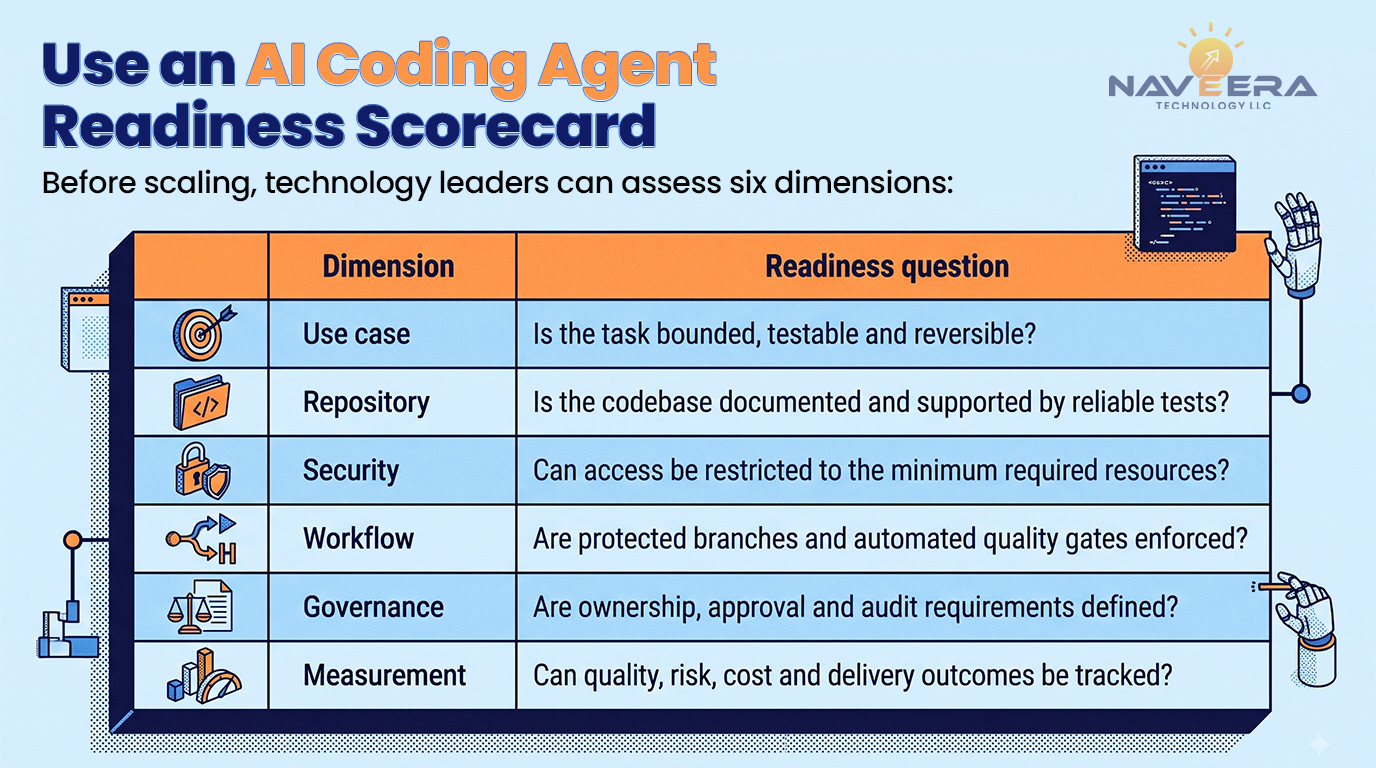
Use an AI Coding Agent Readiness Scorecard
Before scaling, technology leaders can assess six dimensions:
| Dimension | Readiness question |
| Use case | Is the task bounded, testable and reversible? |
| Repository | Is the codebase documented and supported by reliable tests? |
| Security | Can access be restricted to the minimum required resources? |
| Workflow | Are protected branches and automated quality gates enforced? |
| Governance | Are ownership, approval and audit requirements defined? |
| Measurement | Can quality, risk, cost and delivery outcomes be tracked? |
A low score in security, governance or testing should block higher autonomy even if the use case appears valuable.
How Naveera Technology Supports AI-Augmented Development
Naveera Technology helps enterprises assess where AI coding agents can support engineering without weakening security or delivery accountability.
This can include agent-readiness assessment, secure architecture, repository and permission design, DevSecOps integration, testing controls and governance planning. Naveera can also connect AI-assisted workflows with application development services, generative AI services, IT infrastructure services and offshore development services.
The goal is not to automate every engineering decision. It is to identify repeatable work that can be delegated safely while keeping architecture, risk and business outcomes under human control.
Final Takeaway: Scale Autonomy With Control
AI coding agents can expand engineering capacity, accelerate bounded development tasks and support software development automation. Their value depends on the controls surrounding them.
Start with narrow, measurable use cases. Restrict access, isolate execution, protect critical branches and require review. Scale autonomy only when the evidence demonstrates reliable code quality, acceptable security risk and meaningful improvement to the development process.
FAQ
What are AI coding agents?
AI coding agents are systems that can independently plan and execute multi-step software-development tasks, including examining repositories, changing files, running tests and preparing code for review.
How are AI coding agents different from coding assistants?
A coding assistant primarily suggests or explains code in response to direct input. A coding agent can plan and perform a sequence of actions using repositories, terminals and other development tools.
Are AI coding agents safe for enterprise development?
Enterprises can use them safely when they follow least-privilege access, run code in environments, perform automated security checks, protect branches, keep audit logs and require mandatory human review.
What is multi-agent AI in software development?
Multi-agent AI uses specialized agents for responsibilities such as planning, implementation, testing and security. It is most useful when the responsibilities can be separated and their outputs independently validated.
Can AI coding agents replace software developers?
Human engineers can automate development activities. However, human engineers remain responsible for architecture, business context, risk decisions, complex debugging and approval of production changes.
How should enterprises review AI-generated code?
AI-generated code needs to work during automated tests. It must also pass security scans. The code should go through dependency analysis. Then a developer who knows the system well must review the request.
Which coding tasks should be automated first?
Begin with bounded, reversible and easily tested tasks such as documentation, unit-test generation, dependency updates and small bug fixes.
How can companies measure AI coding agent performance?
Measure accepted delivery outcomes, including cycle time, review effort, escaped defects, security findings, rework, rollback frequency and cost per accepted change—not lines of code generated.