Strong data quality for AI means more than fixing missing fields or removing duplicate records. Enterprise data must be accurate, current, traceable, representative, appropriately governed and fit for the specific AI decision it will support. Data that works for quarterly reporting may still be unsuitable for real-time predictions, retrieval-augmented generation (RAG) or autonomous agents.
What Is Data Quality for AI?
Data quality for AI is the degree to which data is suitable for training, evaluating, retrieving information for or operating a defined AI system. Quality is contextual: the same dataset may be acceptable for one use case and inadequate for another because accuracy, freshness, coverage and permission requirements differ.
How AI Data Quality Differs From Traditional Data Quality
Traditional data quality management focuses on whether records are accurate, complete, valid and consistent for reporting or operations. AI data quality includes those requirements but also considers labels, representativeness, bias, feature relevance, retrieval behavior and the relationship between data limitations and AI outcomes.
What Makes Data Fit for an AI Use Case?
Fitness begins with the intended outcome. Teams should define what the system will predict, generate or decide; who may be affected; how current the data must be; and what level of error is acceptable. Only then can they establish meaningful quality rules and approval thresholds.
Why Data Quality Matters for Enterprise AI
AI systems learn patterns or retrieve context from the information supplied to them. Incomplete, conflicting or stale information can produce results that appear plausible but cannot be trusted operationally.
Predictive models may learn from incorrect labels, generative systems may retrieve outdated documents, and AI agents may act on inaccurate operational records. Repeated errors also erode employee confidence and create manual verification work.
Eight Dimensions of AI-Ready Data
An AI-ready data assessment should examine eight connected dimensions:
| Dimension | Enterprise question |
| Accuracy | Does the data represent the real-world object or event correctly? |
| Completeness | Are all required records, fields and documents available? |
| Consistency | Do systems use compatible values, formats and definitions? |
| Timeliness | Is the data current enough for the intended decision? |
| Validity | Does it follow approved formats, ranges and business rules? |
| Uniqueness | Are duplicate entities, events and documents controlled? |
| Traceability | Can teams identify its source, transformations and owner? |
| Representativeness | Does it cover the relevant population and conditions? |
How Data Quality Changes by AI Use Case
Predictive Machine Learning
Data quality for machine learning depends on trustworthy labels, relevant features, population coverage and proper separation of training, validation and test data. Teams must check class imbalance, data leakage, ground-truth reliability and whether historical patterns still represent the production environment.
Generative AI and RAG
Generative AI data quality includes the accuracy, authority, freshness and retrievability of documents supplied to a language model. RAG content must also be parsed, chunked, labeled and indexed so the system returns relevant evidence. Contradictory documents can compete during retrieval, while poor metadata can prevent filtering by product, region, date or permission.
AI Agents and Real-Time Systems
Agents may update records or trigger workflows, so their data must support safe action, not merely relevant answers. Real-time systems also need controls for delayed pipelines, schema drift and upstream changes.
Common Data Problems That Cause AI Failures
Enterprise information is often fragmented across CRM, ERP, support, analytics and document-management systems. Different platforms may assign separate identifiers to the same customer, apply conflicting definitions or refresh at different times.
Frequent problems include duplicate records, missing metadata, unknown lineage, stale policies, inconsistent schemas and sensitive data used without an approved purpose. They often reveal unclear accountability among business owners, data teams and security leaders.
How Poor Data Quality Affects Generative AI and RAG
RAG grounds model responses in retrieved enterprise content, but it cannot automatically confirm that every source is correct, current or authorized. Weak retrieval data may cause irrelevant context, contradictory evidence or answers based on obsolete policies. Poor chunking can separate a rule from its exceptions, and missing access metadata can expose restricted content.
Testing should cover the complete retrieval pipeline: ingestion, parsing, chunking, metadata, vector embeddings, indexing, access filtering, ranking and response generation. Evaluation must confirm that the system retrieved the correct evidence—not simply that its answer sounded fluent.
How to Assess Data Readiness for AI
Data readiness for AI should be evaluated before production integration:
- Define the use case, affected users and business outcome.
- Identify required sources, owners and authoritative records.
- Profile structured and unstructured data.
- Establish quality thresholds for the relevant dimensions.
- Assess bias, privacy, security and permitted use.
- Review lineage, metadata, access and pipeline reliability.
- Prioritize remediation and approve or reject the dataset.
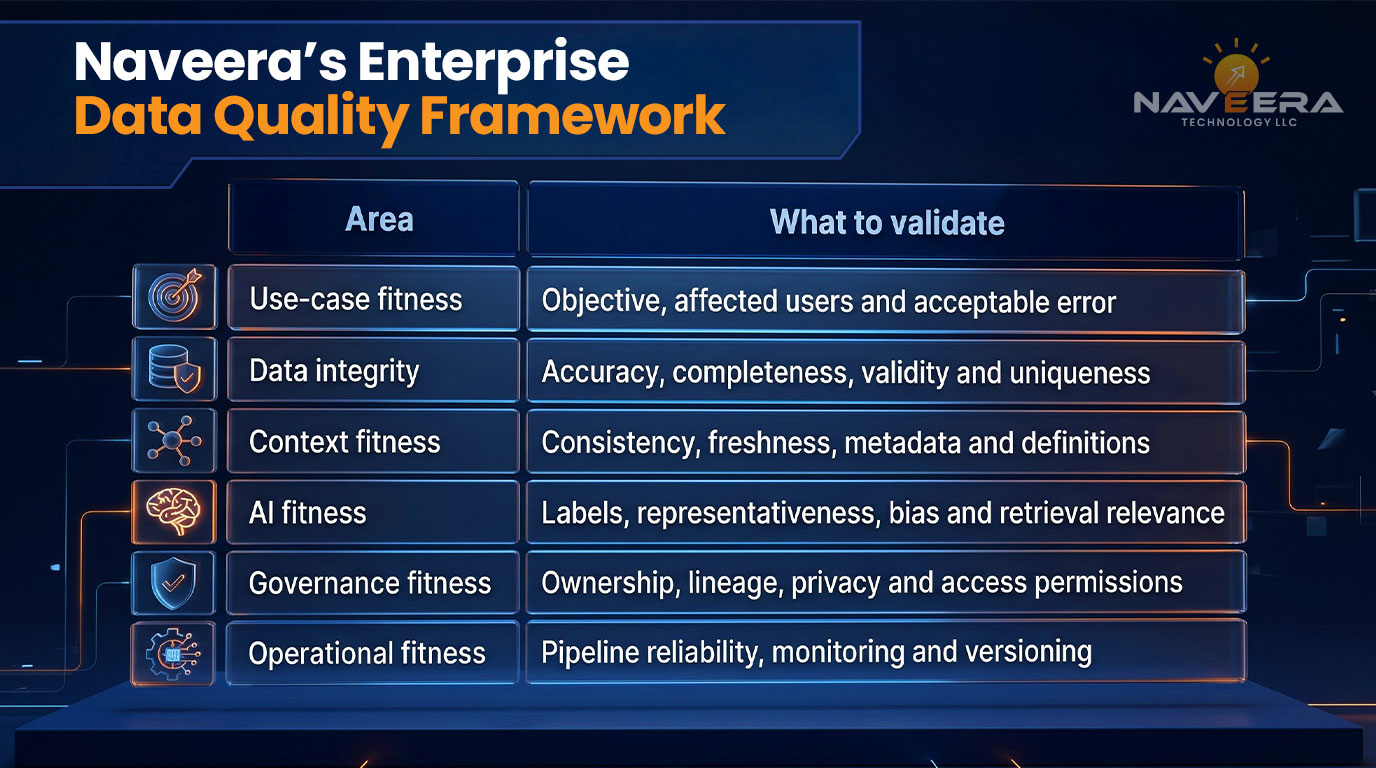
Naveera’s Enterprise Data Quality Framework
The following proposed data quality framework converts assessment into six business decisions:
| Area | What to validate |
| Use-case fitness | Objective, affected users and acceptable error |
| Data integrity | Accuracy, completeness, validity and uniqueness |
| Context fitness | Consistency, freshness, metadata and definitions |
| AI fitness | Labels, representativeness, bias and retrieval relevance |
| Governance fitness | Ownership, lineage, privacy and access permissions |
| Operational fitness | Pipeline reliability, monitoring and versioning |
The output should be a decision, not merely a score. Every gap needs a severity, business impact and owner. Critical gaps should block production use until they are corrected or formally accepted.
How to Measure and Improve AI Data Quality
Begin with metrics tied to business risk: accuracy, required-field completeness, duplicate rate, freshness, schema conformance, lineage coverage and access-control compliance. Machine-learning teams may add label-quality and population-distribution checks. RAG teams should measure retrieval relevance, source freshness and permission-filter accuracy.
Improvement may require standardizing definitions, resolving master records, removing duplicates, enriching metadata and validating pipelines. Data contracts can document the schema, quality expectations and ownership.
How to Monitor Data Quality After Deployment
Continuous data quality monitoring should detect freshness failures, schema changes, distribution shifts and broken pipelines. Those signals should be connected to AI outcomes such as declining prediction accuracy, weaker retrieval or increased human correction.
Teams should retain traceable versions of datasets, models, prompts and retrieval indexes so they can reproduce incidents and identify the source of an incorrect result.
Data Governance and Security for AI-Ready Data
AI data governance establishes who owns data, who may use it, for which purposes and under what controls. Classification should identify personally identifiable information, confidential records and content subject to retention or residency requirements. Access rules must remain effective across training, retrieval and inference—not only within the source repository.
The NIST AI Risk Management Framework provides voluntary guidance for incorporating trustworthiness into the design, development, use and evaluation of AI. Its playbook groups suggested actions under Govern, Map, Measure and Manage, allowing enterprises to adapt controls to their risks and operating environments.
How Naveera Technology Supports Data Quality for AI
Naveera Technology helps enterprises establish data quality for AI through readiness assessments, data profiling, integration, standardization, pipeline validation, metadata management, lineage and continuous monitoring.
Through its data engineering services, Naveera can help organizations build governed data pipelines, improve data reliability and prepare structured and unstructured information for enterprise AI applications.
The goal is to determine whether the available data is fit for a defined AI outcome, address high-impact quality gaps and establish controls that remain effective after deployment.
Final Takeaway: Reliable AI Starts with Trusted Data
Data preparation is not a one-time phase before model development. Sources change, systems evolve and AI use cases expand. Quality must therefore be measured and governed throughout the lifecycle.
Reliable AI starts with clear use cases, authoritative sources, defined thresholds and accountable ownership. When data signals are connected to model and business outcomes, enterprises can scale AI with greater confidence and respond faster when conditions change.
FAQ
What is data quality for AI?
Data quality for AI means that training, evaluation, retrieval or operational data is accurate, complete, current, traceable, representative, secure and fit for a defined AI use case.
Why is AI data quality important?
Strong AI data quality gives models and applications reliable evidence. Weak quality can contribute to inaccurate predictions, poor retrieval, inconsistent outputs and unsafe business actions.
What makes enterprise data AI-ready?
AI-ready data has sufficient accuracy, completeness, consistency, freshness, traceability and representativeness for its intended purpose, together with appropriate ownership and access permissions.
How is AI data quality measured?
Measure enterprise data quality against use-case-specific thresholds for accuracy, completeness, duplicates, validity, freshness, lineage and access compliance. Add model or retrieval metrics where appropriate.
What is the difference between data quality and AI data readiness?
Data quality describes the condition of the data. Data readiness for AI also considers whether that data is accessible, permitted, representative and operationally suitable for a particular AI system.
How does poor data quality affect generative AI and RAG?
Poor generative AI data quality can cause irrelevant retrieval, contradictory context, outdated answers, permission failures and unnecessary processing costs.
How can enterprises monitor AI data quality?
Apply data quality monitoring across pipelines, datasets and retrieval indexes, then connect freshness, drift, schema and validation alerts to model performance and business outcomes.
How can Naveera improve data quality for AI?
Naveera can support assessments, data quality management, integration, governance, lineage, pipeline validation, RAG preparation and continuous monitoring aligned with the enterprise use case.