Choosing between staff augmentation vs dedicated team models affects more than hiring speed. The decision influences delivery ownership, management workload, knowledge retention, security, budget predictability and accountability for business outcomes. For CTOs, the central question is whether the organization needs individual specialists working inside an existing delivery system or a stable external team capable of supporting a longer-term product roadmap.
Both models provide access to external engineering talent without requiring every role to become a permanent position. However, they distribute responsibilities differently. Understanding those differences helps technology leaders select a model that fits their internal capabilities, delivery expectations and operational risks.
What Is the Difference Between Staff Augmentation and a Dedicated Team?
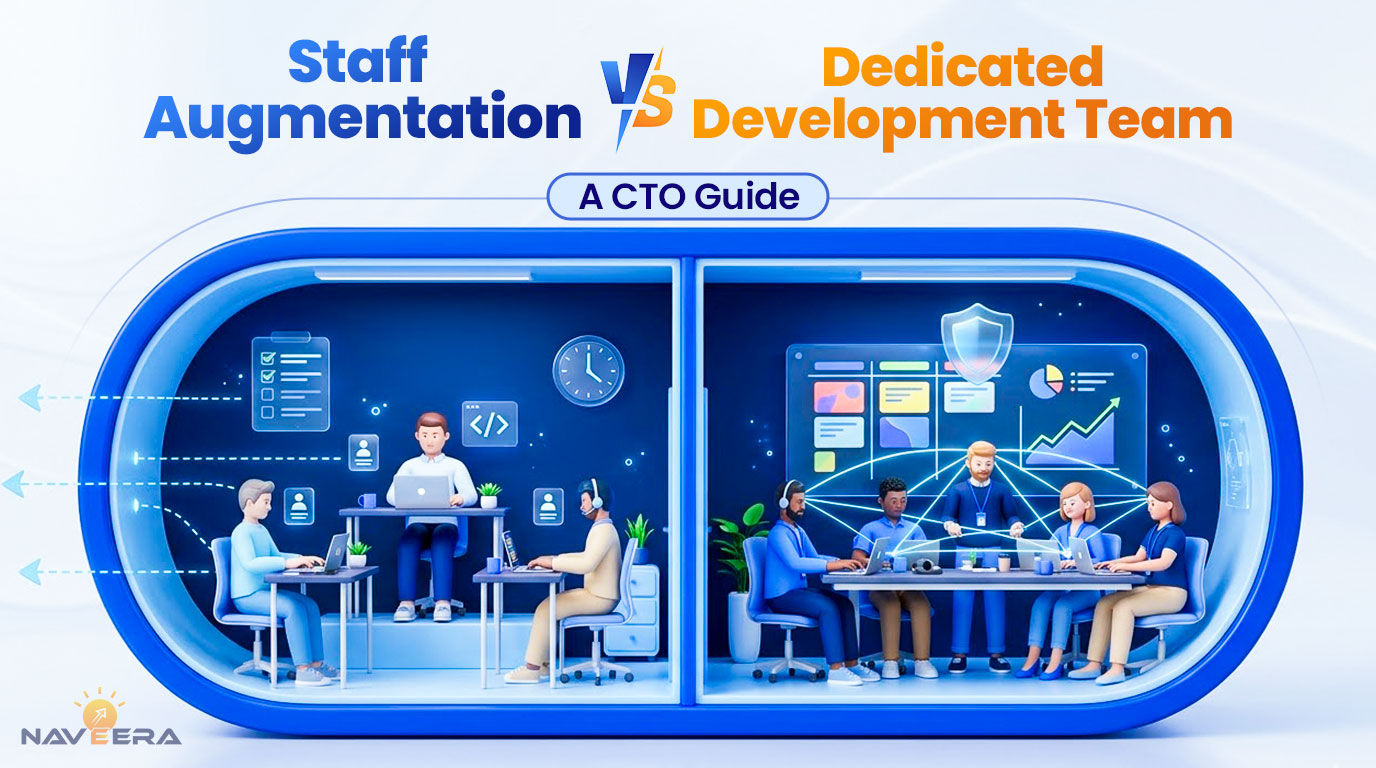
The primary difference is ownership. Staff augmentation adds external professionals to a client-managed team. A dedicated team provides a coordinated group focused on a defined product, platform or engineering objective.
Under staff augmentation, the client generally controls priorities, architecture, task allocation and performance management. With a dedicated team, the client retains strategic control while delivery planning and execution are shared with the service provider.
How Staff Augmentation Works
IT staff augmentation allows a company to add individual developers, data engineers, cloud specialists, quality engineers or other professionals to its existing team. These specialists typically use the client’s tools, attend its meetings and work within its development process.
This model is effective when the organization has strong technical leadership but lacks a specific skill or sufficient capacity. It can support a deadline, temporary workload increase, migration or specialist requirement without expanding permanent headcount.
The client must still manage onboarding, backlog priorities, architecture, code review and performance. Adding more people will not solve unclear requirements or weak internal decision-making.
Organizations that need distributed technical capacity can evaluate Naveera’s offshore development services as part of their resource strategy.
How a Dedicated Development Team Works
A dedicated development team is a stable external group assigned to a product, platform or long-term technology objective. It may include developers, quality engineers, designers, DevOps specialists, architects and a delivery manager.
Unlike individual augmentation, a dedicated software development team operates as a coordinated unit. The client owns the business direction and product priorities, while the provider may share responsibility for sprint planning, technical execution, quality and delivery reporting.
This model is often suitable for application modernization, new product development and multi-phase engineering programs. Naveera’s application development services can support organizations that need coordinated delivery across design, development, integration and deployment.
Staff Augmentation vs. Dedicated Team at a Glance
A practical staff augmentation vs dedicated team comparison should focus on operating responsibility rather than hourly rates alone.
| Decision area | Staff augmentation | Dedicated development team |
| Primary purpose | Fill capacity or skills gaps | Support a sustained product roadmap |
| Structure | Individuals join the internal team | Coordinated external team |
| Daily management | Primarily handled by the client | Often shared with the provider |
| Delivery ownership | Client retains primary responsibility | Responsibility is more distributed |
| Scope | Role-, task- or capacity-based | Product-, platform- or outcome-based |
| Scalability | Individual roles can be adjusted | Team composition can evolve |
| Knowledge retention | Depends on individuals and documentation | Shared across a stable team |
| Best fit | Mature internal delivery organization | Long-term, cross-functional delivery |
Neither model is universally better. The right choice depends on which responsibilities the client can manage internally and which responsibilities it expects the provider to assume.
Which Model Fits Your Technology Roadmap?
The roadmap should guide the engagement model. A short-term capability gap requires a different structure from a multi-year transformation program.
Choose Staff Augmentation for Skill and Capacity Gaps
Staff augmentation services are appropriate when the organization:
- Needs one or more clearly defined technical skills
- Has established architecture and delivery leadership
- Can assign and review work internally
- Requires temporary capacity
- Wants direct control over individual contributors
- Can onboard external professionals efficiently
An extended development team can also support a longer engagement when external specialists work closely with the internal team. However, the client must maintain sufficient management capacity throughout the engagement.
Choose a Dedicated Team for Long-Term Delivery
A dedicated team is generally more suitable when:
- The roadmap spans multiple releases
- Requirements will continue to evolve
- Several technical disciplines must work together
- Continuity and domain knowledge are important
- Internal managers cannot absorb significant coordination work
- The provider is expected to share delivery responsibility
The value of a dedicated team comes from stability and coordination. Over time, the team becomes familiar with the architecture, business rules, users and delivery expectations.
Consider a Hybrid Model for Changing Requirements
A hybrid approach combines a stable core team with temporary specialists. For example, a dedicated product team may own the roadmap while an augmented security specialist supports a compliance initiative.
An offshore development team can provide the long-term delivery core, while short-term experts are added when requirements change. The organization should still define who owns architecture, backlog decisions, quality approval and production support.

Compare Cost, Control and Accountability
Cost should be evaluated together with management effort and delivery accountability. The lowest rate does not necessarily produce the lowest total engagement cost.
Engagement Cost and Budget Predictability
Staff augmentation is usually billed through a time-and-materials arrangement. It provides resource flexibility but may become difficult to forecast if priorities, duration or management needs change.
Dedicated teams may also use time-and-materials pricing, monthly team pricing or a statement of work. Costs can be more predictable when the team structure and delivery cadence remain stable.
CTOs should account for:
- Recruitment and onboarding
- Internal management time
- Technical and delivery leadership
- Development tools and infrastructure
- Security administration
- Rework caused by unclear requirements
- Replacement and knowledge-transfer costs
- Delays caused by missing capabilities
The more useful measure is cost per accepted release or completed outcome—not merely cost per developer.
Management Effort and Decision Control
Staff augmentation gives the client direct control, but that control creates additional management responsibility. Internal leaders must provide context, priorities, reviews and feedback.
A dedicated team reduces some daily coordination, but the client should not become disengaged. Product priorities, architecture principles, risk acceptance and major technical decisions still require active client involvement.
Delivery Ownership and Performance Accountability
In staff augmentation vs outsourcing, the main distinction is not simply where developers work. It is who owns the result.
Staff augmentation usually provides capacity, while software development outsourcing can transfer responsibility for defined deliverables or outcomes to a provider. A dedicated team sits between these models: delivery responsibility is shared, but the roadmap remains closely connected to the client.
Contracts should clearly define deliverables, service expectations, reporting, quality standards and escalation procedures.
Evaluate the Operational Risks
External engineering models introduce manageable risks. These should be addressed through governance rather than treated as reasons to avoid external teams.
Security, Access and Intellectual Property
Access should follow the principle of least privilege. External team members should receive only the repository, environment, data and tool permissions required for their responsibilities.
Contracts should define intellectual-property ownership, confidentiality, data handling, secure development expectations and offboarding procedures. Security requirements should also be incorporated into the development lifecycle. NIST’s Secure Software Development Framework provides practices organizations can integrate into their software development processes.
Naveera’s IT infrastructure services can support cloud access, infrastructure readiness and operational controls surrounding distributed engineering.
Communication and Time-Zone Alignment
Time-zone differences can support extended coverage, but they can also delay decisions. Teams should define overlapping hours, communication channels, response expectations and escalation paths.
Written architecture decisions, sprint objectives and acceptance criteria reduce dependence on meetings. Strong asynchronous communication is essential for distributed development.
Knowledge Transfer and Vendor Dependency
Knowledge concentration can create risk in any delivery model. Require documentation, code review, shared repositories, recorded architectural decisions and structured handover processes.
The client should retain control of source code, cloud accounts, deployment pipelines, credentials and product documentation. Exit terms should explain how knowledge and responsibilities will transfer when the engagement changes.
Use a CTO Decision Scorecard
The following scorecard can support the staff augmentation vs dedicated team decision.
Rate each statement from 1 to 5.The result should inform discussion rather than make the decision automatically. Security, budget structure, communication, product maturity and provider capabilities must also be considered.
How to Select the Right Technology Partner
The selected provider should demonstrate that its operating model fits the organization’s expectations—not simply that it can supply developers.
Validate Technical and Industry Fit
Review technical capabilities, architecture knowledge, quality practices and experience with relevant platforms. Ask who will perform the work, how specialists are evaluated and how replacements are handled.
Do not rely solely on sales presentations. Include technical interviews, scenario discussions or a limited pilot where appropriate.
Review Governance and Delivery Practices
Evaluate backlog management, project reporting, code review, testing, security, DevOps practices and escalation procedures. Determine how the provider manages a distributed or extended development team and how technical risks are communicated.
The engagement should specify meeting cadence, reporting metrics, decision rights and service-level expectations.
Define Success, Reporting and Exit Terms
Before work begins, agree on measurable outcomes. These may include release predictability, accepted deliverables, defect trends, security findings, cycle time and knowledge-transfer completion.
Contracts should also define intellectual-property ownership, replacement terms, notice periods, access removal and final handover obligations.
How Naveera Technology Supports Flexible Engineering Teams
Naveera Technology helps organizations structure external engineering capacity around their roadmap, technical requirements and internal management capabilities.
Support can include targeted staff augmentation services, a coordinated dedicated team or a hybrid delivery model. Engagement planning should begin by defining skills, ownership, governance, security, communication and measurable outcomes.
The objective is not simply to add developers. It is to establish a delivery structure that provides the right balance of control, flexibility, continuity and accountability. Businesses can discuss their engineering requirements with Naveera Technology before selecting an engagement model.
Final Takeaway: Choose Based on Delivery Responsibility
The staff augmentation vs dedicated team decision should be based on delivery responsibility—not headcount alone.
Choose augmentation when internal leadership is strong, the skills gap is specific and the organization can manage contributors directly. Choose a dedicated team when the roadmap requires continuity, cross-functional capability and shared delivery accountability.
A hybrid structure may provide the best balance when long-term product work also requires changing specialist skills.
FAQ
What is the difference between staff augmentation and a dedicated team?
In a staff augmentation vs dedicated team comparison, augmentation adds individual specialists to a client-managed team, while a dedicated team provides a coordinated group focused on a sustained product or engineering roadmap.
Is staff augmentation more affordable than a dedicated team?
IT staff augmentation may cost less for a limited skills gap. A dedicated team may provide better overall value when the engagement requires multiple disciplines, delivery coordination and long-term continuity.
When should a CTO choose staff augmentation?
>A CTO should consider staff augmentation services when internal technical leadership is strong and the organization needs temporary capacity or a clearly defined specialist skill.
When is a dedicated development team a better option?
A dedicated development team is often more appropriate for evolving requirements, multi-release roadmaps and initiatives requiring coordinated skills and shared delivery responsibility.
Who manages a dedicated development team?
Management is normally shared. The client owns business priorities and strategic decisions, while the provider may manage daily coordination, delivery reporting and team performance.
Can staff augmentation and a dedicated team be used together?
Yes. A dedicated software development team can provide a stable delivery core while augmented specialists support temporary security, cloud, data or performance requirements.
How do you protect intellectual property with an external team?
Use clear contracts, access controls, confidentiality obligations, secure repositories, documented ownership terms and formal offboarding. The client should retain control of code, credentials, cloud accounts and essential documentation.
What should a CTO evaluate before selecting a development partner?
Evaluate technical capability, security controls, governance, communication, team continuity, reporting, knowledge transfer, contract terms and the provider’s willingness to accept clearly defined delivery accountability.