
By Naveera Technology LLC
Every AI budget conversation in 2026 has been about the same three things: compute, models, talent. Almost none of them have a line for memory. That gap is about to get expensive.
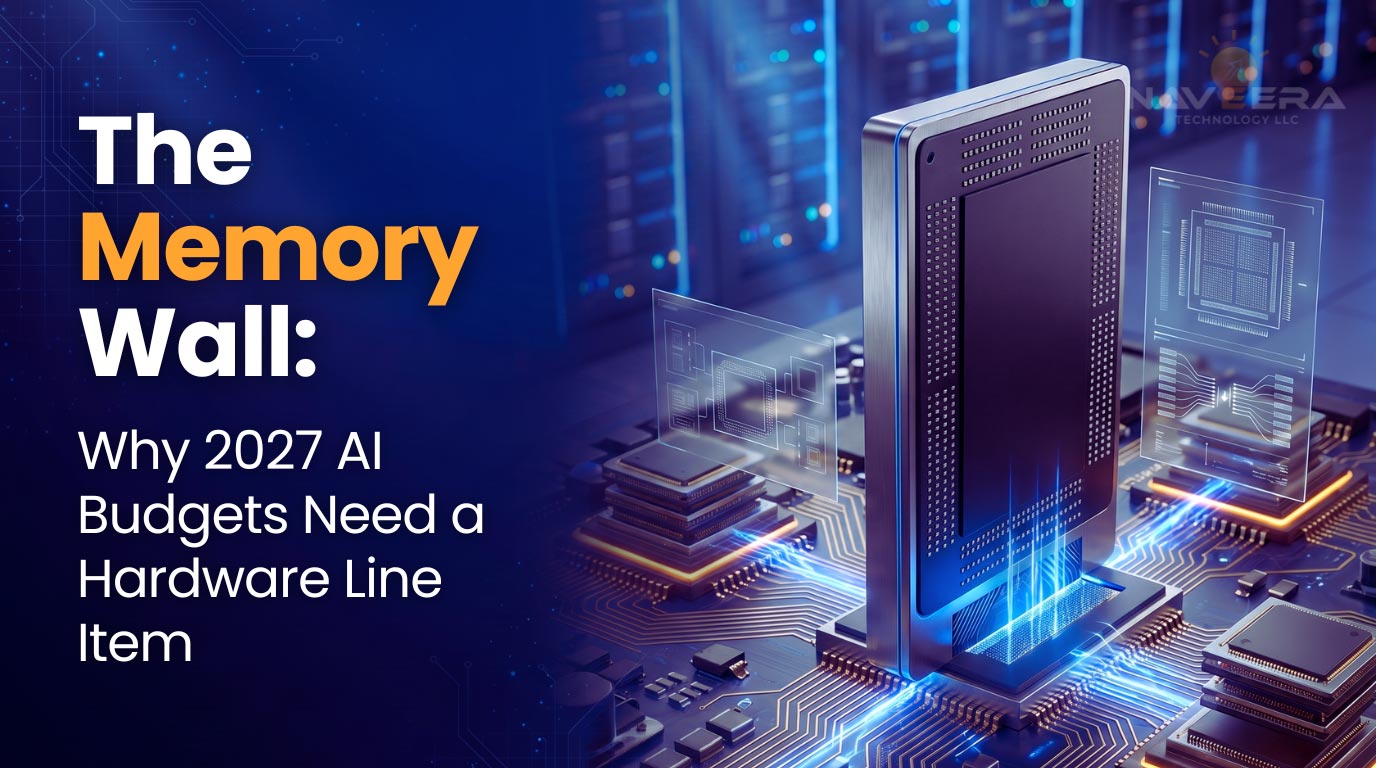
Here’s the uncomfortable truth CEOs need to sit with going into 2027: the constraint on your AI roadmap is no longer GPU access. It’s a memory. Specifically, High-Bandwidth Memory (HBM) — the silicon that feeds data to AI accelerators fast enough for them to be useful at all.
The wall, explained simply
Samsung, SK Hynix, and Micron — the only three companies on earth that make HBM at scale — have spent the last 18 months reallocating fab capacity away from conventional DRAM and toward HBM and enterprise-grade DDR5. HBM commands three to five times the margin of standard memory, so the economics of that decision aren’t complicated. What is complicated is what it does to everyone downstream.
A single HBM wafer displaces two to three conventional DRAM wafers because of its complexity and lower yield. Every wafer that goes into an AI accelerator is a wafer that doesn’t become server memory, laptop memory, or automotive memory. Industry analysts now describe this as a structural reallocation of global silicon capacity, not a cyclical shortage that self-corrects. New fab capacity from Micron’s Singapore expansion and similar projects won’t add meaningful volume before 2028. That means the tightness most enterprises are already feeling, longer lead times, sharper price increases, allocation-based purchasing instead of transactional buying is the operating environment for all of 2027, not a temporary spike to wait out.
For a CEO, that reframes the problem instantly. This isn’t a procurement inconvenience. It’s a capacity risk to your AI roadmap, the same category of risk as a talent shortage or a regulatory delay — and it deserves the same visibility on your P&L.
Why “we’ll buy it when we need it” no longer works
Most enterprise AI budgets are still built the way software budgets have always been built: model licensing, cloud consumption, integration cost, headcount. Hardware sits inside “infrastructure” as a rounding error, assumed to be elastic and always available on demand.
That assumption breaks in a supply-constrained market. Three things change:
- Lead time becomes a planning variable, not a procurement detail. When suppliers are allocating capacity 12–18 months out through long-term supply agreements, you cannot spin up capacity the quarter you decide you need it. Whoever secures allocation early wins the roadmap; whoever waits inherits someone else’s leftovers at someone else’s price.
- Price is no longer a stable input to your model. DDR4 and enterprise DRAM prices have already moved dramatically over the past year as capacity shifted toward AI-grade memory. A budget that treats memory cost as flat from one quarter to the next isn’t conservative — it’s wrong.
- Build-versus-buy math has flipped. Owning hardware used to be the move once a workload was steady enough to amortize. In a market where the asset itself is hard to source, sits at a cyclical price peak, and depreciates against next year’s faster chip, ownership now carries risk it didn’t carry two years ago. Cloud and hybrid consumption models deserve a fresh look, not because they’re cheaper on paper, but because they transfer sourcing risk to a partner who is better positioned to absorb it.
None of this is an argument against investing in AI. It’s an argument for budgeting like the constraint has moved — from compute availability to memory availability — and building a hardware line item that reflects that.
How we think about it at Naveera
We sit across data engineering, AI strategy, and IT infrastructure delivery, which means we see this problem from both ends: the CIO trying to secure capacity, and the CFO trying to model a budget that won’t be obsolete by Q2. Our approach for clients heading into 2027 planning cycles is deliberately unglamorous:
- Workload-first sizing. Before committing capital to any hardware, we map which workloads actually need HBM-class performance versus which can run efficiently on existing or cloud-native infrastructure. Most organizations over-provision because no one has done this exercise rigorously.
- Hybrid sourcing strategy. We help clients structure a mix of committed cloud capacity, colocation, and selective ownership — so no single sourcing decision becomes a single point of failure.
- Scenario-based budgeting. Rather than a single hardware number, we build budgets around supply and price scenarios, so leadership isn’t blindsided when allocation windows shift.
- Production-first delivery. Our engagements are built to get one high-value use case into production with a clear infrastructure path, then scale the pattern — not run a hardware pilot that never leaves the lab.
The organizations that treat memory as a strategic input — not a line buried in “infrastructure, TBD” — will be the ones still shipping AI products on schedule in 2027. The rest will be explaining delays to their board.
If your 2027 AI budget doesn’t have a hardware line item yet, that’s the conversation to have now, not in Q1.
Naveera Technology LLC helps enterprises modernize and scale with data engineering, generative AI, application development, and IT infrastructure services. Talk to our team: naveeratech.com/contact