

A startup can spend months building a polished product only to discover that customers do not need it. The right MVP development services replace assumption-driven development with focused market validation, helping founders launch a credible product faster, gather meaningful customer feedback, and demonstrate real business potential before committing substantial capital to a full-scale build.
An AI-ready MVP does not need artificial intelligence in every workflow. It needs a clean data foundation, modular architecture, secure integrations, and a clear business case for adding AI. That distinction matters: founders should invest in intelligence when it creates measurable value, not simply because the market expects an AI story.
An MVP is not a cheaper version of the final product. It is a disciplined business experiment designed to replace assumptions with evidence.
What an MVP Must Prove
A prototype demonstrates how an experience might look. A proof of concept tests whether a technical approach can work. A minimum viable product goes further: real users can complete a meaningful task, and their behavior produces evidence.
Before committing significant capital, a startup should be able to answer four questions:
- Does the target customer experience a problem important enough to solve?
- Will users adopt, reuse, or pay for the proposed solution?
- Can the core workflow operate reliably and securely?
- Is there a realistic path from early traction to sustainable growth?
Strong MVP development services for startups connect discovery, UX design, engineering, testing, deployment, and analytics to those questions. This prevents delivery from becoming a feature checklist and keeps the first release focused on business learning.
A Practical MVP Development Process
The process begins with product discovery: defining the audience, problem, alternatives, business model, and risks. Founders then prioritize the one customer journey that must work for the product to create value.
Technical discovery runs alongside product discovery. Engineers assess integrations, data availability, performance expectations, compliance requirements, and security risks. If AI is being considered, the team should determine whether rules-based software, machine learning, generative AI, or an AI agent is actually the best fit.
Once the scope is clear, design and architecture translate the business hypothesis into a usable product. Development then proceeds in short cycles, with testing, analytics, and stakeholder feedback built into delivery. A controlled launch allows the startup to measure activation, task completion, engagement, retention, errors, and customer feedback.
The final step is not “add more features.” It is decide what the evidence supports. The team may improve onboarding, remove underused functions, revise pricing, or change direction. Effective MVP development services make those decisions easier because the product generates useful evidence from day one.
What Makes an MVP AI-Ready?
An AI-powered MVP already uses AI in a customer-facing or operational workflow. An AI-ready MVP may launch without it, but its foundation makes future adoption practical.
| Foundation | Why it matters to the business |
| Reliable, permitted data | Improves output quality and reduces privacy and compliance risk |
| API-first architecture | Allows models, platforms, and data services to change without rebuilding the product |
| Scalable cloud infrastructure | Supports demand growth while keeping early operating costs proportionate |
| Security and access controls | Protects sensitive data, models, integrations, and customer trust |
| Monitoring and human oversight | Helps detect poor output, drift, failure, and unintended behavior |
The business use case must come first. AI can reduce manual review, improve knowledge access, accelerate document workflows, identify risk, or personalize an experience. Naveera’s Generative AI Services can help startups validate these opportunities while addressing cost, latency, unpredictable output, and governance obligations. Good AI MVP development services test the value and operational trade-offs before AI becomes central to the product.
Where AI-Ready MVPs Create Value
AI-ready product design can support startups across several industries:
- Healthcare: patient engagement, administrative workflows, scheduling, and knowledge support
- FinTech: fraud signals, document analysis, financial operations, and customer intelligence
- SaaS and B2B technology: copilots, analytics, knowledge retrieval, and workflow automation
- Retail: recommendations, customer-service automation, and demand insights
- Logistics: shipment visibility, exception management, planning, and route intelligence
- Professional services: secure knowledge retrieval, intake, drafting, and document processing
The opportunity differs by industry, but the principle stays the same: validate one consequential workflow before expanding the product. MVP development services for startups are most valuable when they connect that workflow to measurable outcomes such as time saved, conversion improved, errors reduced, or revenue created.
Business Benefits—and Common Mistakes
For founders, focused MVP development services improve capital efficiency. They shorten time to market, expose weak assumptions while change is affordable, and produce a roadmap based on customer behavior.
The approach fails when teams:
- Build too many features before validating the core problem
- Add AI without a defined user or business benefit
- Treat “minimum” as permission to release an unreliable product
- Ignore data quality, privacy, security, or compliance
- Launch without analytics and feedback loops
- Select technology because it is fashionable rather than suitable
Limited scope is acceptable. Broken trust is not. The core workflow must still be secure, understandable, and reliable.
A credible MVP app development company should be willing to challenge scope, explain trade-offs, and identify what should not be built yet. That judgment is often more valuable than raw development speed.
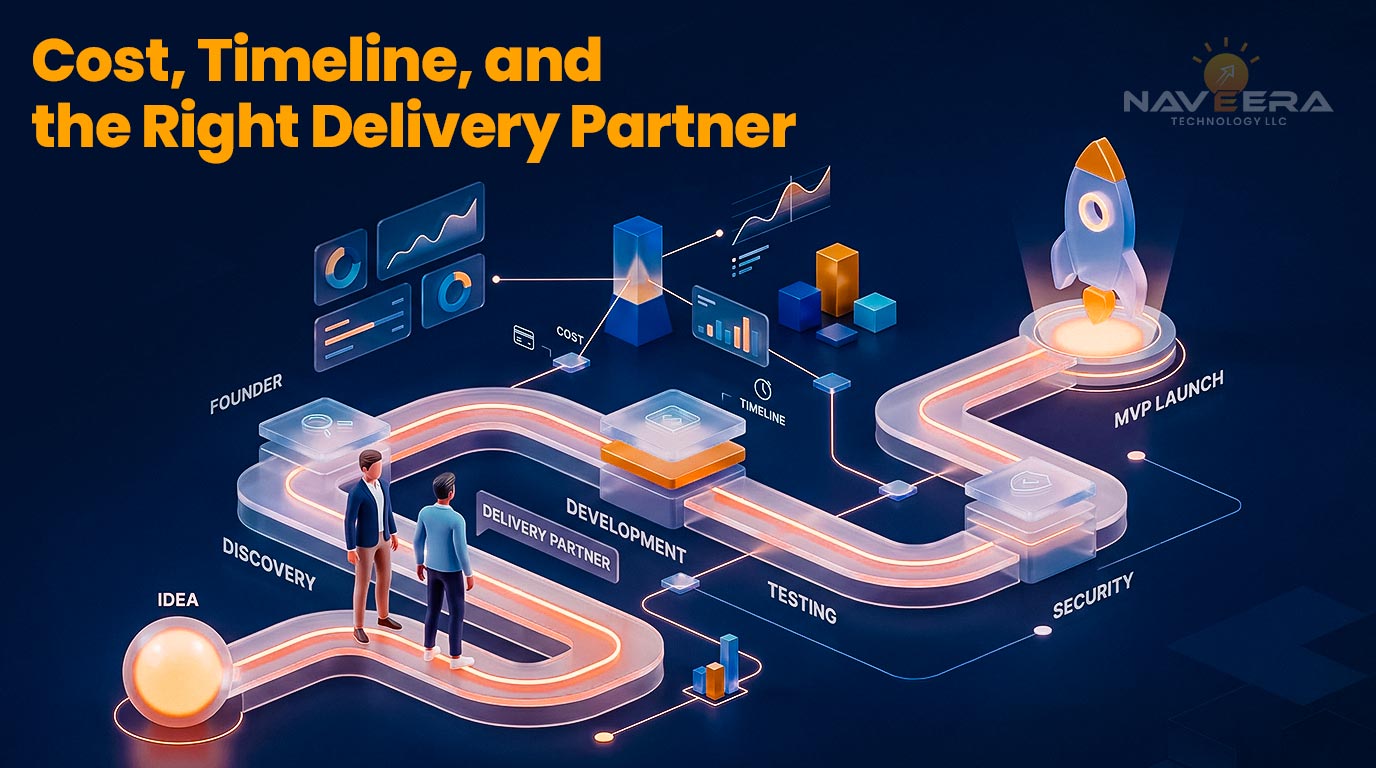
Cost, Timeline, and the Right Delivery Partner
There is no responsible universal MVP price. Budget depends on complexity, integrations, UX depth, compliance, data preparation, AI evaluation, infrastructure, and testing. A focused product may take several weeks; a regulated or integration-heavy product may require several months.
The lowest quote can become expensive if it excludes discovery, security, quality assurance, analytics, or production readiness. Startups control costs more effectively by narrowing the first customer journey, testing high-risk assumptions early, and defining success before development begins.
When evaluating an MVP app development company, founders should look beyond a portfolio of interfaces. The partner should bring product strategy, application engineering, data, cloud, security, DevOps, and AI capabilities together. It should also offer transparent governance, clear documentation, direct communication, and post-launch support.
Ask prospective partners:
- How will you validate our assumptions before defining scope?
- Which metrics will show whether the MVP is working?
- How will security, data, integrations, and scalability be handled?
- What AI feasibility checks are required before development?
- How will the product move from validation to production growth?
The best MVP development services for startups preserve the founder’s strategic ownership while filling critical capability gaps. They give the internal team visibility into decisions, risks, spending, and technical direction.
How Naveera Technology Supports AI-Ready MVPs
Naveera Technology combines product engineering with expertise in AI, data, cloud, and applications. For US startups, that multidisciplinary approach is valuable when an early-stage idea must become a focused roadmap—and then a secure, production-ready product.
Naveera’s MVP development services can support discovery, technical feasibility, UX, web and mobile engineering, SaaS platforms, data foundations, quality assurance, and cloud deployment. Its Artificial Intelligence Services help determine where intelligence creates measurable value and establish the controls needed to use it responsibly.
As an MVP app development company, Naveera can also extend a startup’s capacity through flexible engineering support while founders retain control of product strategy. This creates a practical route from market validation to scalable product development.
Build Faster Without Sacrificing the Future
The strongest MVP balances speed, evidence, security, and scalability. It moves quickly because the scope is disciplined—not because essential engineering practices are skipped. It remains adaptable because the architecture supports sensible growth—not because the first release tries to predict every future requirement.
Choosing the right MVP development services gives founders a faster route from idea to evidence while protecting capital and strategic flexibility. The right MVP app development company will help define the smallest valuable release, uncover risk early, and create a credible foundation for customer growth, investment, and future AI capabilities.
FAQ
What are MVP development services?
They combine product strategy, UX design, engineering, testing, deployment, analytics, and validation to launch the smallest credible product capable of testing core business assumptions with real users.
What is included in an MVP engagement for startups?
MVP development services for startups typically include discovery, market validation, architecture, feature prioritization, software development, integrations, quality assurance, cloud deployment, product analytics, user-feedback collection, and post-launch planning.
What should startups seek in a development partner?
Look for product judgment, transparent delivery, and proven capabilities across applications, AI, data, cloud, security, and scalability. The partner should help validate assumptions—not simply implement a feature list.
Can an MVP become a complete product?
Yes. A well-designed MVP can evolve through evidence-based releases, stronger infrastructure, deeper integrations, improved governance, and additional features. Scaling should follow demonstrated customer demand.