
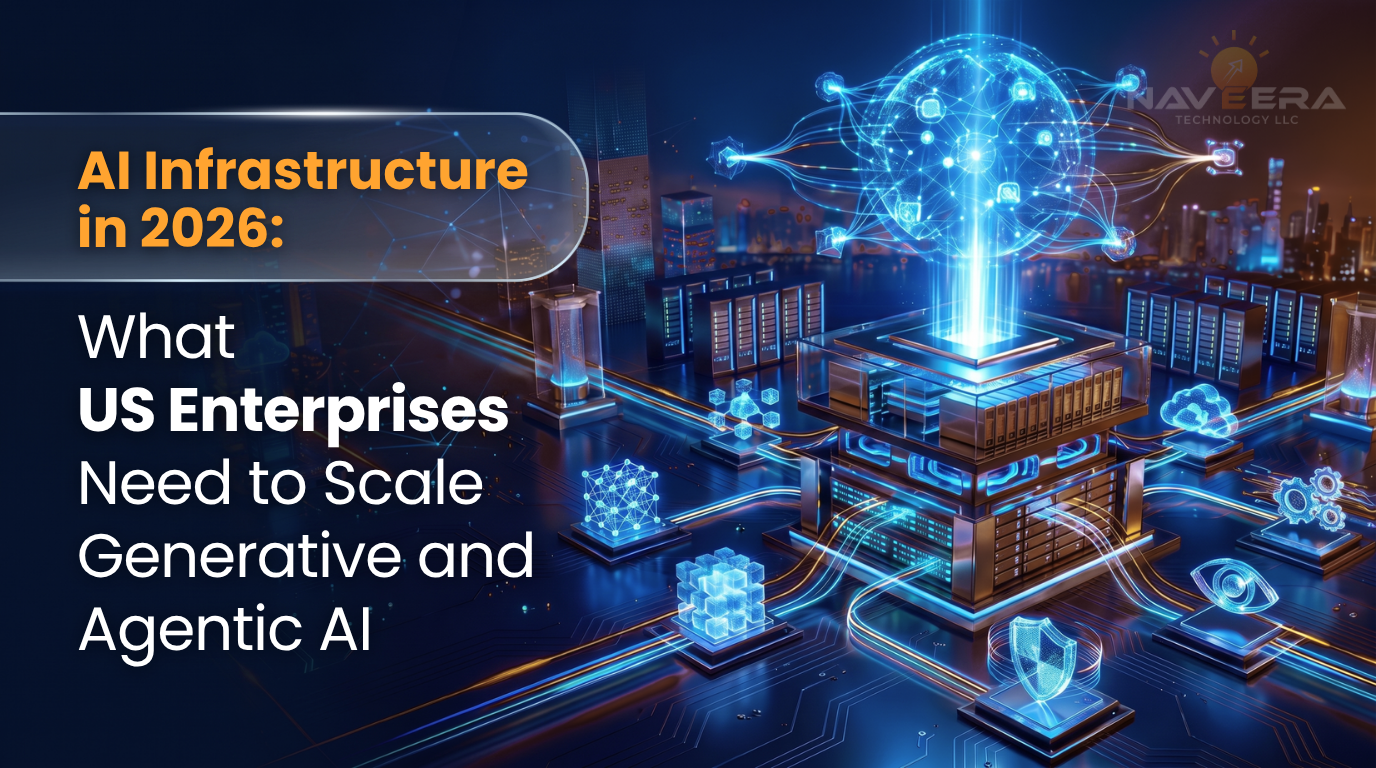
An AI model may perform brilliantly in a pilot and still fail when hundreds of employees, applications, and AI agents begin using it in production. By 2026, the real challenge is no longer proving that AI can create value; it is building the AI infrastructure required to deliver that value securely, reliably, and at a cost the business can sustain as adoption expands.
A pilot may perform well with one model, a controlled dataset, and a small group of users. Production is different. Demand fluctuates. Sensitive data enters the workflow. Models call enterprise applications. Agents may update records, initiate transactions, or trigger processes. At that point, AI is no longer an isolated experiment; it becomes part of the operating environment.
The enterprise AI challenge in 2026 is not simply access to better models. It is building a dependable foundation around those models.
Why AI Infrastructure Is Now a Business Priority
Generative AI applications are becoming embedded in customer service, software engineering, knowledge management, sales, finance, and operations. Agentic AI raises the stakes further by allowing systems to take action rather than only generate responses.
This shift changes what leaders must expect from enterprise AI infrastructure. A production environment must answer:
- Did the model use approved, current information?
- Was access limited to what the user or agent was authorized to see?
- Did the agent select the correct tool and remain within its permitted role?
- Can the organization reconstruct the decision and every resulting action?
- What did the completed task cost, and did it produce measurable value?
Traditional cloud environments were designed mainly for predictable transactions. AI introduces accelerators, vector retrieval, variable inference traffic, extensive data movement, and probabilistic outputs. Existing cloud investments remain useful, but they need AI-aware scheduling, evaluation, security, observability, and cost controls.
What a Production-Ready AI Foundation Includes
Effective AI infrastructure connects technology that many enterprises already own but have not yet integrated into a coherent platform. The objective is not to assemble the longest possible tool list. It is to make compute, data, models, applications, security, and operations work together.
| Foundation | Enterprise requirement | Business impact |
| Compute | GPUs, CPUs, accelerators, workload scheduling, autoscaling | Reliable performance without costly idle capacity |
| Data | Governed pipelines, vector search, lineage, access controls | Accurate answers grounded in trusted information |
| Model layer | Model serving, routing, gateways, versioning | Flexibility to change models without rebuilding applications |
| Integration | Approved APIs, tool controls, durable orchestration | Safe connections to business systems and workflows |
| Security | Identity, least privilege, encryption, policy enforcement | Lower exposure across data, models, and agent actions |
| Operations | Evaluation, tracing, observability, recovery procedures | Faster diagnosis and accountable production performance |
| Economics | Usage attribution and outcome-based measurement | Spending tied to business value rather than AI activity |
Generative AI and Agentic AI Need Different Controls
Strong generative AI infrastructure supports model access, retrieval-augmented generation, prompt management, safety filters, evaluations, and responsive inference. It must keep knowledge current, preserve permissions, and show where answers came from.
Agentic AI adds planning, memory, state, tool use, retries, event handling, and workflow recovery. Because an agent can alter a business system, its identity and permissions must be explicit. Access should be limited by task, action, data sensitivity, and time—not inherited broadly from a powerful user or service account.
For high-impact actions, AI infrastructure also needs:
- Transaction limits and deterministic policy checks
- Human approval at defined risk thresholds
- Durable execution for long-running workflows
- Checkpoints, safe retries, and rollback procedures
- Audit trails covering prompts, data, models, tools, approvals, and final actions
The right degree of autonomy improves the process without creating risk the organization cannot detect, explain, or reverse.
Data Is the Constraint Many AI Programs Underestimate
Reliable AI infrastructure depends on information that is current, governed, discoverable, and approved for its intended use. A more capable model cannot compensate for outdated documents, inconsistent customer definitions, missing lineage, or unrestricted source data.
For RAG and enterprise search, teams must manage ingestion, authorization, freshness, retrieval, and deletion. Access controls must follow data into embeddings, prompts, caches, logs, and generated files. Protecting the source while exposing these copies creates security in appearance, not in practice.
Cloud, On-Premises, or Hybrid?
There is no universal deployment model for enterprise AI infrastructure.
- Cloud is often best when demand is uncertain, speed matters, or teams need rapid access to managed models and accelerators.
- On-premises deployment may fit stable high-volume workloads, sensitive data, low-latency operations, or organizations with mature data-center capabilities.
- Hybrid deployment can balance control and innovation by placing each workload according to sensitivity, latency, resilience, and economics.
The decision should be made workload by workload, comparing latency, utilization, data-transfer charges, resilience, residency, skills, and realistic exit options.
Well-designed generative AI infrastructure can operate across these environments, but hybrid succeeds only when identity, governance, deployment, networking, and observability remain consistent.
Control Cost by Measuring Business Outcomes
AI spending includes more than tokens. One task may involve retrieval, several model calls, tools, retries, monitoring, and human review.
Enterprises can improve efficiency through:
- Better accelerator scheduling, batching, and autoscaling
- Smaller models for classification, extraction, and routine tasks
- Model routing based on quality, sensitivity, latency, and cost
- Caching, prompt compression, and reduced data movement
- FinOps attribution by product, team, model, environment, and use case
The more useful metric is cost per successful outcome: a resolved case, reviewed contract, processed claim, qualified lead, or completed workflow.
A cheaper model is not cheaper if it creates more retries, escalations, or manual correction.
How to Evaluate the Right AI Infrastructure Partner
The top AI infrastructure companies should be evaluated on production capability, not market visibility or a long list of vendor certifications. Enterprise buyers need evidence that a partner understands how data, models, applications, security, and operating teams interact after launch.
Ask the top AI infrastructure companies to demonstrate:
- Production experience with RAG, model serving, agent orchestration, evaluations, and observability
- Security designed into identities, data access, tools, and autonomous actions
- Practical cloud, on-premises, hybrid, and multi-cloud workload placement
- The ability to diagnose quality, latency, integration, and cost problems across the full stack
- Clear measurements connecting technical delivery with business outcomes
The top AI infrastructure companies should also challenge unnecessary complexity and recommend hybrid architecture only when the business case justifies it.
Compare the top AI infrastructure companies against a measurable scorecard, request relevant references, and begin with a focused engagement that reveals how the team makes trade-offs.
Ultimately, the top AI infrastructure companies are not the firms that deploy the most technology. They are the ones that help the enterprise create a secure, supportable platform—and know when additional technology will not improve the outcome.
A Practical Roadmap for US Enterprises
The strongest programs build AI infrastructure around real demand:
Here is the rewritten text:
- Check what work is being done now, what data is available, what systems are connected, what security is in place, what skills are there and what pilots are happening.
- Pick the use cases that have users, data that can be reached, results that can be measured and risks that can be handled.
- Set what compute power, data, speed, availability and connections are needed by using workloads that’re real.
- Set up rules for identity, permissions, model approval, checking models, keeping logs, keeping data and handling problems as soon as possible.
- Build the smallest reusable platform that supports the first valuable production workloads.
- Measure quality, adoption, cost, risk, and business impact together.
Avoid buying GPU capacity before workload testing, scaling prototypes with hard-coded controls, or granting agents broad permissions. These shortcuts accelerate demonstrations but create production liabilities.
How Naveera Technology Helps Build the Foundation
Naveera Technology helps US enterprises connect infrastructure modernization with data readiness, application architecture, governance, and measurable AI use cases—from readiness assessment through RAG, agent orchestration, observability, and cost optimization.
Through its IT Infrastructure Services, Naveera aligns new AI capabilities with the systems, security controls, resilience requirements, and operating realities the enterprise already manages.
The goal is not an oversized platform. It is generative AI infrastructure that can evolve, plus controls for agents to operate safely. With the right enterprise AI infrastructure, teams move faster because model access, governance, deployment, evaluation, and oversight are reusable.
Build for Change, Not for One Model
Things are going to change with models, regulations and priorities. We need an AI infrastructure strategy that is flexible and also follows the rules. The right AI infrastructure gives leaders the information they need to decide where to put their money make things more secure or stop something.
That is what makes a good AI demonstration different, from something the whole business can really trust and use like an enterprise capability that the business can trust.
FAQ
What is AI infrastructure?
AI infrastructure is the combined compute, data, model, integration, security, and operating foundation required to run AI systems reliably in production.
Why do enterprises need AI infrastructure in 2026?
Enterprise AI infrastructure enables organizations to move beyond pilots while controlling performance, security, governance, availability, and cost across production workloads.
What infrastructure is needed for generative AI?
Production-grade generative AI infrastructure needs scalable compute, governed data, model serving, RAG, prompt controls, evaluation, safety filters, and observability.
What infrastructure is required for agentic AI?
Enterprise AI infrastructure for agentic systems requires scoped identities, controlled tool access, durable workflows, approval gates, audit trails, safe retries, and rollback mechanisms.
How is agentic AI infrastructure different from generative AI infrastructure?
Generative AI infrastructure supports content creation and answers. Agentic infrastructure supports planning and action, requiring stronger permissions, oversight, workflow, and recovery controls.
How can enterprises build scalable AI infrastructure?
Scalable AI infrastructure starts with valuable use cases, defined workload requirements, early governance, reusable platform capabilities, and measured quality, risk, cost, and outcomes.
What are the benefits of cloud AI infrastructure?
Cloud AI infrastructure provides rapid access to accelerators, managed services, elastic capacity, and faster experimentation. Strong governance and cost controls remain essential.
Is hybrid AI infrastructure suitable for US enterprises?
Yes. Hybrid enterprise AI infrastructure can balance control, performance, residency, and flexibility when identity, security, deployment, and monitoring remain consistent across environments.
How much does enterprise AI infrastructure cost?
Cost depends on workload volume, models, accelerators, data movement, integrations, availability, security, and support. Evaluate cost per successful business outcome.
How do you choose among the top AI infrastructure companies?
Compare production experience, security design, hybrid capability, observability, pricing transparency, and evidence that the proposed AI infrastructure produces measurable business value.