
For nearly two years, enterprise AI strategy has revolved around a single decision:
Which Large Language Model should we standardize on?
Organizations compared GPT, Claude, Gemini, Llama, and other foundation models, believing model selection would determine competitive advantage.
The market has now reached an inflection point.
Microsoft’s decision to invest $2.5 billion in expanding enterprise AI engineering, solution architecture, implementation services, and customer delivery capabilities signals a broader industry realization:
Enterprise AI success is no longer constrained by model intelligence. It is constrained by enterprise readiness.
The next generation of competitive advantage will not belong to organizations deploying the largest models.
It will belong to organizations capable of operationalizing AI across data platforms, applications, infrastructure, governance, security, and business processes.
Enterprise AI Has Entered Its Systems Integration Era
Early AI adoption focused primarily on model capability.
Today’s enterprise deployments expose a fundamentally different challenge.
A production AI ecosystem requires orchestrating dozens of interconnected technology domains.
An enterprise-grade AI platform depends on:
- Modern Data Engineering
- Real-time Data Pipelines
- Lakehouse & Data Warehouse Architecture
- Knowledge Graphs
- Vector Databases
- API & Event-Driven Integration
- Identity & Access Management
- Enterprise Security Controls
- Cloud Infrastructure
- MLOps & LLMOps
- AI Observability
- Cost Optimization (FinOps)
- Governance & Compliance
- Enterprise Application Modernization
The language model represents only one layer within this architecture.
Without the remaining layers, AI remains a proof of concept rather than an enterprise capability.
Why Most Enterprise AI Programs Stall
Industry research consistently shows that organizations encounter similar barriers after successful pilots.
Fragmented Enterprise Data
AI systems cannot generate reliable intelligence from inconsistent, duplicated, or siloed enterprise data.
Without governed data products and standardized metadata, model accuracy deteriorates rapidly.
Legacy Enterprise Applications
ERP, CRM, HRMS, manufacturing systems, and proprietary platforms often lack modern APIs required for AI orchestration.
Integration—not inference—becomes the primary engineering effort.
Infrastructure Bottlenecks
Enterprise AI workloads introduce new requirements for:
- GPU resource management
- Hybrid cloud orchestration
- High-performance storage
- Low-latency inference
- Secure networking
- Elastic compute
Traditional enterprise infrastructure was never designed for AI-native workloads.
Governance Complexity
Production AI introduces enterprise risks beyond traditional software engineering.
Organizations must establish:
- Responsible AI policies
- Data lineage
- Prompt governance
- Model version control
- Audit trails
- Explainability
- Regulatory compliance
- Human approval workflows
Governance is no longer optional.
It is part of enterprise architecture.
Operational Readiness
Deploying AI models represents the beginning—not the conclusion—of enterprise transformation.
Organizations require operational capabilities for:
- Continuous model evaluation
- Prompt optimization
- Retrieval quality monitoring
- AI observability
- Hallucination detection
- Cost optimization
- Security monitoring
- Continuous improvement
This emerging discipline—often referred to as LLMOps—is becoming as critical as DevOps was during the cloud era.
The New Enterprise AI Stack
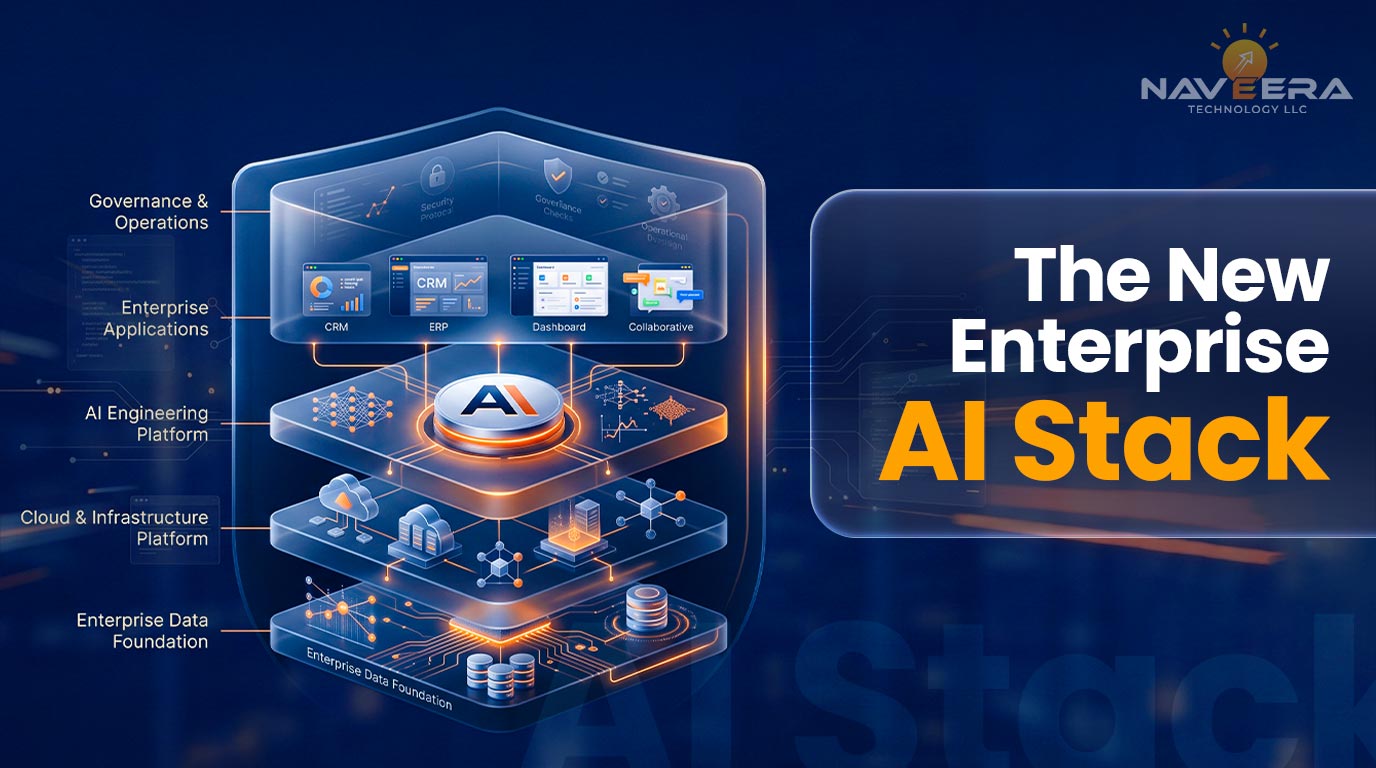
Successful AI organizations are increasingly converging around a layered architecture.
Layer 1 — Enterprise Data Foundation
- Data Engineering
- Master Data Management
- Metadata Management
- Data Governance
- Data Quality
- Lakehouse Architecture
Layer 2 — Cloud & Infrastructure Platform
- Multi-cloud Architecture
- Kubernetes
- GPU Orchestration
- Infrastructure as Code
- Networking
- Security
- Observability
Layer 3 — AI Engineering Platform
- Foundation Models
- RAG Pipelines
- AI Agents
- Vector Search
- MCP Integration
- Agent-to-Agent Communication
- Model Routing
- Prompt Engineering
Layer 4 — Enterprise Applications
- ERP
- CRM
- Supply Chain
- Customer Experience
- Finance
- Healthcare
- Manufacturing
- Digital Workplace
Layer 5 — Governance & Operations
- LLMOps
- MLOps
- AI Security
- Compliance
- Cost Governance
- Continuous Monitoring
Competitive differentiation is achieved when these layers function as a unified platform rather than isolated technology initiatives.
Why Microsoft’s Investment Matters
Microsoft’s investment should not be interpreted simply as expanding professional services.
It reflects recognition that enterprise AI adoption has entered an execution-centric phase.
Organizations require partners capable of integrating AI into complex enterprise ecosystems while maintaining security, scalability, resilience, and governance.
Technology vendors are increasingly complementing software innovation with engineering execution because customers require both.
The industry is moving from AI products to AI operating models.
Naveera’s Perspective: Engineering Enterprise AI from Foundation to Scale
At Naveera Technology, we view enterprise AI as a systems engineering challenge rather than a standalone AI implementation.
Our delivery model aligns technology modernization with measurable business outcomes by integrating every layer of the enterprise AI stack.
AI & Data Engineering
We design AI-ready data ecosystems through modern data platforms, real-time ingestion, governance frameworks, metadata strategies, and analytics architectures that provide trusted enterprise intelligence.
Enterprise AI Engineering
Our teams develop production-ready AI solutions including Retrieval-Augmented Generation (RAG), Agentic AI, Model Context Protocol (MCP), intelligent workflow automation, enterprise copilots, and domain-specific AI assistants.
Cloud & Infrastructure Modernization
We modernize cloud environments using Azure, AWS, and Google Cloud with Kubernetes, Infrastructure as Code, DevSecOps, observability, and secure hybrid architectures optimized for AI workloads.
Intelligent Application Engineering
Rather than deploying isolated AI interfaces, we integrate intelligence directly into enterprise applications, enabling AI-assisted decision-making across operations, finance, healthcare, manufacturing, retail, and customer engagement.
Responsible AI & Governance
Security, compliance, identity, model governance, explainability, and policy enforcement are embedded throughout the AI lifecycle, ensuring enterprise-grade trust and regulatory readiness.
AI Operations
From deployment through continuous optimization, we provide monitoring, evaluation, performance engineering, cost optimization, and lifecycle management to maximize long-term AI value.
Executive Takeaway
The next competitive advantage will not come from deploying another language model.
It will come from building an enterprise architecture where AI operates as an integrated capability—supported by governed data, modern infrastructure, secure engineering practices, intelligent applications, and continuous operational excellence.
Microsoft’s investment underscores a broader industry truth:
The future of enterprise AI belongs to organizations that can engineer AI as a core business capability—not merely consume it as a technology.
At Naveera Technology, we help enterprises bridge that gap by combining Data Engineering, AI Engineering, Cloud Modernization, Application Development, Infrastructure, Security, and Governance into a unified transformation strategy that moves AI from experimentation to enterprise-scale execution.